For social landlords in England
Awaab's Law software one hazard record, every phase.
SiteSurvey keeps each Awaab's Law case on one record, from the first report to closure. The record lists all 21 HHSRS hazards with the phase that covers each, counts the working days against every timeframe with bank holidays taken off, and comes out as a dated PDF.
£25 per user per month on The Works, Base from £13 · trial from £1, cancel any time
See a sample report Start from the Awaab's Law repair record
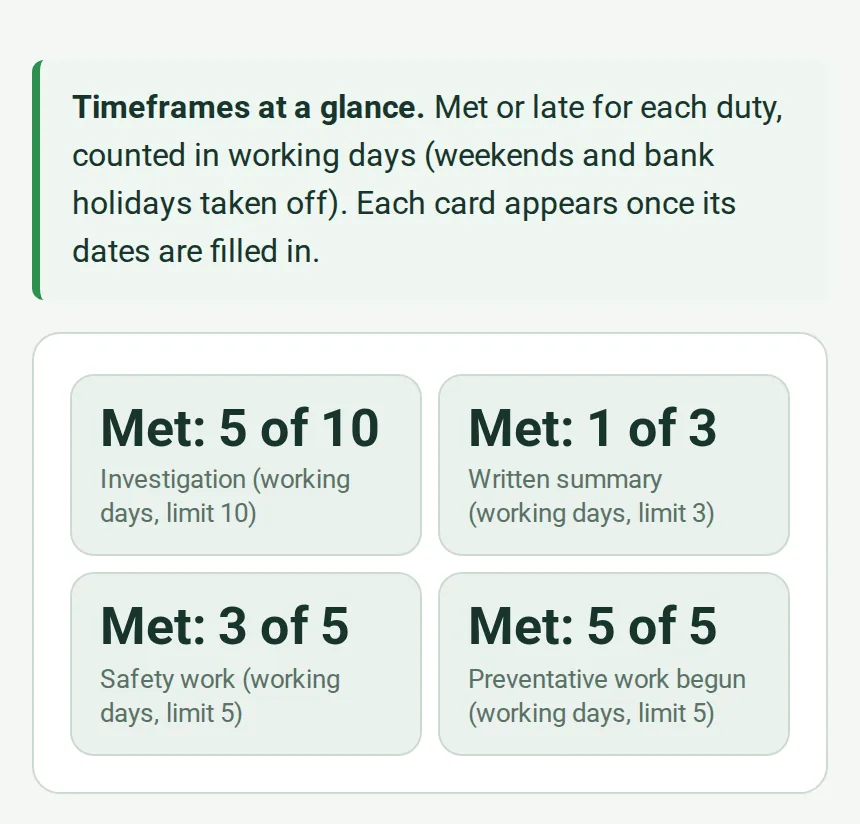
Day 5
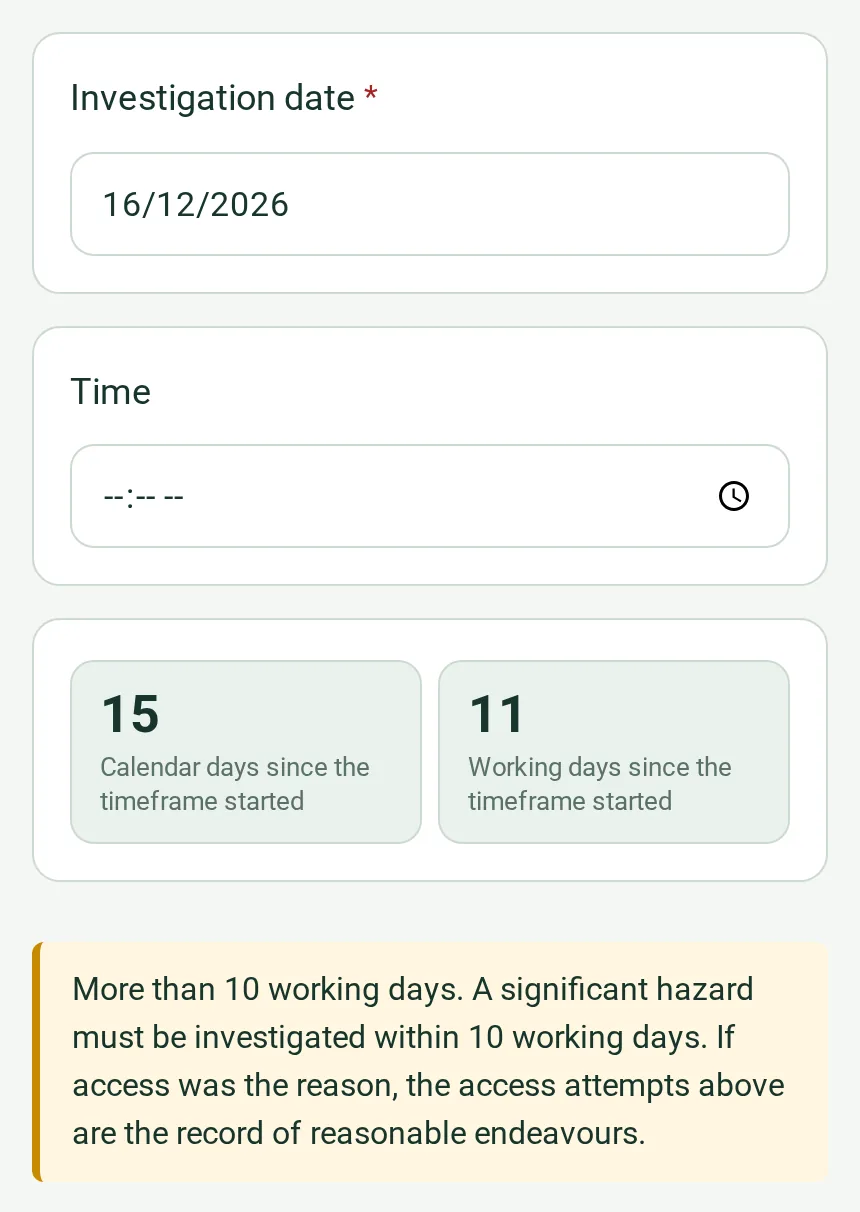
Investigated, limit 10
Day 1
Summary given, limit 3
Day 3
Made safe, limit 5
Flat 12, Holme Court, the sample record below
What is Awaab's Law software?
Awaab's Law software records each hazard report and shows whether the legal timeframes were met. SiteSurvey does this with one hazard record per case on iOS, Android and the web: report, triage, investigation, written summary, works and tenant updates, with the working days counted for you. It covers Phase 1, Phase 2 from 30 November 2026, and the Phase 3 hazards planned for 2027.
Last updated . Facts checked on 20 November 2026 against the Regulations (SI 2025 No. 1042) and the Phase 2 amending regulations (SI 2026 No. 1195).
Awaab's Law phases, and what SiteSurvey records for each
The same timeframes apply in every phase. What changes is which hazards count as significant hazards.
| Phase | Significant hazards covered | Applies from | In SiteSurvey |
|---|---|---|---|
| Phase 1 | Damp and mould growth. Every emergency hazard of any type, except overcrowding. | 27 October 2025 | The hazard record runs the case and the 24 hour emergency checks. The damp and mould inspection form records the visit room by room. |
| Phase 2 | Excess cold, excess heat, falls (on the level, on stairs, between levels), structural collapse, fire and explosions, electrical hazards and domestic hygiene. | 30 November 2026 | The hazard record names each one, asks whether a fire hazard falls under the Fire Safety Order exclusion, and counts from the right date for a case reported before 30 November. |
| Phase 3 | Every remaining HHSRS hazard except overcrowding: asbestos, carbon monoxide and other indoor air pollutants, lead, radiation, entry by intruders, lighting, noise, water supply, flames and hot surfaces, collisions and entrapment. | Planned for 2027. No regulations yet. | Already in the hazard list, marked as covered only as emergencies until the regulations are made. |
| Private renting | To be decided. | Consultation closes 18 December 2026. | Nothing applies to private landlords yet. |
The timeframes: an emergency hazard is investigated and made safe within 24 hours. A potential significant hazard is investigated within 10 working days, the written summary is given within 3 working days of the investigation concluding, and the relevant safety work is completed within 5. Preventative work begins within 5 working days, or as soon as reasonably practicable and within 12 weeks.
Sources: the Regulations (SI 2025 No. 1042), the Phase 2 amending regulations (SI 2026 No. 1195), the Phase 2 guidance, GOV.UK press release, 8 October 2026 (Phase 3 in 2027) and GOV.UK consultation: extending Awaab's Law to private rented tenancies.
SiteSurvey for Awaab's Law, at a glance
- What it is
- A hazard record in the SiteSurvey form library, used on iOS, Android and the web. One record per hazard, in six sections: report, triage, investigation, written summary, works, tenant updates and closure.
- Who it is for
- Housing associations, councils and ALMOs in England, and the surveyors and repairs contractors who investigate for them.
- Hazards
- All 21 hazards in HHSRS Schedule 1, each with a note saying which phase of Awaab's Law covers it.
- What it counts
- Working days to the investigation (limit 10), the written summary (3), the safety work (5) and the start of preventative work (5, and 12 weeks at the latest), plus the 24 hour emergency checks.
- Bank holidays
- England and Wales bank holidays from GOV.UK's list are built in from 2025 to the end of 2028 and taken off every count.
- Price
- £25 per user per month on The Works plan, which includes the form builder and reports. Trial from £1, cancel any time.
- What it does not do
- It does not decide whether a hazard is significant or an emergency, send reminders before a deadline, or connect to a housing management system. The count appears when the dates are entered.
Why an Awaab's Law case needs one record
Each Awaab's Law duty counts from a specific moment: the day the landlord became aware, the day the investigation concluded, the moment there were grounds to believe a hazard was an emergency. Those moments are often logged by different people in different places, the repairs centre, the surveyor and the contractor among them. GOV.UK's guidance strongly advises landlords to keep clear records of all engagement, investigations and communications with tenants. When the Housing Ombudsman examined 410 damp and mould complaints for its 2021 Spotlight report, it found maladministration in 56%.
Sources: GOV.UK Awaab's Law guidance and Housing Ombudsman, Spotlight on damp and mould (2021).
Working days counted by hand
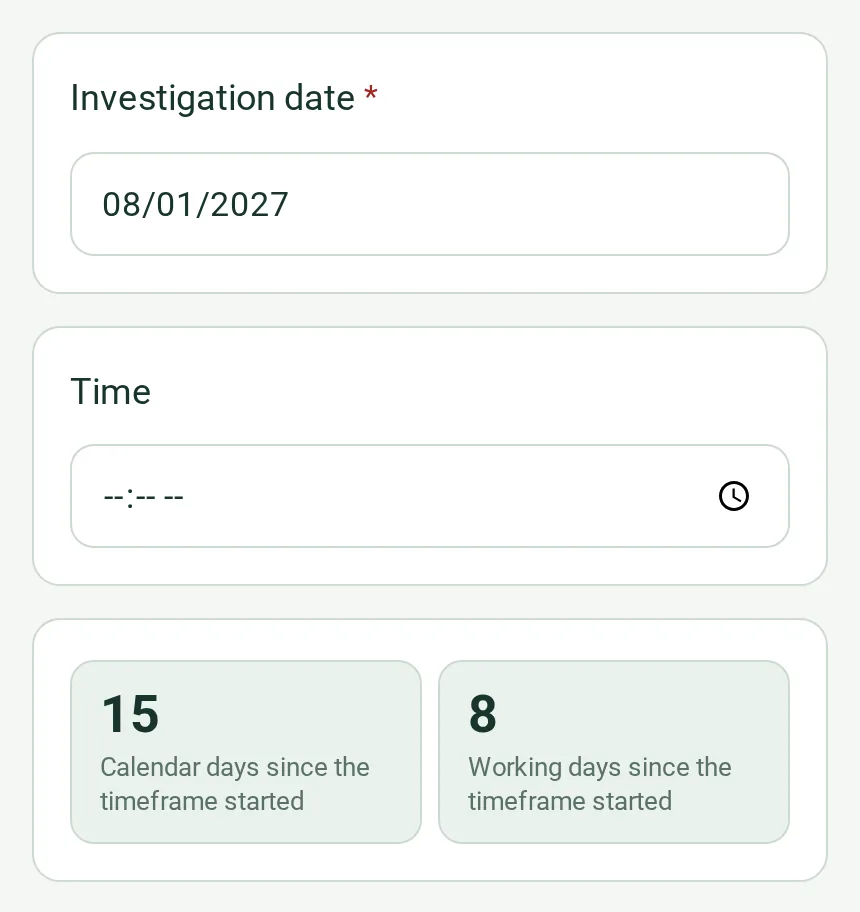
A hazard reported on Thursday 24 December 2026 and investigated on Friday 8 January 2027 took 15 calendar days and 8 working days, so it was in time. On a wall calendar that count is easy to get wrong in either direction.
Phase 2 cases with the wrong start date
For a Phase 2 hazard the landlord already knew about, the timeframes start when it is reported again on or after 30 November 2026, or when something materially changes. They do not all start on 30 November.
Access attempts nobody wrote down
When a tenant cannot give access, the record of each attempt, with whether 24 hours' written notice was given, is what shows the landlord used all reasonable endeavours.
How does a case run through the hazard record?
01 · Report
Log the date and time the landlord became aware, who reported it, what was reported and how the tenant wants to be contacted. Pin the home with GPS.02 · Triage
Pick the hazard from the 21 in HHSRS Schedule 1. A note under it says which phase covers it. Record the initial view: emergency or potential significant hazard.03 · Investigation
Record the type of investigation, every access attempt, whether the hazard is in scope, the finding and the reasons. For damp and mould, add each room with the patch measured.04 · Written summary
Enter the date the summary was given and how, and tick what it covered. The record shows the working days after the investigation and warns past 3.05 · Works
Date the safety work and the start of the preventative work. Record any offer of alternative accommodation, the tenant's answer and the written safety advice.06 · Updates and closure
Log each update to the tenant with its date, method and what was said, then the reason the case closed.What the report looks like
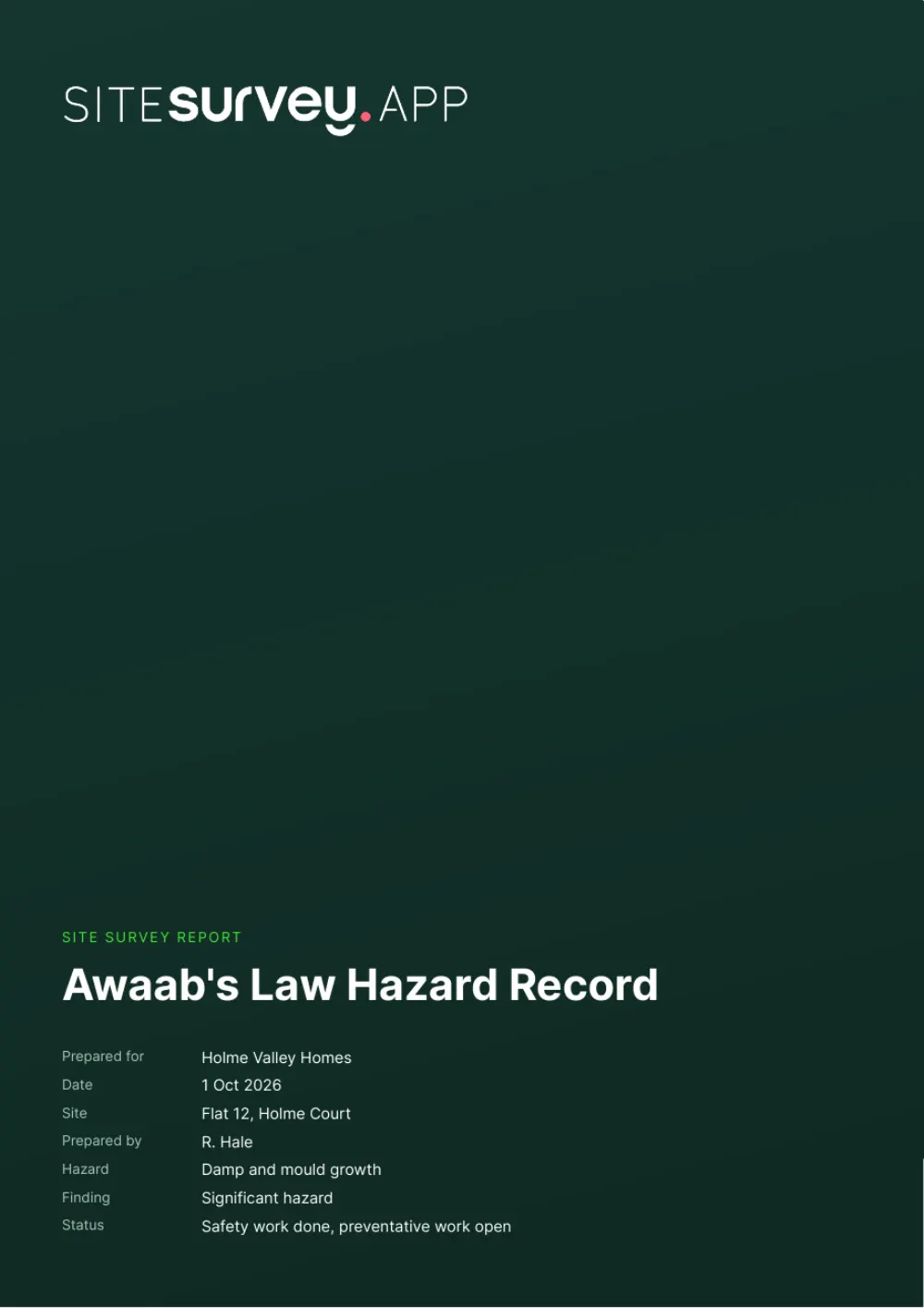
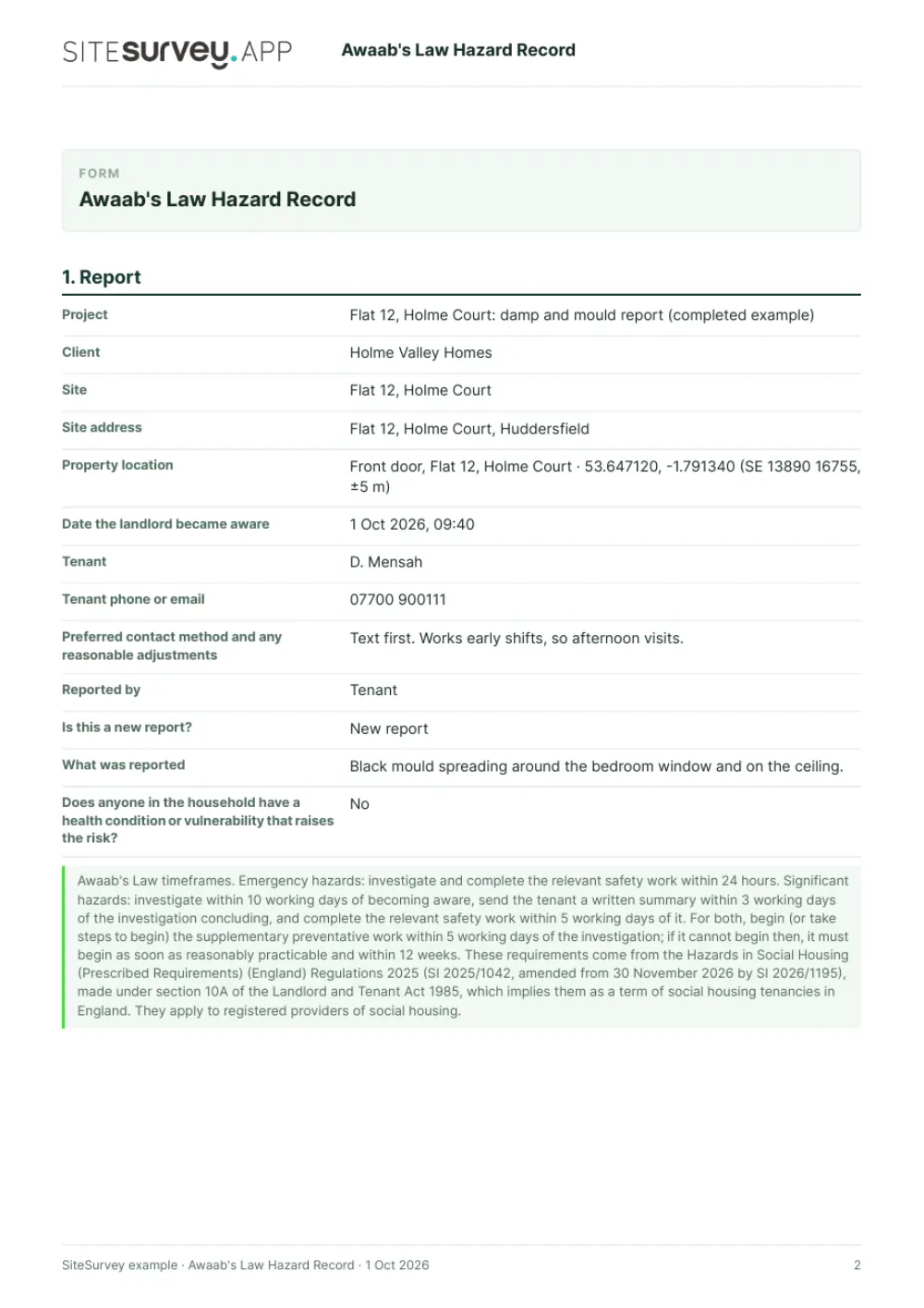
What a completed Awaab's Law record looks like.
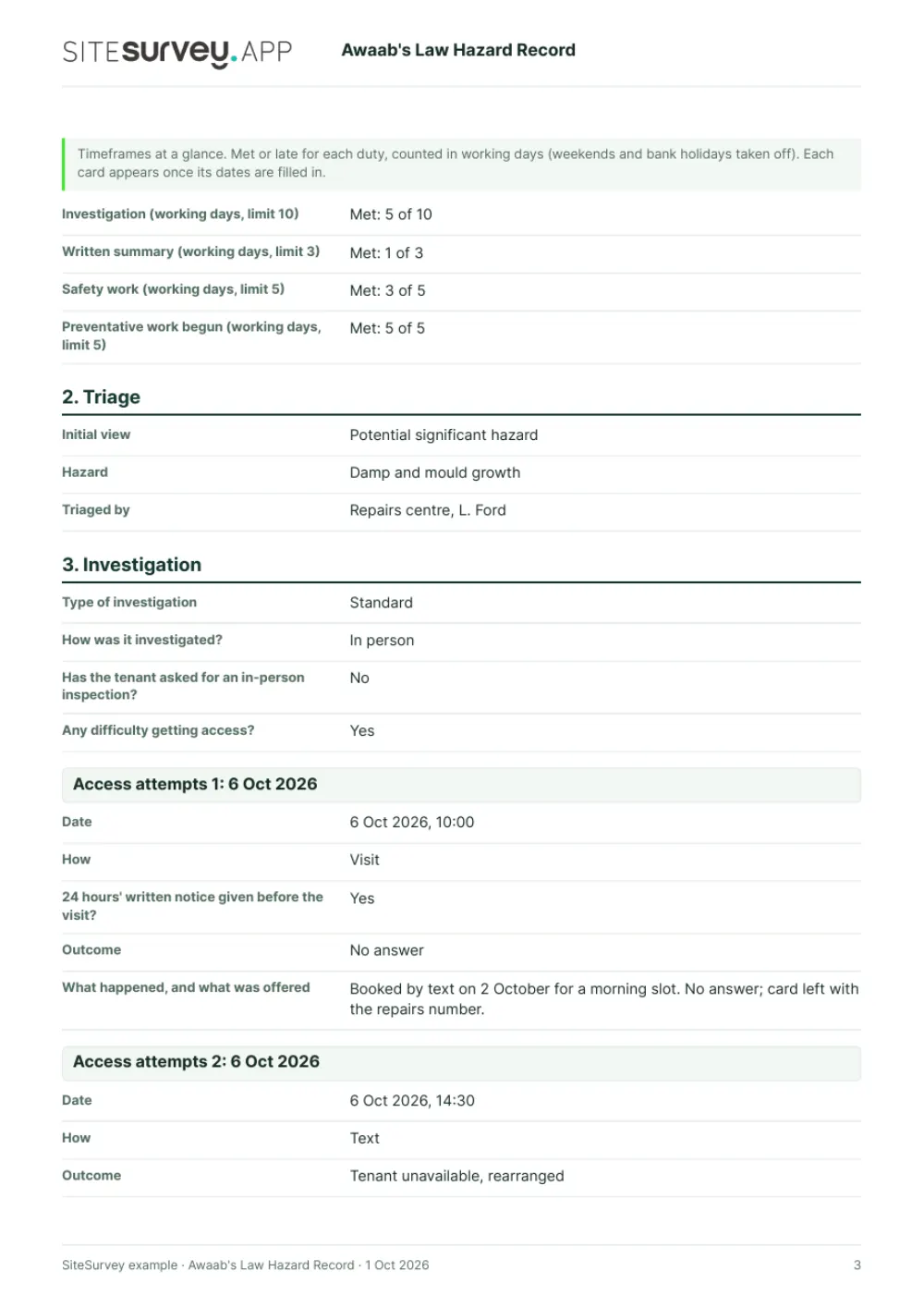
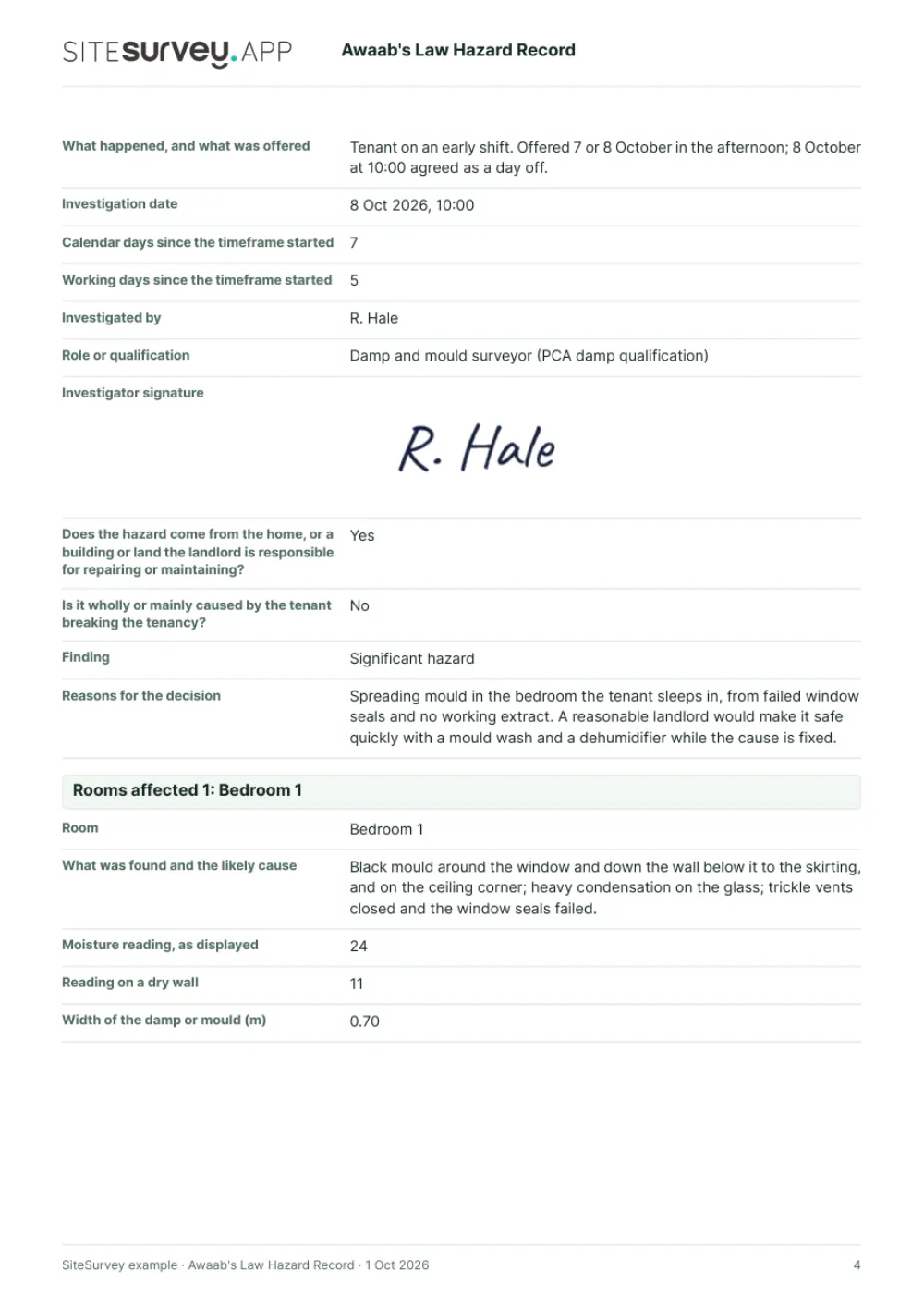
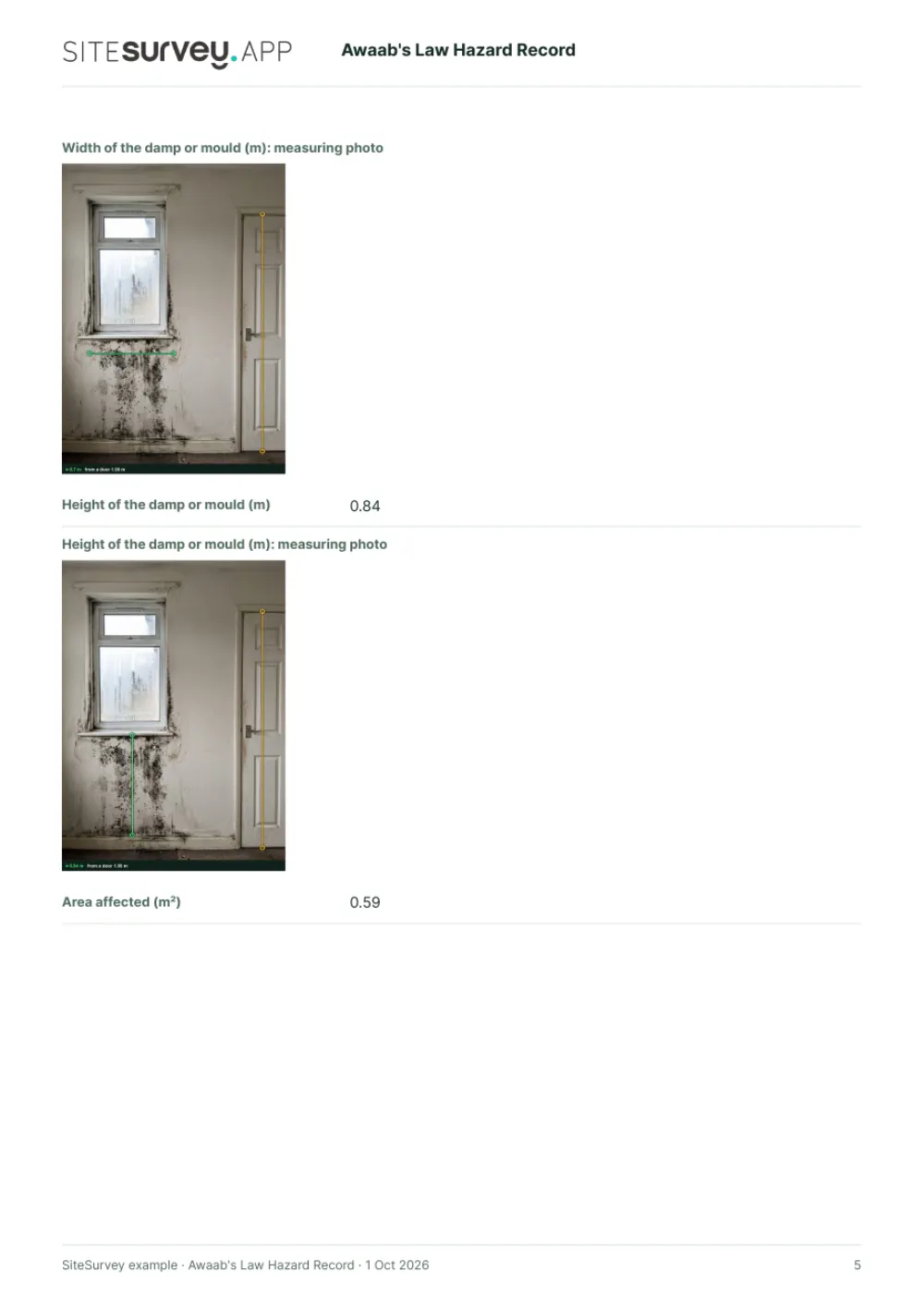
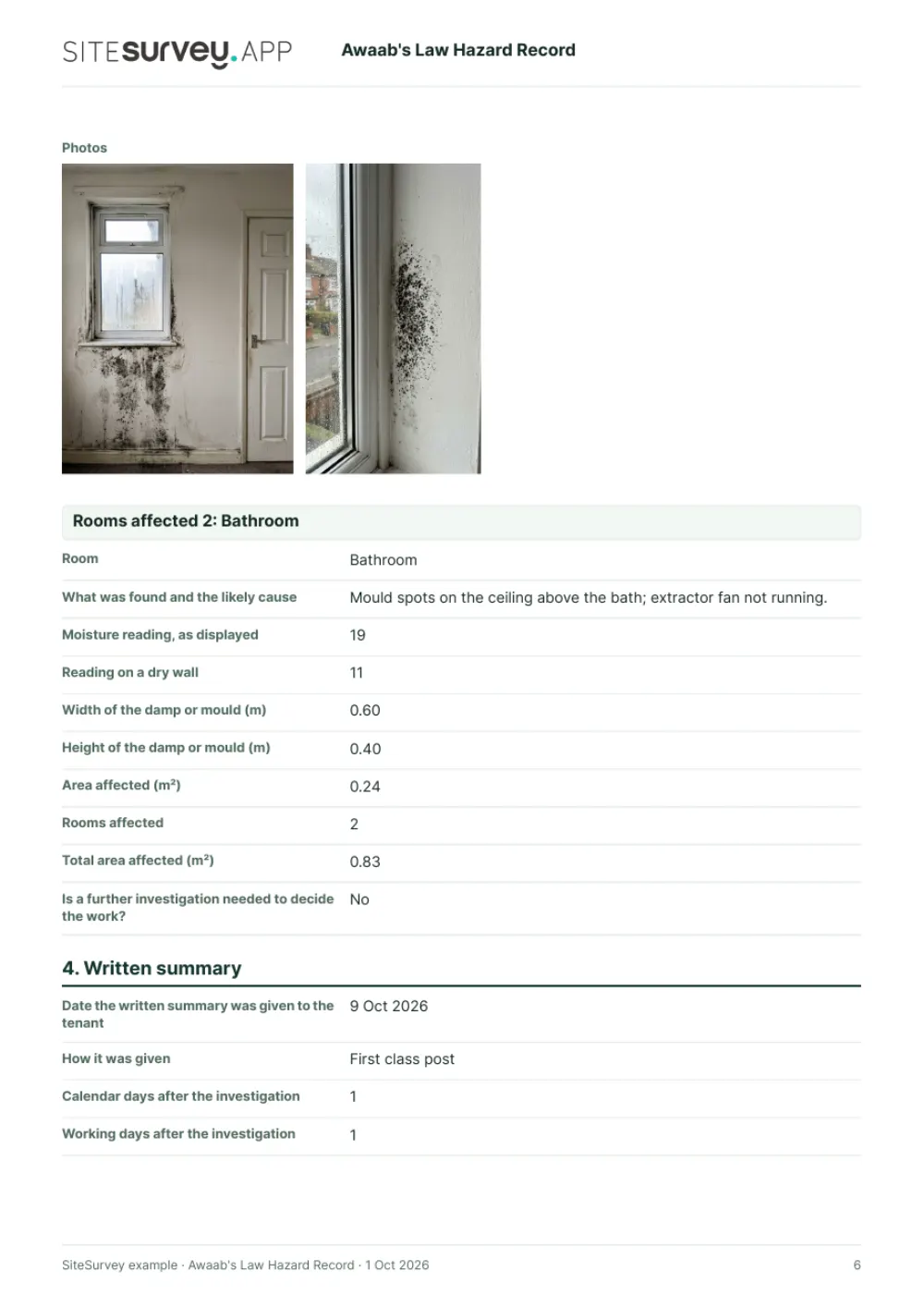
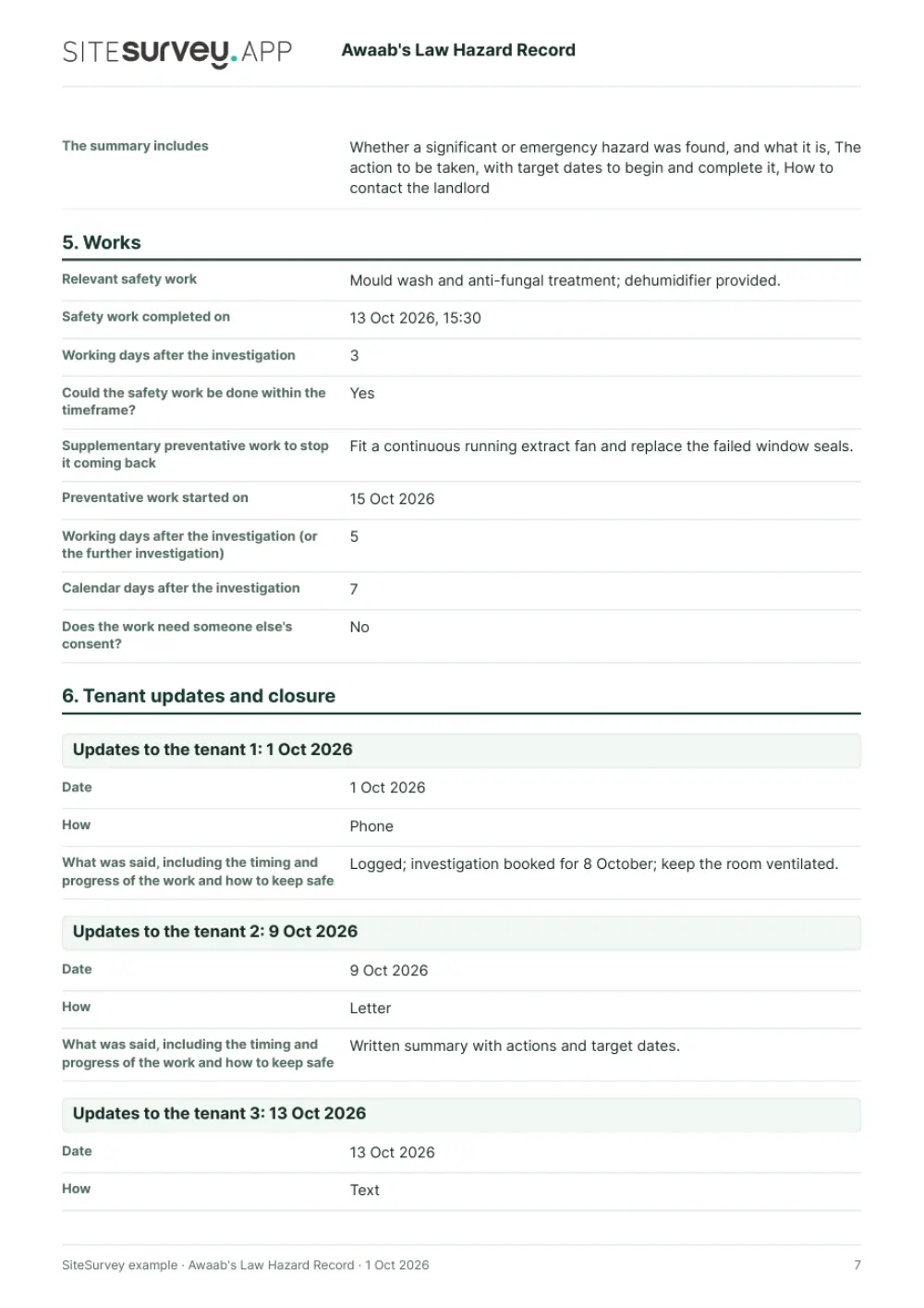
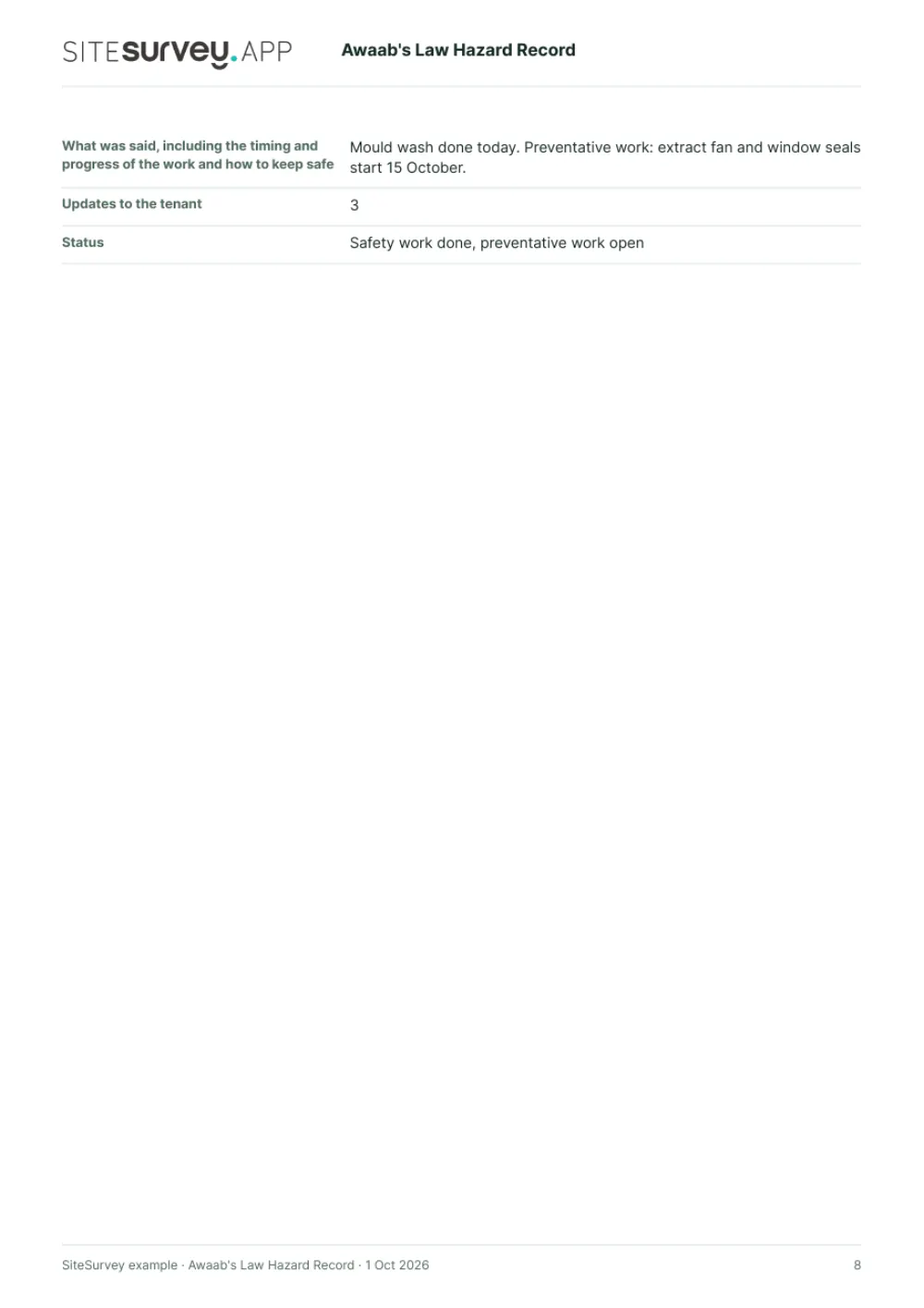
This is the completed example for Flat 12, Holme Court. Damp and mould was reported on 1 October 2026. After two access attempts the home was investigated on working day 5, the written summary was posted the next day, the mould was treated on day 3 and the preventative work began on day 5. Scroll through all 8 pages here or download the PDF.
- 1Timeframes at a glanceMet or late for each duty, in working days, on the first page after the cover.
- 2Every access attemptTwo attempts on 6 October, each with its method, the notice given and the outcome.
- 3The decision and its reasonsThe finding, whether the hazard is in scope and why, signed by the investigator.
- 4Summary, works and updatesWhen and how the written summary was given, the dates of the work and each update to the tenant.
Try the form
The form behind the record. Open it and try it.
A live SiteSurvey form, shared by link with no login. Enter your own dates and the counts and warnings change as you type. Answers are cleared every night.
Open the live form See every question in the Awaab's Law repair recordThe Flat 12 example is also open as a filled-in record, read only. See the finished record
More than Walk Cam
Build the form. Share it by link.
The hazard record is a SiteSurvey form, so it is yours to change. Add your own reference numbers, contractor list or policy wording, and send a finished record to someone outside your team as a link, with no login or app needed.
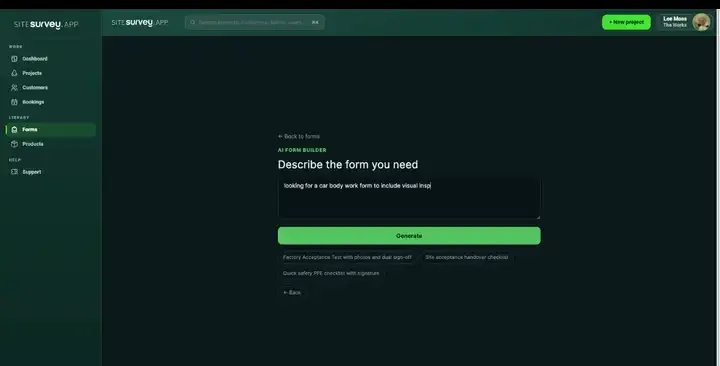
Build your Awaab's Law hazard record with AI
Tell the AI assistant what to add or remove and it edits the form: fields, required photos, readings as numbers and follow-up questions that only appear when they apply. Refine it in chat or edit it visually.
How the form builder works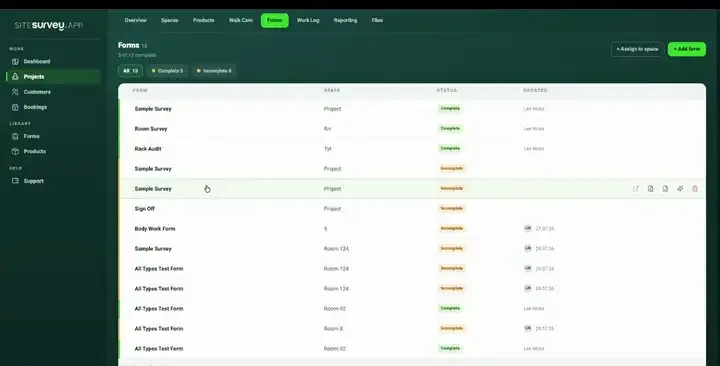
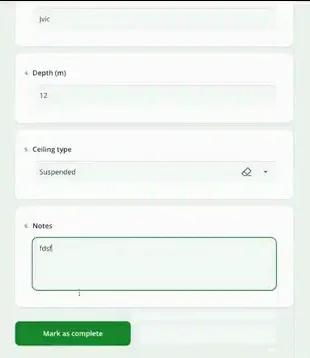
Share by link, no login needed
Make any form shareable and SiteSurvey gives it a unique URL, with an optional password. Customers, tenants or contractors fill it in on their phone’s browser, and their answers land in the same project. Walk Cam recordings and finished reports can be shared the same way, by link or by email.
How Walk Cam sharing worksWhat should Awaab's Law software record?
The dates each duty counts from, the decision and who made it, and every contact with the tenant. These are the parts of the record a complaint, a disrepair claim or an Ombudsman case asks for months later.
Every HHSRS hazard, by phase
Choose any of the 21 hazards and the record says whether it is covered now as a significant hazard, from 30 November 2026, or only as an emergency until Phase 3.
Working days, bank holidays off
Each count starts the working day after the event and leaves out weekends, Christmas Day, Good Friday and England and Wales bank holidays to the end of 2028.
Timeframes at a glance
One card per duty at the top of the record and of the PDF. It reads Met: 5 of 10 when the investigation was on working day 5, or Late: 11 days when it was not.
The 24 hour emergency check
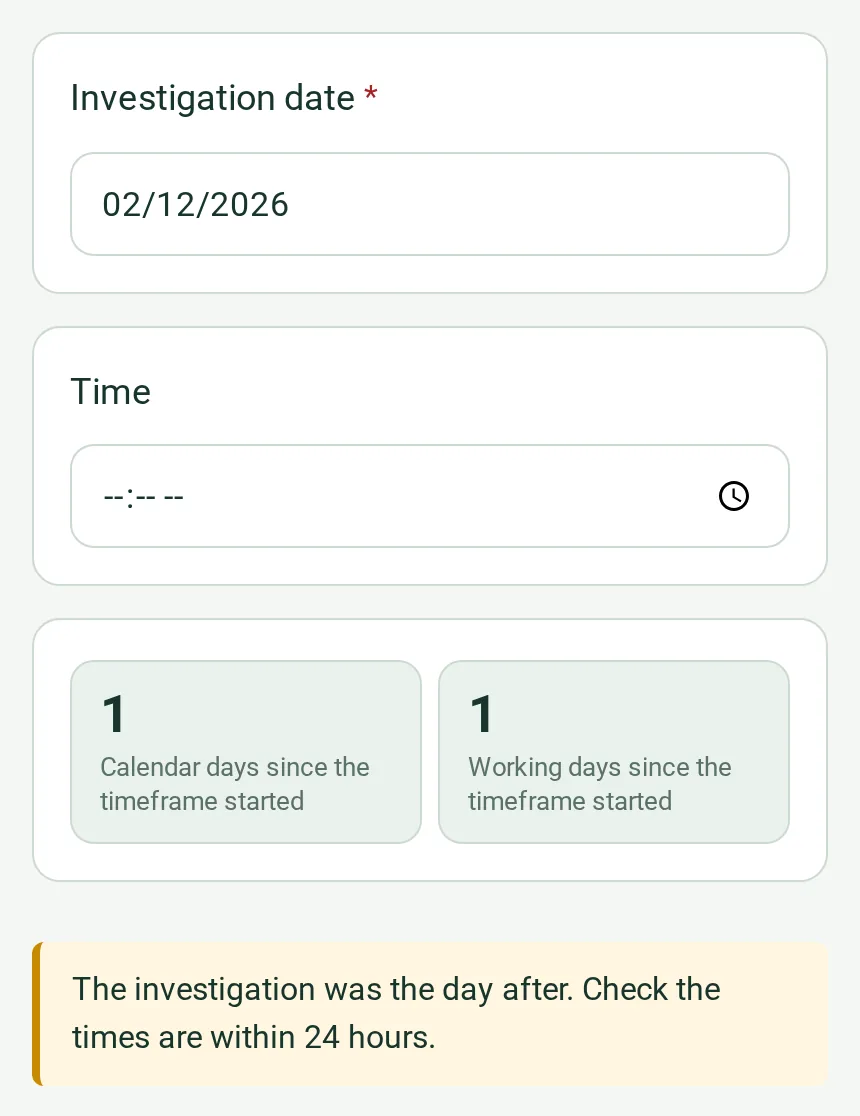
The emergency clock runs from the moment there were grounds to believe it was an emergency. If the investigation or the safety work fell on the next day, the record asks you to check the times.
Cases known before 30 November
For a Phase 2 hazard reported before the start date, the record asks when it was reported again or materially changed, and counts from that date.
The Fire Safety Order exclusion
Choose Fire and explosions and the record asks whether the hazard arises in a part of the block covered by the Fire Safety Order, such as a flat's front door onto the common parts. Those are outside Awaab's Law from 30 November 2026.
Access attempts
Each attempt is logged with its date, method, outcome and whether 24 hours' written notice was given. A late investigation then points back to that log.
Damp and mould, measured
Each affected room takes its moisture readings and the width and height of the patch, measured from a photo or with a tape. The record works out the area per room and the total.
Works offline, dated and named
The record is filled in on a phone with no signal and syncs later. Every entry keeps who captured it and when.
Worked examples
Two counts that go wrong on a wall calendar.
A working day under Awaab’s Law is any day except a Saturday, a Sunday, Christmas Day, Good Friday or a bank holiday in England and Wales (regulation 2 of SI 2025 No. 1042). The day of the event is day zero and day one is the next working day.
The hazard record does this arithmetic from the dates you enter. These two cases are in the help guide to the timeframes, which works through seven, and you can check either against the live form.
Over Christmas: 15 calendar days, 8 working days
The landlord becomes aware on Thursday 24 December 2026 and investigates on Friday 8 January 2027. Christmas Day, the Boxing Day substitute on Monday 28 December, New Year’s Day and two weekends come off. That leaves 29, 30 and 31 December and 4 to 8 January: 8 working days, inside the limit of 10.
Over Easter: 6 calendar days, 2 working days
The investigation concludes on Thursday 25 March 2027 and the written summary is given on Wednesday 31 March. Good Friday, the weekend and Easter Monday come off, so Tuesday is day one and Wednesday is day two. The summary met its 3 working day limit.
Bank holiday dates come from GOV.UK’s list for England and Wales. If a date in a case falls after 2028, the record says so and asks you to take later bank holidays off yourself.
Four forms, one library
Which form for which job.
The hazard record is the case file. Three other forms in the SiteSurvey library cover the visits around it, and all four are added from the form library and edited to your own policy.
Awaab's Law hazard record
One record per hazard, from the first report to closure, with the working days counted. Use it for every case in every phase. See the hazard record.
Damp and mould inspection form
The room by room visit: 94 questions on location, extent, likely cause, readings and ventilation, with photographs. See the damp and mould form.
Awaab's Law and HHSRS inspection
One form for one visit: the Awaab’s Law case, the damp and mould rooms and an entry for any other hazard, each with an optional HHSRS score. See the combined form.
HHSRS inspection form
Scores all 21 hazards when a score is wanted. Government guidance says an HHSRS assessment is not required under Awaab’s Law. See the HHSRS form.
Start from the Awaab's Law hazard record.
Add it from the form library and use it for the next hazard reported. Every question can be edited, in chat or visually. The form page lists every question.
When the landlord became aware, and who reported it
The hazard, from all 21 in HHSRS Schedule 1, and its phase
Type of investigation and every access attempt
Whether the hazard is in scope, the finding and the reasons
Written summary: the date, how it was given and what it covered
Safety work and preventative work, each dated
Alternative accommodation and written safety advice
Every update to the tenant, and why the case closed
Try it on your phone
Try it on this phone
Fill in the Awaab's Law repair record on your phone now
See how the Awaab's Law repair record looks on your phone
Scan the code with your phone camera. It opens the real form, no sign-up needed.
Open the live example and fill it in, just as your team would on site. No sign-up needed.
See it on this phoneEvery question is editable. Add this form to your account, then change the wording, add or remove questions and options, and make it fit your own jobs.
Does SiteSurvey make a landlord compliant with Awaab's Law?
No. Compliance means investigating and making the home safe within the legal timeframes, and that depends on your people, your contractors and your processes. SiteSurvey holds the record of each case: what was reported, what the investigation found, the decision and its reasons, the dates of the work and every contact with the tenant, with the working days counted. It shows whether each timeframe was met. It does not decide whether a hazard is significant, and it does not send a reminder before a deadline.
Which hazards does Awaab's Law cover, and from when?
Since 27 October 2025 it covers significant damp and mould hazards and every emergency hazard of any type except overcrowding. From 30 November 2026 it also covers, as significant hazards, excess cold and excess heat, falls, structural collapse, fire and explosions, electrical hazards and domestic hygiene. The government plans a third phase for 2027 that adds every remaining HHSRS hazard except overcrowding. No regulations for it have been made yet. It applies to social landlords in England.
Sources: the Regulations (SI 2025 No. 1042), the Phase 2 amending regulations (SI 2026 No. 1195), GOV.UK press release, 8 October 2026 (Phase 3 in 2027) and Awaab's Law: the complete guide.
What changes on 30 November 2026?
Phase 2 starts. The amending regulations (SI 2026 No. 1195) were made on 13 November 2026. They add seven groups of hazards to the significant hazard duties and reword the test: a significant hazard is one a reasonable landlord, knowing the household's circumstances, would make safe within 15 working days. They also take out fire hazards that arise in the parts of a block of flats covered by the Fire Safety Order, which stay with the building's Responsible Person. The hazard record already asks about each of these.
Sources: the Phase 2 amending regulations (SI 2026 No. 1195), the Phase 2 guidance and Awaab's Law Phase 2: the new hazards.
What about a Phase 2 hazard reported before 30 November 2026?
The timeframes for it start when the concern is reported again on or after 30 November 2026, or when the landlord becomes aware of a material change. The hazard record asks whether the landlord already knew about the hazard and, if so, for the date it was reported again or changed. It counts the 10 working days from that date.
Source: the Phase 2 amending regulations (SI 2026 No. 1195).
How does the record count working days?
It counts the weekdays from the day after the start date up to and including the end date, then takes off any England and Wales bank holiday in that period. The bank holidays come from GOV.UK's list and are built in from 2025 to the end of 2028. The start date moves when the regulations say it does: to the date of the request if the tenant asked for an in-person inspection, and to the further investigation for preventative work when one was needed. The 24 hour emergency periods are counted from the moment of the trigger.
Sources: the Regulations (SI 2025 No. 1042), GOV.UK bank holidays for England and Wales and How the Awaab's Law timeframes are worked out.
Do we need an HHSRS assessment for an Awaab's Law case?
No. Government guidance says an HHSRS assessment is not required under Awaab's Law, which looks at the circumstances of the actual tenant, while the HHSRS assumes a notional vulnerable occupant. The hazard record uses the HHSRS list only to name the hazard and to say which phase covers it. If your policy asks for a score as well, the combined Awaab's Law and HHSRS inspection form takes one for each hazard.
Sources: GOV.UK Awaab's Law guidance and HHSRS hazards explained.
Does it replace our housing management or repairs system?
No. SiteSurvey has no connection to housing management or repairs systems, so jobs are still raised and tracked where they are today. What it holds is the case record and its evidence, captured on a phone in the home. Each finished record exports as a PDF or opens from a link, which can be filed against the job in your own system.
Does Awaab's Law apply to private landlords?
Not yet. The Renters' Rights Act 2025 lets the government extend Awaab's Law to private rented homes, and a consultation on how and when closes on 18 December 2026. Until regulations are made, nothing in Awaab's Law applies to private landlords. The hazard record can still be used as a repairs record, with the timeframes read as a guide.
Sources: GOV.UK consultation: extending Awaab's Law to private rented tenancies and Awaab's Law and private landlords.
Can we change the hazard record?
Yes. It is a SiteSurvey form, so every question, choice and note can be edited, in chat with the AI assistant or in the visual editor. Landlords add their own case reference, contractor names and policy wording. The working day counts are calculated fields, so take care when changing the date questions they read from.
Does it work in a home with no signal?
Yes. The record, its photographs and its measurements are captured on the device and sync once the phone is back in coverage. The working day counts are worked out on the phone, so they appear with no connection.
How much does it cost?
Pricing is per user, with no charge per case or per property. The Works plan, which includes the form library, the form builder and PDF reports, is £25 per user per month. The Base plan starts at £13 per user per month. Every plan starts with a trial from £1, cancel any time.
Source: SiteSurvey pricing.
Go deeper
Guides and tools behind this workflow.
See it on your next job