- 01
Add the form and know what it covers
Add it from Forms > Add New > Browse form library > Awaab's Law Hazard Record. It is one record per hazard, in six sections: report, triage, investigation, written summary, works, and tenant updates and closure. It covers every phase of Awaab's Law, the Hazards in Social Housing (Prescribed Requirements) (England) Regulations 2025 as amended from 30 November 2026.
- Phase 1, since 27 October 2025: significant damp and mould hazards, and every emergency hazard except overcrowding.
- Phase 2, from 30 November 2026: excess cold, excess heat, falls, structural collapse, fire and explosions, electrical hazards and domestic hygiene as significant hazards.
- Phase 3, planned by the government for 2027: the remaining HHSRS hazards except overcrowding. They are already in the form's hazard list, marked as covered only as emergencies until the regulations are made.
The form records the evidence and does the arithmetic. Deciding whether a hazard is significant or an emergency, and acting in time, stays with your team.
- 02
Which hazards are covered, and from when
Pick the hazard in section 2. A note under it says which phase covers it. The hazard names follow Schedule 1 to the Housing Health and Safety Rating System (England) Regulations 2005, as revised on 23 June 2026.
Hazard As a significant hazard As an emergency hazard Damp and mould growth Since 27 October 2025 Since 27 October 2025 Excess cold, excess heat, falls (on the level, on stairs, between levels), structural collapse, fire and explosions, electrical hazards, domestic hygiene From 30 November 2026 Since 27 October 2025 Asbestos and mineral fibres, indoor air pollutants (carbon monoxide, fuel gas and others), lead, radiation, entry by intruders, lighting, noise, water supply, flames and hot surfaces, collisions and entrapment Phase 3, planned for 2027 Since 27 October 2025 Crowding and space (overcrowding) Not covered Not covered From 30 November 2026, a fire, smoke or fumes hazard arising in a part of a block of flats covered by the Fire Safety Order (the structure, external walls, common parts, or a flat's front door onto them) is outside Awaab's Law, for emergencies as well as significant hazards. The form asks about this when you choose Fire and explosions.
- 03
How a working day is counted
A working day is any day except a Saturday, a Sunday, Christmas Day, Good Friday or a bank holiday in England and Wales (regulation 2). Every working-day count starts on the day after the event, so the event day itself is day zero. The 24 hour emergency periods are different: they run from the moment of the trigger (regulation 5(8)). The form counts the weekdays from the day after the start date up to and including the end date, then takes off any England and Wales bank holidays in that period.
- Bank holidays come from GOV.UK's official list and are built into the form from 2025 to the end of 2028. Every one of them falls on a weekday, so taking them off is exact.
- When Christmas Day or Boxing Day falls at a weekend, the substitute weekday is the bank holiday, and the form takes that day off.
- If any date is after 2028, the form says so and asks you to take off later bank holidays yourself until the list is extended.
- 04
When each count starts
Working-day counts run from the day after their start date; the 24 hour counts run from the moment of the trigger. The start date is not always the day you first heard about the hazard, so the form works it out from your answers.
Count Starts from Limit Investigation, significant hazard The day after the landlord became aware. If the tenant asked for an in-person inspection, the request date if later. For a Phase 2 hazard known before 30 November 2026, the date it was reported again or materially changed. 10 working days Investigation, emergency hazard The moment the grounds to believe it was an emergency arose (the awareness date and time unless you enter later ones) 24 hours Written summary The day after the investigation 3 working days Safety work, significant hazard The day after the investigation 5 working days Safety work, emergency hazard The moment the grounds to believe it was an emergency arose, or the end of the investigation if that is what found the emergency 24 hours Preventative work begun The day after the investigation, or after the further investigation if one was needed 5 working days, and within 12 weeks of the investigation at the latest - 05
What the calculation cards show
Each section with dates shows its counts as cards: calendar days and working days side by side. Near the top of the form, Timeframes at a glance turns them into one card per duty, which also appears at the top of the PDF report.
Card says Meaning Met: 5 of 10 Done on working day 5 of the 10 allowed Late: 11 days Done on working day 11, past the limit Met: same day An emergency step was done on the day the clock started Next day: check times Done the next calendar day, which may or may not be within 24 hours. Compare the times recorded. Rehousing offered Safety work ran late, and alternative accommodation was offered Within 12 weeks Preventative work began after 5 working days but inside 12 weeks. The steps taken to start it within 5 working days should be in the updates. 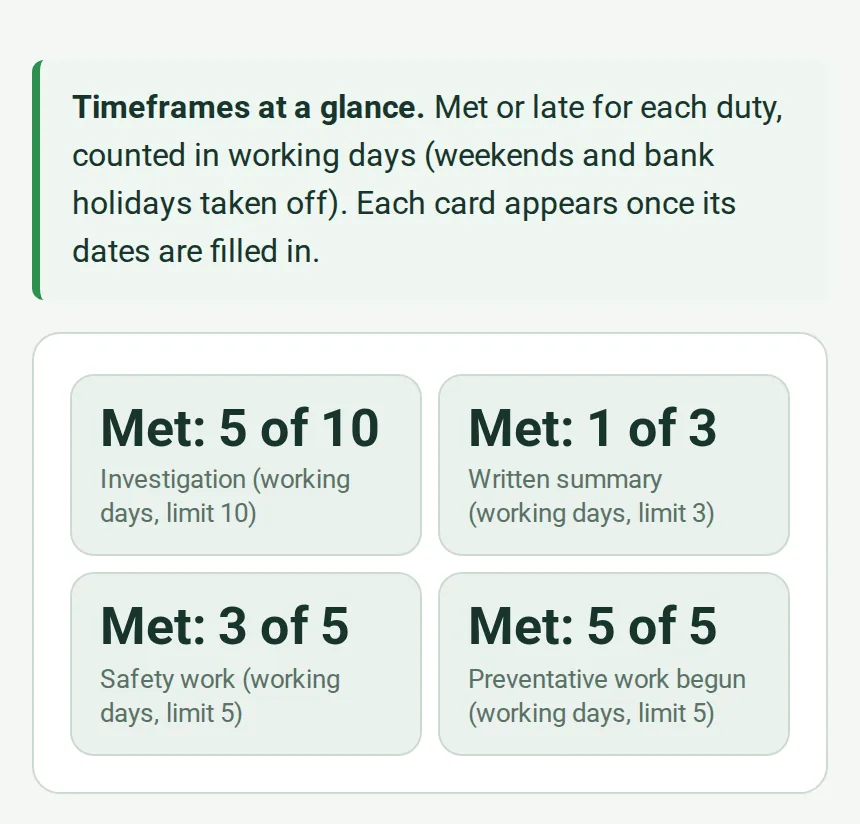
- 06
Worked example 1: over Christmas
The landlord became aware of damp and mould on Thursday 24 December 2026 and investigated on Friday 8 January 2027. That is 15 calendar days, but only 8 working days, so the investigation was within the 10 day limit.
Day Counted? Fri 25 Dec No: Christmas Day Sat 26 and Sun 27 Dec No: weekend Mon 28 Dec No: Boxing Day (substitute bank holiday) Tue 29, Wed 30, Thu 31 Dec Yes: working days 1 to 3 Fri 1 Jan No: New Year's Day Sat 2 and Sun 3 Jan No: weekend Mon 4 to Fri 8 Jan Yes: working days 4 to 8 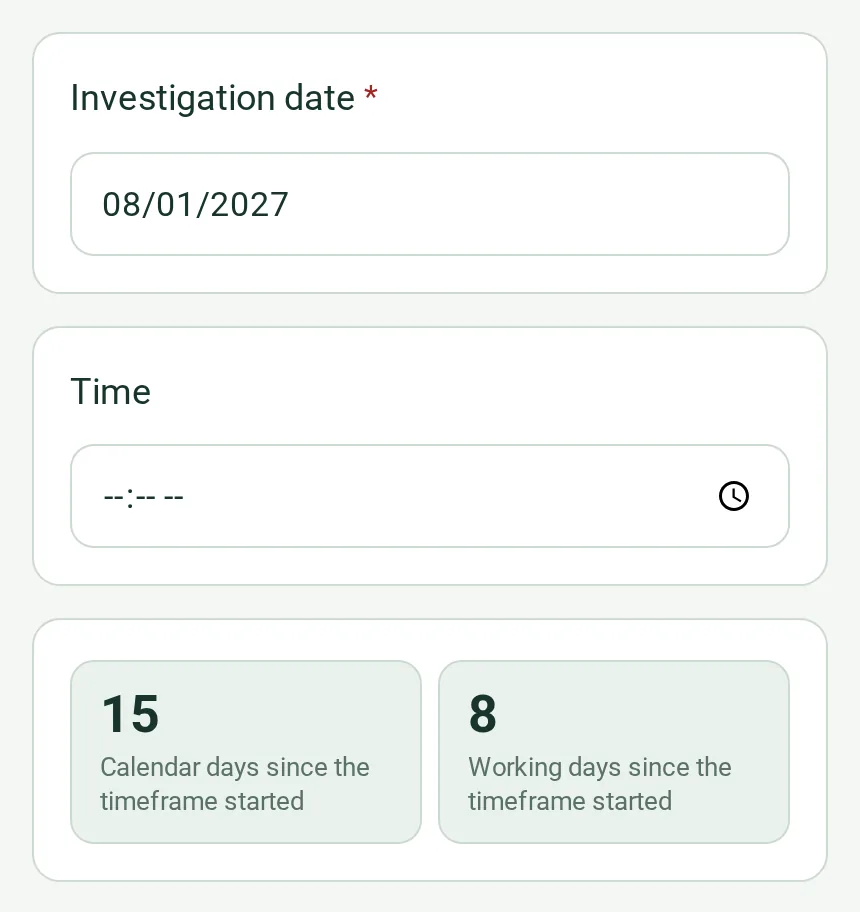
- 07
Worked example 2: a late investigation
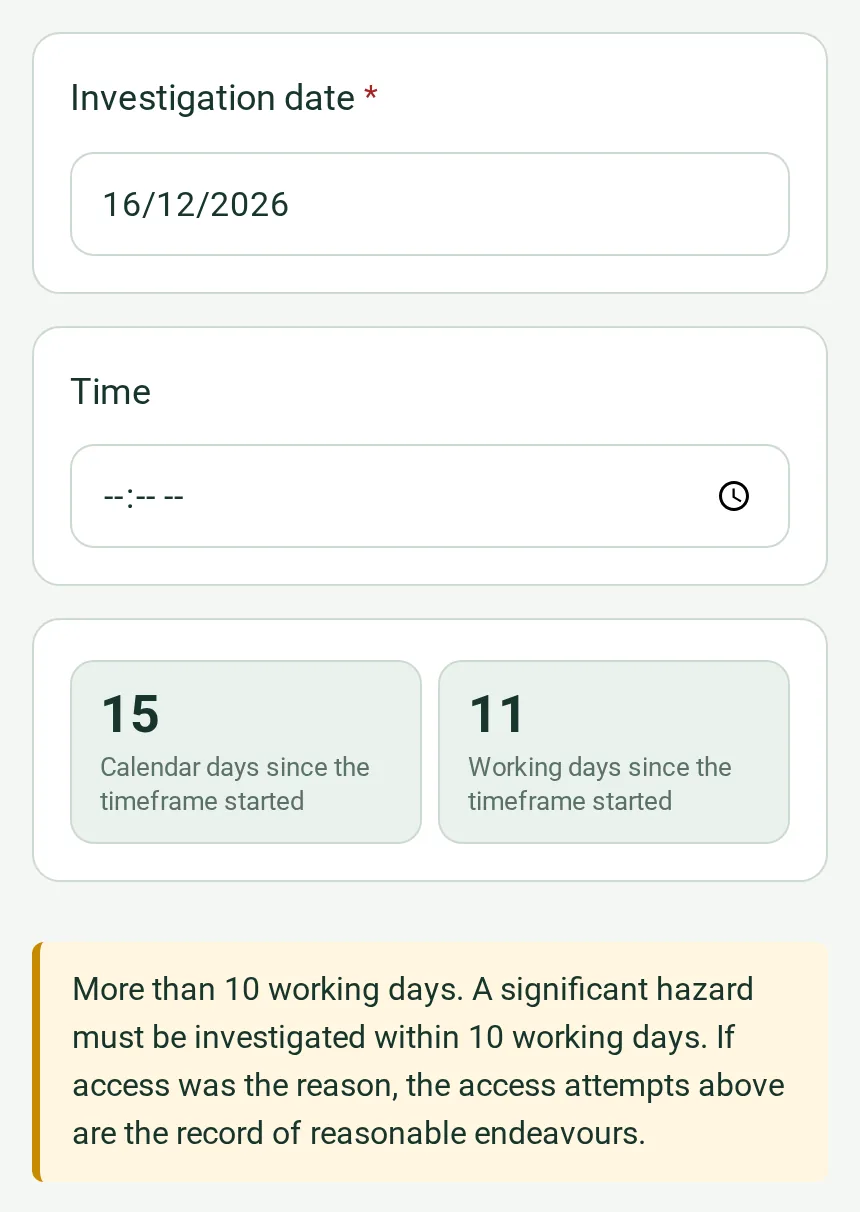
Aware on Tuesday 1 December 2026, investigated on Wednesday 16 December. There are no bank holidays in between, so the two weekends come off: 15 calendar days, 11 working days. The card shows 11 and an amber note says it is past the 10 working day limit.
If the delay was because the tenant could not give access, turn on Any difficulty getting access? and log each attempt. Government guidance says a landlord is not in breach if it can show it used all reasonable endeavours, and the log is that record.
- 08
Worked example 3: the written summary over Easter
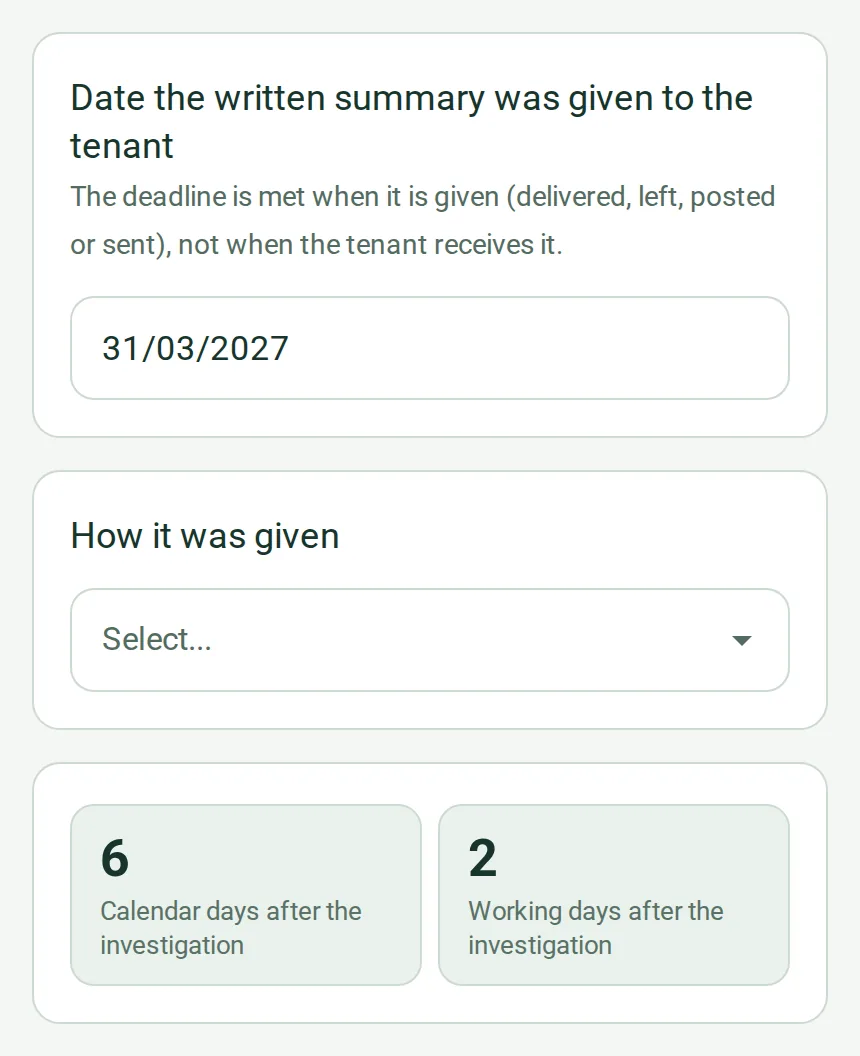
The investigation concluded on Thursday 25 March 2027 and the written summary was posted on Wednesday 31 March. Good Friday (26 March) and Easter Monday (29 March) are bank holidays, so only Tuesday 30 and Wednesday 31 count: 2 working days, inside the 3 allowed, even though 6 calendar days have passed.
The deadline is met when the summary is given (handed over, left at the home, posted first class or sent electronically to an address the tenant gave), not when it arrives. Record how it was given in the field next to the date.
- 09
Worked example 4: an emergency investigated the next day
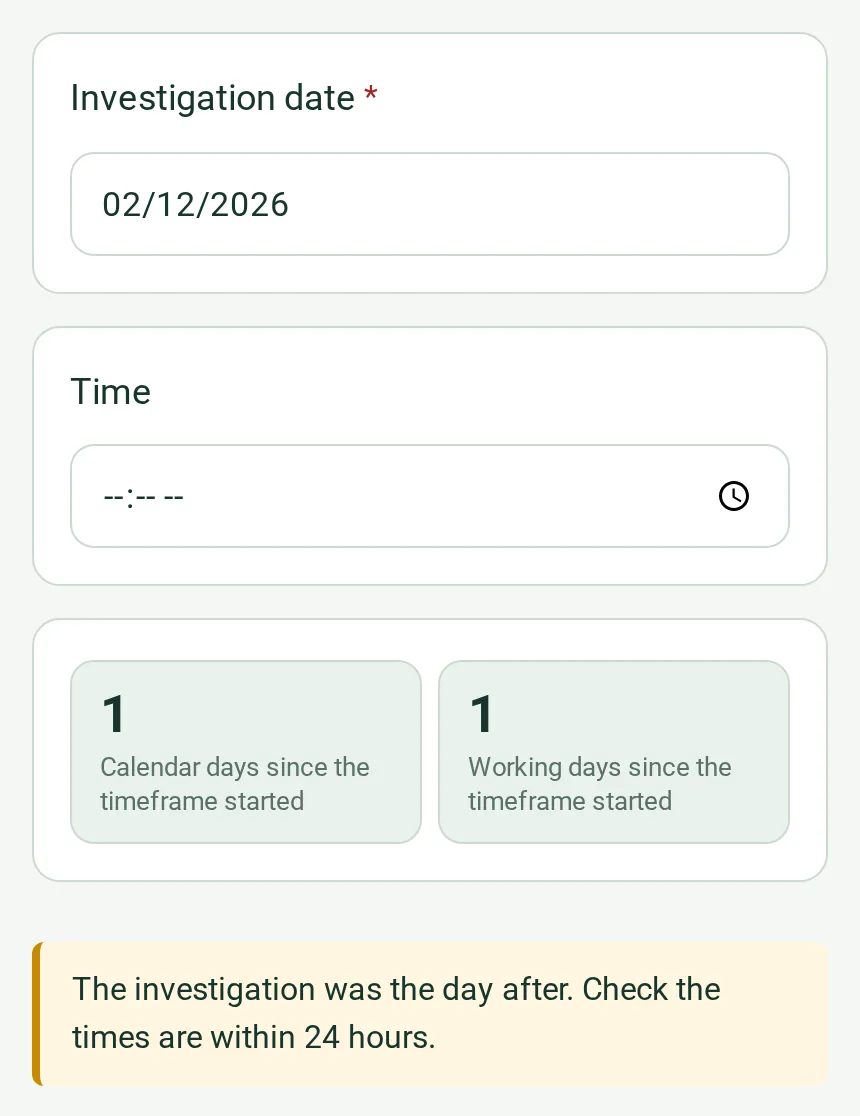
A potential emergency hazard reported on Tuesday 1 December 2026 was investigated on Wednesday 2 December. The form compares dates, so it cannot tell whether 1 calendar day is 3 hours or 30. It shows a note asking you to check the times recorded against the 24 hours. A gap of 2 or more days is flagged as more than 24 hours.
If it only became clear part way through an investigation that the hazard was an emergency, enter that date in When did the grounds to believe it is an emergency arise? The 24 hours then run from it (regulation 5(8)).
- 10
Worked example 5: a Phase 2 hazard you already knew about
A tenant reported on Tuesday 10 November 2026 that two radiators were not heating; the rest of the heating worked, so it was not an emergency. Excess cold only becomes a significant hazard under Awaab's Law on 30 November 2026. For a matter the landlord already knew about, the timeframes start only when it is reported again on or after that date, or the landlord learns of a material change (regulation 21, as amended).
- Answer Yes to Did the landlord know about this before 30 November 2026?
- Enter the date it was reported again: Tuesday 1 December 2026.
- Investigation on Wednesday 16 December: the form counts from 1 December, not 10 November, and shows 11 working days, so it is late.
- 11
Worked example 6: the tenant asks for an in-person inspection
A hazard reported on Wednesday 2 December 2026 was investigated remotely from photos. On Wednesday 9 December the tenant asked for an in-person inspection, which then took place on Monday 21 December. The 10 working days for that inspection run from the day after the request (regulations 6 and 7), so the form counts from 9 December: 8 working days, within time.
If the investigation method is Remotely and the tenant has asked for an in-person inspection, an amber note reminds you to arrange one.
- 12
Worked example 7: a further investigation before the preventative work
The investigation on Tuesday 1 December 2026 found a significant hazard but needed a damp survey to decide the repair. The survey was completed on Monday 14 December and the preventative work began on Friday 18 December.
- The 5 working days to begin preventative work run from the day after the further investigation: 15 to 18 December is 4 working days, so it was met (regulation 13).
- The 12 weeks still run from the first investigation: preventative work must begin by Tuesday 23 February 2027 at the latest.
- Any safety work the first investigation identified still had to be done within its own 5 working days.
- 13
What the form does not work out for you
The counts are only as good as the dates entered, and some judgements stay with your team.
- Whether a hazard is significant or an emergency. The form explains the tests: a reasonable landlord, knowing the household's circumstances, would make it safe within 15 working days, or within 24 hours.
- Exact hours. Emergency steps are compared by date, so a next-day step needs the recorded times checking.
- Bank holidays after 2028, until the built-in list is extended.
- Whether access attempts amount to all reasonable endeavours, and whether the alternative accommodation offered was suitable.
Good to know
- ✓Fill in the date the landlord became aware even when the report came through a contractor or call centre. A report to anyone acting for the landlord can count as the landlord becoming aware.
- ✓Record a material change, such as worse symptoms or a worse hazard, as a new report. The timeframes start again.
- ✓The Timeframes at a glance cards are the first thing a manager, the Housing Ombudsman or a court will read in the report, so check them before you close a case.
Was this guide helpful?
Your feedback helps us improve support content.