Hazards and control measures
Working at height hazards and control measures
The hazards of working at height, who gets hurt and how, and the control measures HSE expects, from avoiding the height to guardrails, inspections, a rescue plan and a harness as the last resort. With a worked example from a completed RAMS.
What are the main hazards of working at height?
Working at height means any work where a person could fall a distance liable to cause injury: from a ladder, a roof edge, a scaffold, a platform or through a fragile surface. Falls from height are the biggest single cause of death at work in Great Britain, with 31 of the 126 workers killed in 2025/26. The Work at Height Regulations 2005 expect you to avoid the height where you can, use guardrails or a platform before a ladder, check the equipment, and plan the rescue before anyone goes up.
Last updated . Facts checked by the SiteSurvey team on 24 October 2026 against HSE: Work at height, The Work at Height Regulations 2005 and HSE: Work-related fatal injuries in Great Britain.
What counts as work at height
Work at height is any work in a place where, without precautions, a person could fall a distance liable to cause personal injury. There is no minimum height. A roofer on a felt roof, an electrician on a stepladder fitting a light, an AV installer on a mobile tower in a school hall and a grounds worker in a tree are all working at height, and so is anyone working next to an open excavation or a fragile rooflight. The Work at Height Regulations 2005 cover all of them, whether the work is construction or not.
The hazards are the obvious ones and the ones people forget. A fall from a ladder that was not footed or tied. A fall through a rooflight or an asbestos cement sheet that looked solid. A fall from a scaffold lift with no guardrail yet because the next lift was still going up. A fall from a tower that was moved with someone on it, or pushed over by wind on an exposed site. And the hazard to everyone below: a dropped tool, a dislodged tile or a bag of fixings that falls off the edge.
Who is harmed, and how
HSE's fatal injury figures put falls from height at the top of every year's list. In 2025/26, 31 of the 126 workers killed in Great Britain died in a fall from height, and construction, with 25 deaths in all, remains the industry where most of them happen. Behind the deaths are the far larger number of broken legs, pelvises and spines from falls of only two or three metres, which is why the regulations set no minimum height.
The people hurt are rarely the specialist roofer on a well-planned job. They are more often the person doing a short task from a ladder because the proper access felt like too much trouble, the labourer who stepped onto a fragile surface nobody had pointed out, or the maintenance worker alone on a flat roof with no edge protection and no one to raise the alarm. Members of the public and other trades are harmed by what falls from the work, which is why an exclusion zone below it is a control in its own right.
What the law expects
The regulations set an order. First avoid the work at height altogether, for example by assembling at ground level or using an extending tool from below. Where it cannot be avoided, prevent falls with a safe place of work or equipment that stops a fall happening: a platform, tower, scaffold or MEWP with guardrails and toeboards. Only where that is not reasonably practicable do you minimise the distance and consequences of a fall with nets, airbags or a harness clipped to a rated anchor. A ladder is allowed for short, low-risk work where a platform is not justified, with three points of contact and the ladder footed or tied.
Around that order sit the duties that make it work: the job is planned and supervised, the people are competent, the weather is checked, the equipment is inspected before use and a scaffold is inspected at least every seven days, fragile surfaces are identified, and there is a rescue plan with the equipment to carry it out on site. In SiteSurvey, the RAMS template asks whether the work could be done without working at height, which access equipment is used, whether a person could fall two metres or more and when the tower or scaffold was last inspected, and the Suggested controls list follows the same order.
Suggested controls
Work at height: control measures, most effective first
These are the 7 controls the SiteSurvey RAMS and risk assessment forms offer for this hazard as a tick list, grouped by their level in the hierarchy of controls. They are a starting point from HSE guidance, not an assessment of your job: tick what applies and say how it works on your site. If only personal protective equipment is ticked, the form says so. How suggested controls work and the hierarchy of controls explained.
Take the hazard away altogether, usually by doing the job a different way or from a different place.
- Do the work from the ground or inside the building instead
Keep people away from the hazard with a physical measure: a guardrail, a barrier, extraction, isolation.
- Tower, MEWP or scaffold with guardrails and toeboards rather than ladders
Change the way the work is done: a permit, a check, training, supervision, timing.
- Ladders only for short, light work with three points of contact
- Access equipment checked before use and inspected within the last 7 days
- Rescue plan agreed and the equipment for it on site
- Work at height stopped in high wind, ice or poor light
Protect the person as the last line: a harness, hard hat, gloves or respirator. Never the only control.
- Harness and lanyard clipped to a rated anchor where guardrails are not possible
Offered to: every type of work in the RAMS form.
Try it
Build the controls for work at height
Tick the controls you would put in place, see which levels of the hierarchy they reach, and score the risk before and after. Or fill in the example from a completed RAMS to see how one crew did it.
Interactive
Try it: work at height
Works the same way as the RAMS form. Nothing you tick is saved or sent anywhere.
Your controls, by level
- Eliminatenot ticked
- Substituteno control at this level for this hazard
- Engineeringnot ticked
- Adminnot ticked
- PPEnot ticked
Nothing ticked yet.
3. Score the risk with these controls
What the law says
- Work at Height Regulations 2005
- Avoid work at height where you can, prevent falls where you cannot, and minimise the distance and consequences where a fall is still possible. Planning, competence, equipment inspection and rescue arrangements.
- Management of Health and Safety at Work Regulations 1999, regulation 3
- The suitable and sufficient risk assessment that identifies the work at height and the controls.
- Construction (Design and Management) Regulations 2015
- On construction work, the principal contractor plans and manages the work, including the access and the fragile surfaces, through the construction phase plan.
Worked example
Work at height in a completed RAMS
The hazard entry exactly as it was recorded in one of our completed example RAMS: the controls ticked from the list, how they apply on that job, and the score before and after the further action.
Construction and building work
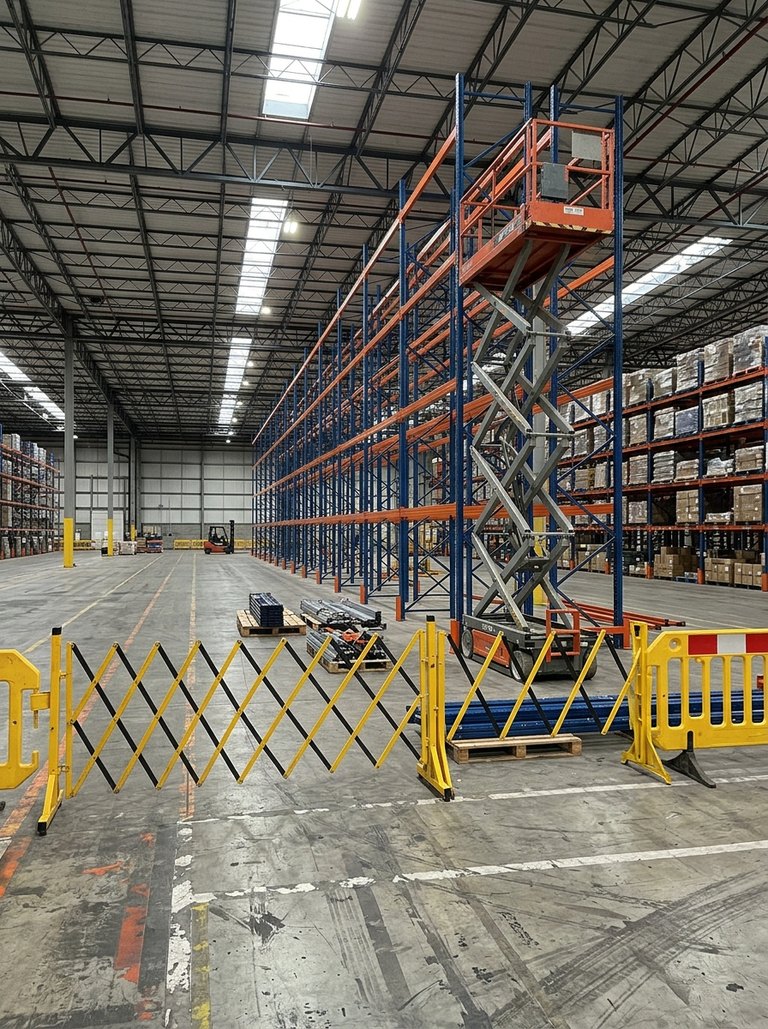
Castlemead Logistics, Nottingham: pallet racking installation, aisles 12 to 17
- Hazard
- Work at height: Aisles 12 to 17, beam levels 2 to 5 (2.5 m to 8.0 m)
- What could happen, and to whom
- Falls from the scissor lift platform while fitting beams and safety locks up to 8 m, and falls from the frames if anyone climbs them to reach a beam or a lock. The two installers on the lifts, and the labourer or supervisor if they go up with them.
- Controls ticked
- Tower, MEWP or scaffold with guardrails and toeboards rather than ladders
- Access equipment checked before use and inspected within the last 7 days
- Rescue plan agreed and the equipment for it on site
- Work at height stopped in high wind, ice or poor light
- How they apply on this job
- Beams above the first level are fitted only from the two electric scissor lifts, standing inside the guardrails with the gate shut. Nobody climbs the frames or stands on a beam at any time; a beam that cannot be reached is reached by moving the lift. Both lifts are hired with a thorough examination certificate under 6 months old and get a pre-use check by the operator each morning, recorded on the IPAF checklist in the van. Only K. Osei, L. Wrigley and P. Danvers (all IPAF 3a) operate the lifts. Level 1 beams and bracing up to 2.5 m are fitted from the floor or podium steps. The MEWP rescue plan is on page 6 and a second operator trained on the ground controls is always within sight of a working lift. Indoor work, so the wind rule applies only to the dock doors: lifts are not driven across the dock apron with the doors open in gusty weather.
- Risk with these controls (likelihood x severity)
- 4 x 5 = 20 (High)
- Further action
- Hire company to deliver both lifts on 23 November with their LOLER certificates, and P. Danvers to check the certificates, the pre-use checks and the 'no climbing the frames' rule at the start of each day's briefing. The rule is written on the barrier signs at each aisle end. Owner: P. Danvers.
- Residual risk
- 2 x 5 = 10 (Medium)
A fictional job, filled in as a worked example. The form and the report are real.
It also appears in felt roof renewal on a school sports hall, led display and speakers in a school hall, outdoor stage and rig for a christmas lights switch-on, dismantling a storm-damaged ash near an 11 kv line, welding heating pipework in a hospital plant room and independent scaffold on a seafront hotel. All eleven completed RAMS.
Work at height: common questions
Is there a minimum height before the Work at Height Regulations apply?
No. The regulations apply wherever a person could fall a distance liable to cause injury, which includes a fall from a stepladder or into an open excavation. The old two-metre rule went in 2005. The RAMS template still asks whether a person could fall two metres or more, because that answer changes the equipment and the rescue plan, not because the law stops below it.
Can we use a ladder?
Yes, for short, low-risk work where a platform or tower is not justified, with three points of contact and the ladder on a firm level base, footed or tied. HSE's rule of thumb is a task of under 30 minutes. If the work needs both hands, tools at the top or a reach beyond the stiles, it needs a platform. The tick list puts the ladder below the tower, MEWP or scaffold for that reason.
What should the rescue plan say?
Who gets a person down, with what, and how quickly. Someone hanging in a harness needs to be rescued within minutes, and the fire service is not a rescue plan. The plan names the equipment, such as a MEWP, a rescue kit or a second tower, confirms it is on site before the work starts, and says who has been trained to use it. The work at height rescue plan template records all of that.
How often must a scaffold or tower be inspected?
A scaffold from which a person could fall two metres or more must be inspected by a competent person before first use, after any alteration or event that could affect its strength, and at intervals of no more than seven days, with the inspection recorded. Mobile towers follow the same rule once assembled. The RAMS template asks for the date of the last inspection and warns when it is more than seven days ago.
Last updated . See every hazard in the library.
Write the RAMS with these controls already listed.
Pick the hazard, tick its controls, score it and brief the crew, on a phone or laptop. The report goes to the client as one PDF.