Hazards and control measures
Fragile roof hazards and control measures
The hazards of fragile roofs, rooflights and skylights, who falls through them and why, and the control measures the law expects: keep off the fragile surface, cover or fence rooflights, staging with guard rails, nets and warning notices. With a worked example from a completed RAMS.
What are the hazards of working on a fragile roof?
A fragile roof or rooflight will not safely support the weight of a person and what they are carrying, so one wrong step means a fall through to the floor below. HSE says falls through fragile surfaces account for 22% of all fall from height deaths in construction, mostly through fibre-cement roofs and rooflights. The Work at Height Regulations 2005 expect you to keep people off fragile surfaces where the work can be done another way, and otherwise use platforms, covers, guard rails and nets, with warning notices on the approach.
Last updated . Facts checked by the SiteSurvey team on 24 October 2026 against HSE: Roof work, HSE: Fragile surfaces and The Work at Height Regulations 2005, regulation 9.
What counts as a fragile roof
A fragile surface is one that will not safely support the weight of a person and any materials they are carrying. HSE lists the likely candidates: non-reinforced fibre-cement sheets whatever their profile, rooflights, liner panels, corroded metal sheets, glass including wired glass, rotted chipboard, wood wool slabs, slates and tiles. Its advice is to treat every roof as fragile until a competent person has confirmed it is not, and not to trust any sheeted roof, whatever the material.
Rooflights are the trap. Some are hard to see in certain light and others have been painted over, so a roof that looks solid from the access point has a row of holes in it. The hazard turns up on far more jobs than roofing. Electricians and AV installers fitting cable runs, aerials or solar kit, maintenance staff clearing gutters, cleaners and surveyors all end up on industrial and farm roofs. Edges are a hazard in their own right, covered on the work at height page.
Who is harmed, and how
HSE says almost one in five deaths in construction work involve roof work, and that falls through fragile surfaces, particularly fibre-cement roofs and rooflights, account for 22% of all fall from height deaths in the industry. Workers doing roof work and building maintenance are killed or permanently disabled by these falls.
The people who fall are often not roofers on a planned job. HSE says those carrying out small, short-term maintenance and cleaning jobs are over-represented in the injury figures. It is the person who went up to look at a leak, clear a gutter or fix a cable, walked across the sheets to save time and stepped onto a rooflight nobody had pointed out.
What the law expects
Regulation 9 of the Work at Height Regulations 2005 sets the order. First, nobody passes across or near, or works on or near, a fragile surface where the work could reasonably be done safely another way, for example from a MEWP working from below. Where that is not possible, provide suitable platforms, coverings, guard rails or similar that can bear any foreseeable load, and if a fall is still possible, minimise its distance and consequences. Warning notices go on the approach to any fragile surface.
HSE describes what that looks like: a platform beneath the roof where possible, stagings with guard rails across the fragile area, rooflights protected by barriers or covers that are secured and labelled with a warning, and safety nets slung beneath and close to the roof, with fall restraint or fall arrest where those are not enough. A flat roof edge needs a secure double guardrail and toeboard. In SiteSurvey, the RAMS template records the controls ticked for each fragile area and warns when only PPE such as a harness is ticked, and the Suggested controls list follows the same order.
Suggested controls
Fragile roofs and skylights: control measures, most effective first
These are the 5 controls the SiteSurvey RAMS and risk assessment forms offer for this hazard as a tick list, grouped by their level in the hierarchy of controls. They are a starting point from HSE guidance, not an assessment of your job: tick what applies and say how it works on your site. If only personal protective equipment is ticked, the form says so. How suggested controls work and the hierarchy of controls explained.
Take the hazard away altogether, usually by doing the job a different way or from a different place.
- Work done without going onto the fragile surface, from a MEWP or below
Keep people away from the hazard with a physical measure: a guardrail, a barrier, extraction, isolation.
- Rooflights covered or fenced before work starts nearby
- Crawling boards or staging with guardrails across fragile areas
Change the way the work is done: a permit, a check, training, supervision, timing.
- Fragile surfaces and rooflights identified, signed and pointed out at the briefing
Protect the person as the last line: a harness, hard hat, gloves or respirator. Never the only control.
- Safety nets or a harness on a rated anchor where covers are not possible
Offered to: Construction and building work, Electrical and M&E, AV, IT and data cabling installation, Roofing, scaffolding and work at height, Facilities, cleaning and maintenance, Grounds, landscaping and tree work.
Try it
Build the controls for fragile roofs and skylights
Tick the controls you would put in place, see which levels of the hierarchy they reach, and score the risk before and after. Or fill in the example from a completed RAMS to see how one crew did it.
Interactive
Try it: fragile roofs and skylights
Works the same way as the RAMS form. Nothing you tick is saved or sent anywhere.
Your controls, by level
- Eliminatenot ticked
- Substituteno control at this level for this hazard
- Engineeringnot ticked
- Adminnot ticked
- PPEnot ticked
Nothing ticked yet.
3. Score the risk with these controls
What the law says
- Work at Height Regulations 2005, regulation 9
- Keep people off and away from fragile surfaces where the work can be done safely another way; otherwise platforms, coverings and guard rails, measures to minimise any fall, and warning notices on the approach.
- Construction (Design and Management) Regulations 2015
- On construction work, the client, designers and contractors plan out access across fragile roofs and manage it through the construction phase plan.
- Management of Health and Safety at Work Regulations 1999, regulation 3
- The suitable and sufficient risk assessment that identifies the fragile surfaces and the controls before anyone goes up.
Worked example
Fragile roofs and skylights in a completed RAMS
The hazard entry exactly as it was recorded in one of our completed example RAMS: the controls ticked from the list, how they apply on that job, and the score before and after the further action.
Roofing, scaffolding and work at height
Ashcombe Academy sports hall: felt roof renewal
- Hazard
- Fragile roofs and skylights: Six polycarbonate rooflights along the centre line
- What could happen, and to whom
- Falling through a rooflight while walking the roof or moving materials. The crew.
- Controls ticked
- Fragile surfaces and rooflights identified, signed and pointed out at the briefing
- Rooflights covered or fenced before work starts nearby
- Crawling boards or staging with guardrails across fragile areas
- How they apply on this job
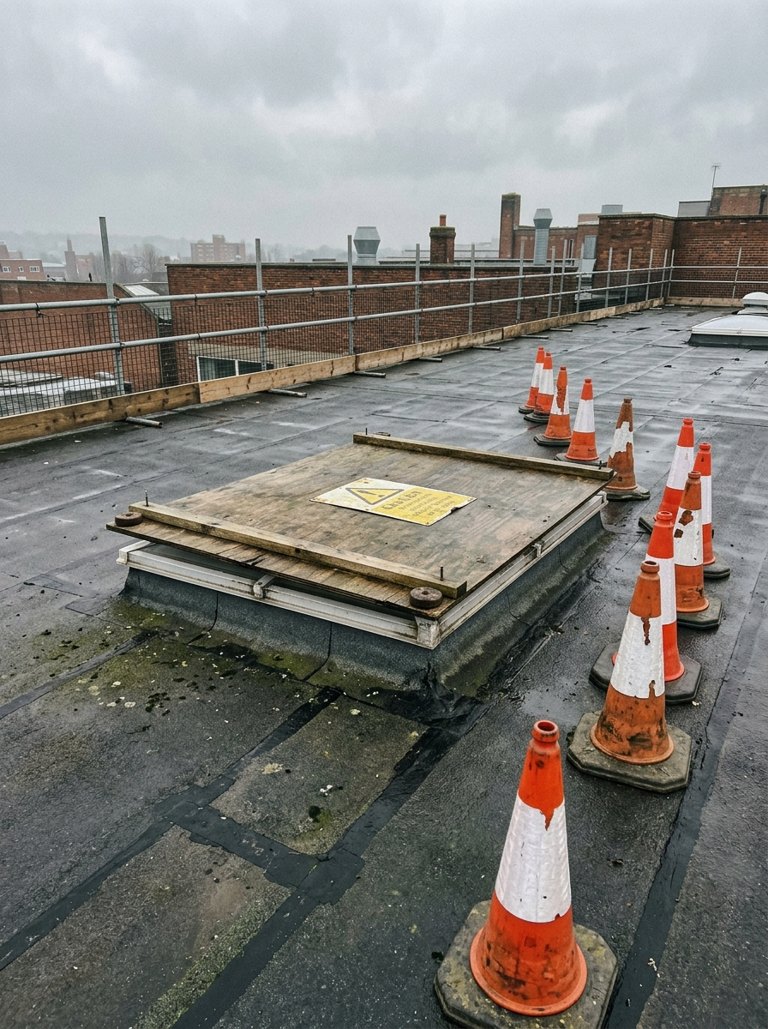
- Each rooflight covered with a fixed, signed timber cover before any other work starts, covers checked at the start of each shift and after every move of materials. Routes across the roof marked with cones away from the rooflights.
- Risk with these controls (likelihood x severity)
- 3 x 5 = 15 (High)
- Further action
- Covers fitted and checked by D. Hale as a hold point before stripping starts. Owner: D. Hale.
- Residual risk
- 1 x 5 = 5 (Medium)
A fictional job, filled in as a worked example. The form and the report are real.
Fragile roofs and skylights: common questions
How do we know if a roof is fragile?
Assume it is. HSE says every roof, once fixed, should be treated as fragile until a competent person has confirmed that it is not. Fibre-cement sheets, rooflights, corroded metal sheets, liner panels and glass are all likely to be fragile, and a rooflight may have been painted over to match the sheets. Ask the client or building owner what they know before anyone goes up, and record it in the RAMS.
Is a harness enough to work on a fragile roof?
Not on its own. Regulation 9 puts platforms, coverings and guard rails ahead of measures that only limit a fall, and HSE describes a combination of stagings, guard rails, fall restraint, fall arrest and safety nets. A harness needs a rated anchor, a short enough fall clearance and a rescue plan, and it does nothing for the next person who walks onto the sheets unclipped. Use it where covers and staging cannot be used, not instead of them.
What warning signs does a fragile roof need?
Regulation 9 requires warning notices fixed at the approach to any fragile surface, where that is reasonably practicable, and other ways of making people aware where it is not. Put them at every access point to the roof, such as the ladder head, the hatch or the access door. Covers over rooflights should also be secured and labelled with a warning. The briefing then points out each fragile area to the crew before work starts.
Can we walk on the purlin or bolt lines of a sheeted roof?
Do not rely on it. HSE says not to trust any sheeted roof, whatever the material, to bear the weight of a person, and that includes the ridge and purlins, and the regulations expect people to stay off fragile surfaces unless the work cannot be done another way. If access is needed, use staging with guard rails across the fragile area, with nets or other protection below. Plan a walkway that keeps everyone away from the rooflights.
Last updated . See every hazard in the library.
Write the RAMS with these controls already listed.
Pick the hazard, tick its controls, score it and brief the crew, on a phone or laptop. The report goes to the client as one PDF.