Hazards and control measures
Falling objects hazards and control measures
The hazards of tools, materials and loads falling from height, who gets hurt and how, and the control measures the law expects: stop things falling with toe boards, brick guards and tethered tools, keep people out of the zone below, and hard hats last. With a worked example from a RAMS.
What are the main falling objects hazards at work?
A falling object hazard is any tool, fixing, material or load that can drop, be knocked or be blown from a height onto someone below, from a scaffold, roof, tower, MEWP or ladder. In 2025/26, 21 of the 126 workers killed in Great Britain were struck by a moving object. The Work at Height Regulations 2005 expect you to stop things falling in the first place, keep people out of the area below where you cannot, never throw or tip anything from height, and store materials so they cannot collapse or roll.
Last updated . Facts checked by the SiteSurvey team on 24 October 2026 against The Work at Height Regulations 2005, HSE: Work-related fatal injuries in Great Britain, HSE: Protecting the public and HSE: Construction head protection.
What counts as a falling objects hazard
A falling object hazard is anything that can drop, be knocked off or be blown from a height onto a person below: a drill, a bag of fixings, a scaffold fitting, a brick, a roof tile, a length of trunking or a load on its way up to a platform. It shows up wherever people work above other people. Scaffolders passing tube and boards, roofers stripping tiles, electricians and AV installers working from towers and MEWPs over a hall floor, event crews rigging over a stage and grounds staff in a tree above a path all create it. It is the other half of work at height: the person on the platform may be safe while everyone below is not.
The Work at Height Regulations 2005 deal with it directly. Regulation 10 covers material or objects falling from height, anything thrown or tipped from height, and materials stored where they could collapse, overturn or move unexpectedly. Schedule 2 asks for guard rails, toe boards and barriers placed to prevent the fall of persons, materials or objects from a work position, so the edge protection that stops a person going over should stop their tools and materials going over too.
Who is harmed, and how
HSE's fatal injury figures for 2025/26 record 126 workers killed in Great Britain, 21 of them after being struck by a moving object. Behind them are many more injuries from a spanner, a fitting or an offcut that hits a head, a shoulder or a hand. The person hurt is often not the person who dropped it. It is the labourer at the base of the scaffold, the next trade working underneath, the driver waiting to unload or the colleague passing equipment up to the platform.
Members of the public are at risk too. HSE lists materials or tools falling outside the site boundary among the ways members of the public are seriously injured by construction work, and says you must make sure objects cannot fall outside it. On a town centre scaffold that means pedestrians on the pavement, people using a building entrance and traffic on the road. Inside a school hall or an office it means a caretaker or a member of staff who walks in while the crew is working overhead.
What the law expects
Regulation 10 sets the order. First take suitable and sufficient steps to prevent anything falling, so far as is reasonably practicable. Where that is not reasonably practicable, take steps to stop people being struck by whatever could fall. Nothing is thrown or tipped from height where it is likely to injure someone, and materials are stored so they cannot collapse, overturn or move unexpectedly.
In practice, preventing the fall means toe boards on every working lift, brick guards where materials are stacked, debris netting on scaffolds, tools tethered, fixings in a lidded tray, materials kept back from the edge and waste lowered by hoist or chute. Stopping people being struck means an exclusion zone below the work, fenced and signed, and where the public pass, fans or a covered walkway. HSE says construction work should be organised to minimise the risk of head injury before relying on head protection, so hard hats inside the zone are the last layer, not the plan. In SiteSurvey, the RAMS template records the controls ticked for each hazard and warns when only PPE is ticked, and the Suggested controls list follows the same order.
Suggested controls
Falling objects: control measures, most effective first
These are the 5 controls the SiteSurvey RAMS and risk assessment forms offer for this hazard as a tick list, grouped by their level in the hierarchy of controls. They are a starting point from HSE guidance, not an assessment of your job: tick what applies and say how it works on your site. If only personal protective equipment is ticked, the form says so. How suggested controls work and the hierarchy of controls explained.
Keep people away from the hazard with a physical measure: a guardrail, a barrier, extraction, isolation.
- Exclusion zone below the work, fenced and signed
- Toeboards, brick guards or debris netting on the scaffold lifts
- Waste lowered by hoist or chute, never dropped
Change the way the work is done: a permit, a check, training, supervision, timing.
- Tools tethered and materials kept back from the edge
Protect the person as the last line: a harness, hard hat, gloves or respirator. Never the only control.
- Hard hats worn by everyone inside the zone
Offered to: Construction and building work, Electrical and M&E, AV, IT and data cabling installation, Roofing, scaffolding and work at height, Events, exhibitions and staging, Grounds, landscaping and tree work.
Try it
Build the controls for falling objects
Tick the controls you would put in place, see which levels of the hierarchy they reach, and score the risk before and after. Or fill in the example from a completed RAMS to see how one crew did it.
Interactive
Try it: falling objects
Works the same way as the RAMS form. Nothing you tick is saved or sent anywhere.
Your controls, by level
- Eliminateno control at this level for this hazard
- Substituteno control at this level for this hazard
- Engineeringnot ticked
- Adminnot ticked
- PPEnot ticked
Nothing ticked yet.
3. Score the risk with these controls
What the law says
- Work at Height Regulations 2005, regulation 10
- Prevent material and objects falling where reasonably practicable, otherwise stop people being struck; nothing thrown or tipped from height; materials stored so they cannot collapse, overturn or move.
- Work at Height Regulations 2005, Schedule 2
- Guard rails, toe boards and barriers placed to prevent the fall of persons, materials or objects, with toe boards on construction work suitable to stop material falling.
- Personal Protective Equipment at Work Regulations 1992
- Where a risk of head injury remains after the work is organised, suitable head protection is provided and worn.
- Management of Health and Safety at Work Regulations 1999, regulation 3
- The suitable and sufficient risk assessment that identifies what could fall, who is below and the controls.
Worked example
Falling objects in a completed RAMS
The hazard entry exactly as it was recorded in one of our completed example RAMS: the controls ticked from the list, how they apply on that job, and the score before and after the further action.
AV, IT and data cabling installation
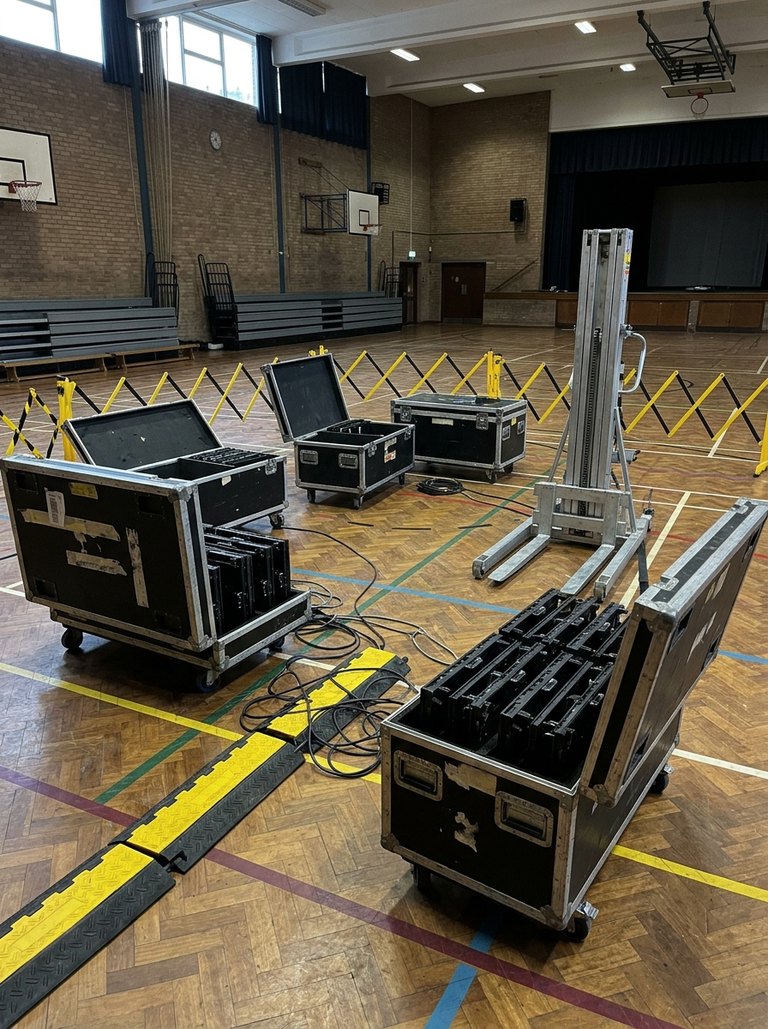
Whitley Vale Academy main hall: LED display and line array installation
- Hazard
- Falling objects: Hall floor below the tower, the speaker positions and the display frame
- What could happen, and to whom
- Drills, fixings, bracket parts and 14 kg display cabinets dropped from the tower or the genie lift onto someone on the hall floor. The crew on the floor, and the caretaker if he enters the hall.
- Controls ticked
- Exclusion zone below the work, fenced and signed
- Tools tethered and materials kept back from the edge
- Hard hats worn by everyone inside the zone
- How they apply on this job
- An exclusion zone 3 m out from the tower and the display frame, marked with barrier posts and chain and signed, set up by L. Bright before the tower goes up and kept until the last cabinet is hung. Drills and hand tools are tethered to the operator's harness point on the tower, fixings stay in a lidded tray on the platform, and nothing is left on the toeboard line. Cabinets go up one at a time on the genie lift, never carried up the tower. Hard hats worn by everyone in the zone, including whoever is passing cabinets to the lift.
- Risk with these controls (likelihood x severity)
- 3 x 4 = 12 (Medium)
- Further action
- Zone marked out and checked by P. Marchetti before the tower build, and walked again after every tower move. Owner: L. Bright.
- Residual risk
- 1 x 4 = 4 (Low)
A fictional job, filled in as a worked example. The form and the report are real.
It also appears in outdoor stage and rig for a christmas lights switch-on, dismantling a storm-damaged ash near an 11 kv line, independent scaffold on a seafront hotel and pallet racking in a live warehouse. All eleven completed RAMS.
Falling objects: common questions
How big should the exclusion zone be?
There is no single distance in the regulations. Size it from the height of the work, what could fall and how far it could bounce, roll or be blown, then mark it with barriers and signs rather than tape alone. Keep it in place for as long as anyone is working overhead and walk it again after a tower or MEWP moves. The worked example on this page sets the zone 3 m out from a tower and a display frame in a school hall.
Are hard hats enough on their own?
No. HSE says construction work should be organised to minimise the risk of head injury first, for example with scaffolds that have toe boards and, where needed, brick guards. Head protection is then provided and worn where a risk remains. A hard hat does nothing for a shoulder or a hand, and it does nothing for a member of the public on the pavement, so it sits below the controls that stop things falling.
Can we drop waste from a scaffold or roof into a skip?
Not where it is likely to injure anyone. Regulation 10 says no material or object is thrown or tipped from height where it is likely to cause injury. Use an enclosed chute into the skip, a hoist or a gin wheel, or carry it down. The RAMS should say which, and the exclusion zone at the bottom of the chute still applies.
Does a toe board stop everything falling?
It stops material rolling or being kicked off the platform edge, which is what Schedule 2 asks of it on construction work, alongside a top guard rail at least 950 mm high and no unprotected gap over 470 mm. It will not stop a tool knocked over the top rail or a fitting dropped while it is being passed up the outside. That is why stacked materials need brick guards or netting, tools are tethered and nothing is passed up the outside face.
Last updated . See every hazard in the library.
Write the RAMS with these controls already listed.
Pick the hazard, tick its controls, score it and brief the crew, on a phone or laptop. The report goes to the client as one PDF.