Hazards and control measures
Temporary structure and rigging hazards
The hazards of temporary demountable structures and rigging at events, from stage roofs and PA towers overturning in the wind to flown loads falling, who gets hurt and how, and what HSE expects: build to the design, competent riggers, planned lifts, ballast, wind limits and sign off before use.
What are the main hazards of temporary structures and rigging?
The main hazards are a stage roof, truss tower or screen overturning or collapsing because it was not built to the design, was missing ballast or was caught by wind it was not designed for, and a flown load such as a speaker cluster or lighting truss falling during the lift or once it is up. HSE notes that these loads can weigh up to 500 kg and often hang 6 m or more above the ground. The control measures are a design that accounts for wind and ground, a competent crew who build exactly to it, lifts planned by a competent person, wind limits that are monitored, and a check and sign off before anything is flown or anyone uses the structure.
Last updated . Facts checked by the SiteSurvey team on 24 October 2026 against HSE: Temporary demountable structures, HSE: Outdoor equipment to support speaker clusters, lights etc, HSE: How CDM applies in the entertainment industry and Lifting Operations and Lifting Equipment Regulations 1998, regulation 8.
What counts as a temporary structure hazard
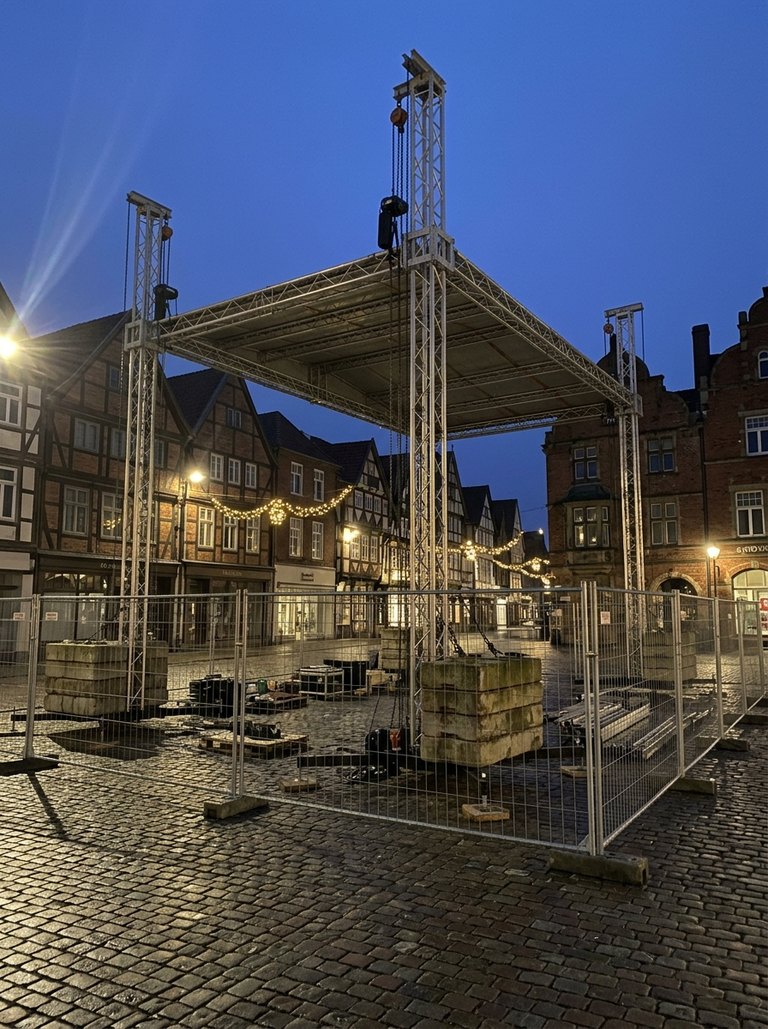
Temporary demountable structures are the stages, ground support roofs, truss towers, screens and platforms that are built for an event or production and taken down afterwards. Riggers and stage crews meet them every week, but so do AV and lighting contractors, scaffolders, marquee firms and the venue staff who host them. Rigging hazards come with them: hoists, slings, shackles and steels holding speaker clusters, lighting trusses and screens over people's heads.
HSE's guidance on equipment that supports speaker clusters and lights sets out how these structures fail. Some of the equipment is lifting equipment and all of it is work equipment, so both sets of regulations apply. Wind is the big one: foreseeable wind loading has to be designed for, usually with a base big enough and enough ballast on it to give a factor of safety against overturning, and sometimes guy ropes. Ground strength and slope matter, the ballast has to stay in place for the whole time the structure is in use, and kit designed only for indoor use is not designed for wind loading and can overturn to the rear or sides with very little load.
Who is harmed, and how
HSE reports that wrongly selected or adapted equipment supporting speaker clusters at outdoor events has overturned and hit people, causing serious injuries, and that there have been near misses where wind on an elevated device made the supporting mast buckle and partly collapse. The riggers are on and under the structure while it is built and taken down, when it is incomplete and loads are moving. Once it is finished, the people underneath are the artists and the audience.
Members of the public are at risk in another way too. HSE advises a barrier around the base of a tower to stop people tampering with winches, brakes or ballast, which also stops someone climbing the structure and falling. The demand for temporary structures around the 2012 Olympics led HSE to commission research on safe practice in building and taking them down, with a suggested model for managing them.
What the law expects
HSE's CDM guidance for entertainment is clear that building, fitting out and taking down temporary structures for live events is construction work, so the Construction (Design and Management) Regulations 2015 apply. There must be a construction phase plan proportionate to the risk, and the build and takedown can be treated as one project. Any lift, from raising a roof grid to flying an array, must be planned by a competent person, supervised and carried out safely under the lifting regulations.
In hierarchy order: design out what you can, for example by choosing a proprietary outdoor system designed for wind loading rather than adapting indoor kit, or de-rating the hoists. Then build exactly to the design or the manufacturer's instructions, with competent contractors and the ballast checked. HSE points to the Institution of Structural Engineers' guidance on temporary demountable structures for the detail. Monitor the weather and know what to do when the wind rises; where that plan is not in place, HSE suggests an exclusion zone of about 1.5 times the tower height. Lifting is covered in more depth on lifting hazards. In SiteSurvey, the RAMS template records the controls for each hazard with a score before and after, and the Suggested controls list follows the same order.
Suggested controls
Temporary structures and rigging: control measures, most effective first
These are the 5 controls the SiteSurvey RAMS and risk assessment forms offer for this hazard as a tick list, grouped by their level in the hierarchy of controls. They are a starting point from HSE guidance, not an assessment of your job: tick what applies and say how it works on your site. If only personal protective equipment is ticked, the form says so. How suggested controls work and the hierarchy of controls explained.
Keep people away from the hazard with a physical measure: a guardrail, a barrier, extraction, isolation.
- Structure designed and built to the drawing or the supplier instructions
- Area beneath the rigging cleared while loads are raised
Change the way the work is done: a permit, a check, training, supervision, timing.
- Rigging done by competent riggers and loads kept within the rating
- Checked and signed off before use and after any change
- Wind limits set, the weather monitored and the structure secured or lowered above them
Offered to: Events, exhibitions and staging.
Try it
Build the controls for temporary structures and rigging
Tick the controls you would put in place, see which levels of the hierarchy they reach, and score the risk before and after. Or fill in the example from a completed RAMS to see how one crew did it.
Interactive
Try it: temporary structures and rigging
Works the same way as the RAMS form. Nothing you tick is saved or sent anywhere.
Your controls, by level
- Eliminateno control at this level for this hazard
- Substituteno control at this level for this hazard
- Engineeringnot ticked
- Adminnot ticked
- PPEno control at this level for this hazard
Nothing ticked yet.
3. Score the risk with these controls
What the law says
- Construction (Design and Management) Regulations 2015
- Apply to building, fitting out and taking down temporary structures for events: plan the work, appoint competent people, and have a construction phase plan.
- Lifting Operations and Lifting Equipment Regulations 1998, regulation 8
- Every lifting operation, including raising a roof and flying loads, is properly planned by a competent person, appropriately supervised and carried out safely.
- Lifting Operations and Lifting Equipment Regulations 1998, regulation 9
- Lifting equipment whose safety depends on how it is installed is thoroughly examined after installation, and after assembly at each new site, before it is used.
- Provision and Use of Work Equipment Regulations 1998
- Towers, trusses and the equipment that suspends loads from them are work equipment: suitable for the conditions, maintained, and used by trained people.
Worked example
Temporary structures and rigging in a completed RAMS
The hazard entry exactly as it was recorded in one of our completed example RAMS: the controls ticked from the list, how they apply on that job, and the score before and after the further action.
Events, exhibitions and staging
Durham Market Place Christmas lights switch-on: covered stage build
- Hazard
- Temporary structures and rigging: Stage deck and ground-support roof, 10 m by 8 m, centre of the Market Place
- What could happen, and to whom
- Collapse or overturning of the roof structure during the raise, under wind load, or because the ballast, bracing or sleeve block pins are not as the drawing. The crew on and under it, the artists on stage and the audience in the pen.
- Controls ticked
- Structure designed and built to the drawing or the supplier instructions
- Rigging done by competent riggers and loads kept within the rating
- Checked and signed off before use and after any change
- Wind limits set, the weather monitored and the structure secured or lowered above them
- Area beneath the rigging cleared while loads are raised
- How they apply on this job
- The roof is built exactly to the supplier's drawing NL-GS-10x8 rev 3 and the ballast schedule in the wind management plan (WMP-NL-114): 1,000 kg water ballast per tower leg plus the deck bracing, checked with the schedule in hand. O. Brennan and M. Szabo build the towers and grid; nobody else touches the structure. The raise is done in stages with all four hoists together and the grid levelled and pinned at each stage. K. Ashworth checks the structure against the drawing and the ballast schedule and signs the structure sign-off sheet before any PA or lighting is flown, and again after any change. Wind is read from the anemometer on the stage-left tower and logged every hour.
- Risk with these controls (likelihood x severity)
- 3 x 5 = 15 (High)
- Further action
- Structure sign-off sheet NL-SO-114 completed and signed by K. Ashworth as the hold point at the end of step 3, with photographs of each ballast tank gauge and each sleeve block pin. Nothing is flown from the grid until it is signed. Owner: K. Ashworth.
- Residual risk
- 1 x 5 = 5 (Medium)
A fictional job, filled in as a worked example. The form and the report are real.
Temporary structures and rigging: common questions
Who signs off a stage or roof before it is used?
The structure should be checked against the drawing or the supplier's instructions by someone competent to do it, before any load is flown and before anyone uses it, and again after any change. HSE expects the structure to be built in accordance with the design and the ballast to stay in place while it is in use. In the worked example the production manager signs a structure sign off sheet, with photographs of each ballast gauge and pin, as a hold point before anything is flown.
What wind speed is too high for a stage roof?
There is no single figure. The limits come from the designer or supplier of the structure, usually in a wind management plan, and they differ from system to system. HSE expects you to measure the local weather if the structure is susceptible to it and to know in advance what you will do to keep it stable. If those arrangements are not in place, HSE suggests an exclusion zone of about 1.5 times the tower height.
Can indoor truss and towers be used at an outdoor event?
HSE says no. Equipment intended only for indoor use is not generally designed for wind loading, and it can usually resist overturning in one direction only. It is also not designed for the extra bending forces from ballast, restrained bases or being out of plumb on uneven ground. Use a proprietary outdoor system designed for the wind loading instead.
Does CDM apply to a one day event build?
Yes. HSE's entertainment guidance says CDM applies to all construction projects, including building and taking down temporary structures for live events, but what you do should be proportionate to the risk. The construction phase plan can sit inside the event management plan, as long as the health and safety information is easy to find. The project only needs notifying to HSE if it lasts more than 30 working days with more than 20 workers at once, or exceeds 500 person days.
Last updated . See every hazard in the library.
Write the RAMS with these controls already listed.
Pick the hazard, tick its controls, score it and brief the crew, on a phone or laptop. The report goes to the client as one PDF.