Hazards and control measures
Lifting hazards and control measures for lifting operations
The hazards of lifting with cranes, lorry loaders, hoists, chain blocks and slings, who gets hurt and how, and the controls LOLER expects: lifts planned by a competent person, equipment thoroughly examined, trained slingers and nobody under the load. With a worked RAMS example.
What are the main hazards of lifting operations?
The main hazards of lifting with equipment are the load falling or slipping from its slings, the equipment being overloaded or failing, and people being struck by the load or the machine. LOLER requires every lifting operation to be planned by a competent person, supervised and carried out safely, with equipment marked with its safe working load and thoroughly examined, every 6 months for accessories and equipment that lifts people and every 12 months for the rest. Nobody should be under or beside a load while it is in the air.
Last updated . Facts checked by the SiteSurvey team on 24 October 2026 against HSE: Lifting Operations and Lifting Equipment Regulations 1998 (LOLER), HSE: Safe lifting by machine, HSE: Thorough examination of lifting equipment and The Lifting Operations and Lifting Equipment Regulations 1998.
What counts as a lifting operation
This page is about lifting with equipment: cranes, lorry loaders and other vehicle-fitted cranes, hoists, telehandlers, material lifts, MEWPs lifting people, manually operated chain blocks, and the lifting accessories that join the load to the machine, such as slings, chains, hooks, shackles, eyebolts and spreader beams. For lifting by hand, see manual handling hazards. LOLER defines a lifting operation as an operation concerned with the lifting or lowering of a load, and HSE notes that the load can be a person.
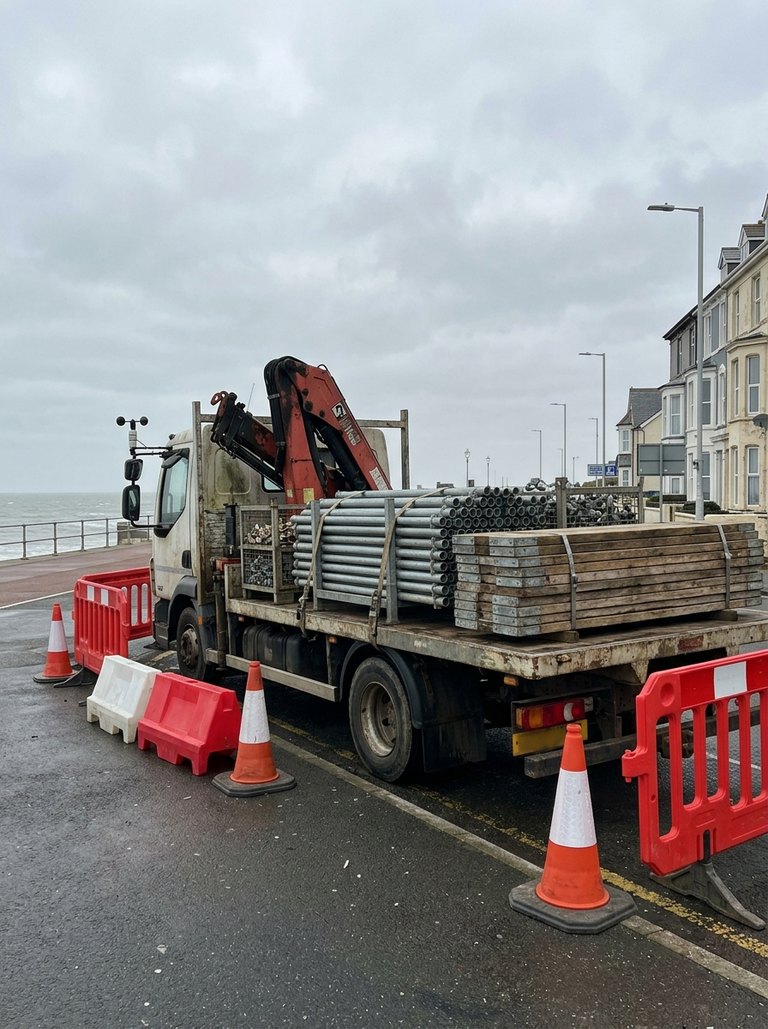
Lifting is not just a crane job on a large site. Scaffolders lift bundles of tube off a lorry with the hiab, AV installers raise display frames on a material lift, electricians pull a transformer into place with a chain block, and maintenance teams hoist plant onto a roof. Each one is a lifting operation, and the same law applies whether the lift happens once a year or fifty times a day.
Who is harmed, and how
HSE names the ways it goes wrong. People are struck by moving parts of the machine or by things falling. A load slips from its slings because it was badly attached, unbalanced or not bound together. The equipment is overloaded beyond its safe working load, or fails because it has deteriorated in wet, abrasive or corrosive conditions. Slings and chains are damaged, knotted, kinked or frayed and still used. And the lift is planned or carried out by people who have not been trained to do it.
The person hurt is often the one closest to the load: the slinger guiding it in, the labourer who stepped under it to steady it, the driver standing by the lorry. When a lorry loader works from the road, pedestrians and traffic are next to the lift as well. That is why the controls are as much about where people stand as about the equipment itself.
What the law expects
The Lifting Operations and Lifting Equipment Regulations 1998 set out the duties. First, think about whether the lift is needed, or whether the item can be delivered to where it is used, and position the equipment to reduce the risk of the load striking someone, drifting or falling. Then, under regulation 8, every lifting operation is properly planned by a competent person, appropriately supervised and carried out in a safe manner. The equipment must have adequate strength and stability and be marked with its safe working load, and HSE says never to lift if there is any doubt about the weight of the load or the adequacy of the equipment.
Regulation 9 requires a thorough examination before first use, after installation where safety depends on it, and then at least every 6 months for accessories and equipment that lifts people and every 12 months for other equipment, unless an examination scheme sets different intervals, plus pre-use checks by the people using it. Loads are slung by trained people with a responsible slinger or banksman and a recognised signalling system, and nobody stands under the load. In SiteSurvey, the RAMS template records the controls ticked for each lift and warns when only PPE is ticked, and the Suggested controls list follows the same order.
Suggested controls
Lifting operations: control measures, most effective first
These are the 5 controls the SiteSurvey RAMS and risk assessment forms offer for this hazard as a tick list, grouped by their level in the hierarchy of controls. They are a starting point from HSE guidance, not an assessment of your job: tick what applies and say how it works on your site. If only personal protective equipment is ticked, the form says so. How suggested controls work and the hierarchy of controls explained.
Keep people away from the hazard with a physical measure: a guardrail, a barrier, extraction, isolation.
- Exclusion zone under and around the load, with no lifting over people
Change the way the work is done: a permit, a check, training, supervision, timing.
- Lift plan written by an appointed person for every lift
- Lifting equipment and accessories with a current thorough examination
- Loads slung and signalled only by trained people
- Lifts stopped above the wind limit in the lift plan
Offered to: Construction and building work, Electrical and M&E, AV, IT and data cabling installation, Roofing, scaffolding and work at height, Events, exhibitions and staging, Facilities, cleaning and maintenance.
Try it
Build the controls for lifting operations
Tick the controls you would put in place, see which levels of the hierarchy they reach, and score the risk before and after. Or fill in the example from a completed RAMS to see how one crew did it.
Interactive
Try it: lifting operations
Works the same way as the RAMS form. Nothing you tick is saved or sent anywhere.
Your controls, by level
- Eliminateno control at this level for this hazard
- Substituteno control at this level for this hazard
- Engineeringnot ticked
- Adminnot ticked
- PPEno control at this level for this hazard
Nothing ticked yet.
3. Score the risk with these controls
What the law says
- Lifting Operations and Lifting Equipment Regulations 1998, regulation 8
- Every lifting operation properly planned by a competent person, appropriately supervised and carried out in a safe manner.
- Lifting Operations and Lifting Equipment Regulations 1998, regulation 9
- Thorough examination before first use, after installation, at least every 6 months for accessories and equipment lifting people and every 12 months for the rest (or to an examination scheme), and after exceptional circumstances.
- Provision and Use of Work Equipment Regulations 1998
- Lifting equipment is also work equipment, so it must be suitable, maintained and used by people with the right training.
- Management of Health and Safety at Work Regulations 1999, regulation 3
- The suitable and sufficient risk assessment that identifies each lift, who could be struck and the controls.
Worked example
Lifting operations in a completed RAMS
The hazard entry exactly as it was recorded in one of our completed example RAMS: the controls ticked from the list, how they apply on that job, and the score before and after the further action.
Roofing, scaffolding and work at height
Pevensey Court Hotel, Eastbourne: seafront scaffold for render repairs
- Hazard
- Lifting operations: Hiab lifts from the lorry to the base; gin wheel on each lift
- What could happen, and to whom
- A bundle of tubes or boards slipping from the hiab slings or the gin wheel rope and falling on the crew, the pavement or passing traffic; the hiab overturning if the stabilisers are not set on the camber. The crew, the TM operatives and the public.
- Controls ticked
- Lift plan written by an appointed person for every lift
- Lifting equipment and accessories with a current thorough examination
- Loads slung and signalled only by trained people
- Exclusion zone under and around the load, with no lifting over people
- Lifts stopped above the wind limit in the lift plan
- How they apply on this job
- Hiab lifts run under lift plan MPS-LP-04 (bundles from the lorry to ground level only, nothing lifted onto the scaffold), reviewed for this site by N. Okonkwo as appointed person. R. Kowalczyk is the trained lorry loader operator and slings every load; L. Mbeki signals. Slings, chains and the gin wheel carry thorough examination reports less than six months old, kept in the van. The pavement is closed at both ends while a load is in the air and no load passes over the gantry, the footway or the live lane. Stabilisers fully out on pads before the first lift, checked by R. Kowalczyk after the lorry settles. Gin wheel fixed to a tube with a right-angle coupler and a check coupler, loads under 50 kg, rope and hook checked each morning, and nobody under it while a load is moving. Lifting stops at the same wind limit as the erection.
- Risk with these controls (likelihood x severity)
- 2 x 5 = 10 (Medium)
- Further action
- Hiab and accessory thorough examination reports and the lift plan added to the SiteSurvey project before the job; checked by P. Gallagher at the briefing on day one. Owner: N. Okonkwo.
- Residual risk
- 1 x 5 = 5 (Medium)
A fictional job, filled in as a worked example. The form and the report are real.
It also appears in felt roof renewal on a school sports hall, led display and speakers in a school hall, outdoor stage and rig for a christmas lights switch-on and pump replacement in a foul water chamber. All eleven completed RAMS.
Lifting operations: common questions
Does every lift need its own written plan?
Regulation 8 requires every lifting operation to be properly planned by a competent person, but it does not set a format. A routine lift with the same equipment and similar loads can work from one plan that is reviewed for each site. A lift over a public road, a heavy or awkward load or a lift close to people who are not part of the job needs a plan written for that lift. Keep the plan with the RAMS so the crew can see it on the day.
What is the difference between a thorough examination and a pre-use check?
A thorough examination is a detailed, systematic examination of the equipment and its safety-critical parts by a competent person, at the intervals LOLER sets, with a written report. HSE says that person should be independent and impartial, so not the person who maintains the equipment. A pre-use check is a simple routine check by the user before each use, such as looking over a sling or chain for damage. You need both.
Who can sling and signal a load?
Only people trained and competent to do it. HSE expects a responsible slinger or banksman and a recognised signalling system, so the operator and the ground crew are using the same signals. The slinger should know the weight of the load, where its centre of gravity is and the safe working load of each accessory. The RAMS names who slings, who signals and who operates for each lift.
What happens if a thorough examination finds a defect?
The competent person tells the duty holder straight away and follows it up with a written report. If the defect could put people in danger, the equipment is not used until it has been put right, and a copy of the report goes to the enforcing authority. Take the item out of service and label it so nobody picks it up by mistake.
Last updated . See every hazard in the library.
Write the RAMS with these controls already listed.
Pick the hazard, tick its controls, score it and brief the crew, on a phone or laptop. The report goes to the client as one PDF.