Hazards and control measures
Power tool hazards and control measures
The hazards of power tools and work equipment, who gets hurt and how, and the controls the law expects: the right tool for the job, guards in place, checks before use, inspection records, trained users and faulty kit taken out of use. With a worked example from a completed RAMS.
What are the main hazards of power tools and work equipment?
The main hazards are contact with moving parts such as blades, bits and discs, a tool kicking back or snagging, flying fragments, damaged leads, and equipment that is unsuitable, badly maintained or used by someone who has not been trained. Contact with moving machinery killed 10 of the 126 workers who died at work in Great Britain in 2025/26. The law expects the right equipment for the job, guards in place, regular checks and inspection, and trained users.
Last updated . Facts checked by the SiteSurvey team on 24 October 2026 against HSE: PUWER overview, HSE: Inspection of work equipment, The Provision and Use of Work Equipment Regulations 1998 and HSE: Work-related fatal injuries in Great Britain.
What counts as work equipment
HSE defines work equipment as any machinery, appliance, apparatus, tool or installation for use at work. That takes in a carpenter's chop saw, an electrician's SDS drill, a groundworker's disc cutter, a cleaner's floor scrubber, a caterer's slicer and a grounds team's strimmer, and it includes equipment workers bring in for their own use. Use is wider than operating the tool: HSE says it includes starting, stopping and programming it.
The hazards come from the energy in the tool and from the way it is used. Rotating bits and blades catch clothing, gloves and fingers. A drill or grinder that jams kicks back into the wrist or the face. Cutting, drilling and grinding throw out fragments, dust and noise. Leads get cut, crushed or wet, which is why the electrical hazards page sits alongside this one. And many accidents start with the wrong tool, a missing guard or a tool that was already faulty when the job began.
Who is harmed, and how
HSE's fatal injury figures for 2025/26 record 10 workers killed after contact with moving machinery, out of 126 workers killed in Great Britain in all. Those figures are provisional, and they count only deaths. They leave out the non-fatal injuries from hand-held tools, which a RAMS has to plan for just as much.
The person hurt is usually the user, but not always. The labourer holding a frame foot while someone else drills, the apprentice passing materials at the bench saw and the member of the public walking past a disc cutter are all within reach of the fragments and the kickback. Inexperience is a common thread: a tool used for a job it was not designed for, a guard removed to get a better view of the cut, or a user who was never shown how the tool should be set up.
What the law expects
The Provision and Use of Work Equipment Regulations 1998 set the duties. Equipment must be suitable for the work and used only for operations and conditions it is suitable for. It must be maintained in efficient order and good repair. Where its safety depends on how it was installed, or where conditions cause it to deteriorate, it must be inspected, and the inspection recorded and kept at least until the next one. HSE notes that a quick check before use, such as looking over the cable on a hand-held power tool, is a form of inspection that does not normally need a record.
For dangerous parts the regulations set their own order. First fixed guards that fully enclose the part, then other guards or protection devices, then jigs, holders or push-sticks, with the information, instruction, training and supervision the job needs. Users must be trained in how to use the equipment, its risks and the precautions, and so must the people who supervise them. Eye and hearing protection come last, for what the guards cannot stop. In SiteSurvey, the RAMS template records the controls for each hazard and warns when only PPE is ticked, and the Suggested controls list follows the same order.
Suggested controls
Power tools and work equipment: control measures, most effective first
These are the 5 controls the SiteSurvey RAMS and risk assessment forms offer for this hazard as a tick list, grouped by their level in the hierarchy of controls. They are a starting point from HSE guidance, not an assessment of your job: tick what applies and say how it works on your site. If only personal protective equipment is ticked, the form says so. How suggested controls work and the hierarchy of controls explained.
Keep people away from the hazard with a physical measure: a guardrail, a barrier, extraction, isolation.
- Guards in place and checked before each use
Change the way the work is done: a permit, a check, training, supervision, timing.
- Faulty equipment taken out of use at once and labelled
- Users trained and, where a card applies, holding it
- Inspection and test records in date for the equipment on this job
Protect the person as the last line: a harness, hard hat, gloves or respirator. Never the only control.
- Eye and hearing protection worn for cutting, grinding and drilling
Offered to: every type of work in the RAMS form.
Try it
Build the controls for power tools and work equipment
Tick the controls you would put in place, see which levels of the hierarchy they reach, and score the risk before and after. Or fill in the example from a completed RAMS to see how one crew did it.
Interactive
Try it: power tools and work equipment
Works the same way as the RAMS form. Nothing you tick is saved or sent anywhere.
Your controls, by level
- Eliminateno control at this level for this hazard
- Substituteno control at this level for this hazard
- Engineeringnot ticked
- Adminnot ticked
- PPEnot ticked
Nothing ticked yet.
3. Score the risk with these controls
What the law says
- Provision and Use of Work Equipment Regulations 1998, regulations 4 to 6
- Equipment suitable for the work and used only where suitable, maintained in efficient order and good repair, and inspected where installation or deterioration could make it unsafe, with records kept.
- Provision and Use of Work Equipment Regulations 1998, regulation 9
- Adequate training for everyone who uses work equipment and for those who supervise or manage its use.
- Provision and Use of Work Equipment Regulations 1998, regulation 11
- Prevent access to dangerous parts of machinery: fixed enclosing guards first, then other guards or protection devices, then jigs, holders and push-sticks.
- Management of Health and Safety at Work Regulations 1999, regulation 3
- The suitable and sufficient risk assessment that identifies the equipment, its hazards and the controls.
Worked example
Power tools and work equipment in a completed RAMS
The hazard entry exactly as it was recorded in one of our completed example RAMS: the controls ticked from the list, how they apply on that job, and the score before and after the further action.
Construction and building work
Castlemead Logistics, Nottingham: pallet racking installation, aisles 12 to 17
- Hazard
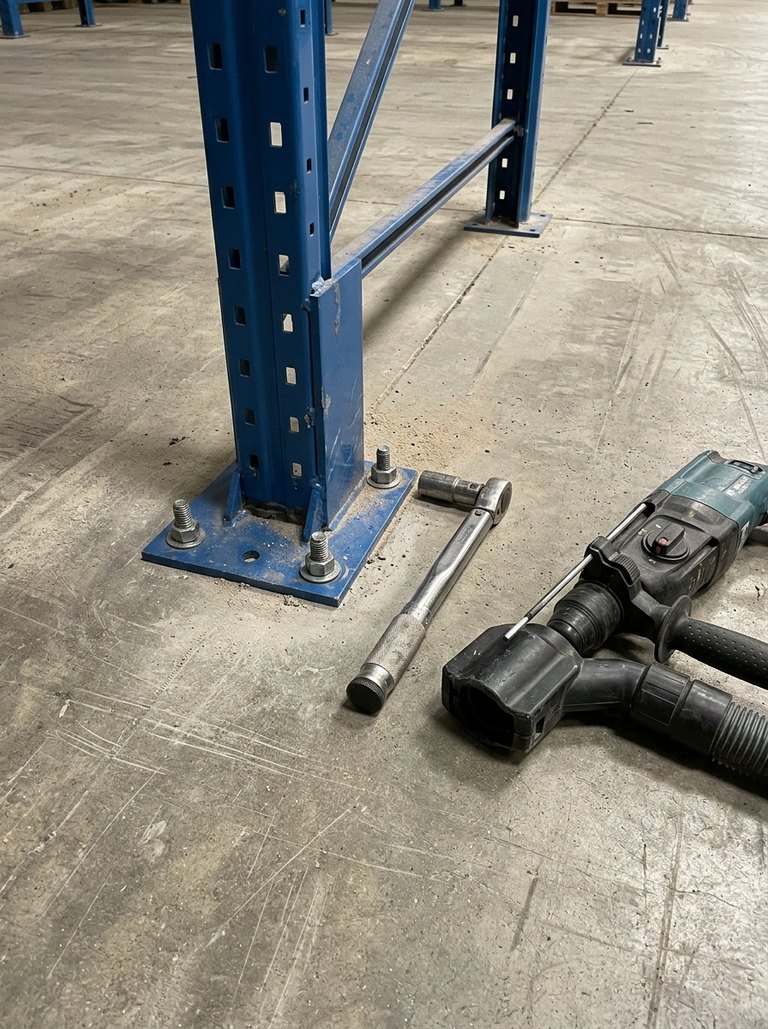
- Power tools and work equipment: Floor anchor drilling at every frame foot; torque wrenches at the anchors and beam locks
- What could happen, and to whom
- SDS rotary hammer drills kicking back or snagging when drilling 12 mm holes in the slab, flying concrete chips, and strained wrists from the torque wrench. The person drilling and whoever is holding the frame foot.
- Controls ticked
- Guards in place and checked before each use
- Faulty equipment taken out of use at once and labelled
- Users trained and, where a card applies, holding it
- Inspection and test records in date for the equipment on this job
- Eye and hearing protection worn for cutting, grinding and drilling
- How they apply on this job
- Two 110 V SDS drills off the client's 110 V transformer at the dock, with side handles fitted and the drills, leads and transformer PAT tested in October 2026 (labels on the tools, register in the van). A. Hussain and K. Osei do the drilling and both are trained on the drills; A. Hussain holds Abrasive wheels in case any slab cutting is needed, which is not planned. A drill that jams, overheats or has a damaged lead is unplugged, labelled 'Do not use' and swapped for the spare in the van. Torque wrenches are calibrated (certificates dated August 2026) and set to the anchor and beam lock values on the drawing. Eye protection and hearing protection worn by the driller and the person holding the frame foot, and the extraction shroud stays on the drill.
- Risk with these controls (likelihood x severity)
- 3 x 3 = 9 (Medium)
- Further action
- PAT labels and torque wrench calibration certificates checked by P. Danvers at the step 1 hold point and photographed into this RAMS. Owner: P. Danvers.
- Residual risk
- 1 x 3 = 3 (Low)
A fictional job, filled in as a worked example. The form and the report are real.
Power tools and work equipment: common questions
Do workers' own tools count as work equipment?
Yes. HSE says the regulations cover equipment employees provide for their own use at work, not just what the company owns. A personal drill or saw brought onto the job needs the same checks, inspection and suitability as the company's kit. The RAMS should say whose tools are being used and how they were checked.
How often do power tools need to be inspected?
PUWER does not set a fixed interval. Equipment must be inspected where its safety depends on how it was installed, and at suitable intervals where it is exposed to conditions that cause deterioration, such as a site tool used outdoors every day. A quick check of the cable, plug and casing before each use is part of it. Formal inspections are recorded and the record kept at least until the next one.
Who can inspect work equipment?
HSE says a competent person is anyone with enough knowledge and experience of the equipment to know what to look at, what to look for and what to do about a problem. For simple tools that can be a trained supervisor. For complex machinery it may need a specialist. The worked example on this page names the supervisor who checks the test labels before work starts.
What should happen to a tool that is found faulty?
Take it out of use at once, label it so nobody picks it up again, and swap it for a working spare or get it repaired by someone competent. The regulations require equipment to be kept in efficient order and good repair, and a tool with a damaged lead or a missing guard is neither. The RAMS should say where the spare is and who the fault is reported to.
Last updated . See every hazard in the library.
Write the RAMS with these controls already listed.
Pick the hazard, tick its controls, score it and brief the crew, on a phone or laptop. The report goes to the client as one PDF.