Hazards and control measures
Electrical hazards and control measures
The electrical hazards at work: shock, burns, arc flash and fire. Who gets hurt and how, and the control measures HSE expects, from working dead with safe isolation and proving dead to 110 V tools on site and live work only when it is justified. With a worked example from a completed RAMS.
What are the main electrical hazards at work?
The main electrical hazards are electric shock, burns from current or from an arc flash, and fire or explosion started by arcing or overheated equipment. HSE says most electrical accidents happen because people work on equipment they think is dead but is live, or on live equipment without the training, tools or precautions to do it safely. The Electricity at Work Regulations 1989 expect work to be done dead, with the supply isolated, locked off and proved dead, and allow live work only when all three conditions in regulation 14 are met.
Last updated . Facts checked by the SiteSurvey team on 24 October 2026 against HSE: Electrical injuries, HSE: Electricity at work: Safe working practices (HSG85), HSE: Memorandum of guidance on the Electricity at Work Regulations 1989 (HSR25) and HSE: Fatal injuries by kind of accident (RIDDOR tables).
What the hazard is and where it shows up
Electricity hurts people in four ways. Current through the body causes a shock that can stop the heart or breathing, and the muscle spasm can throw a person off a ladder or break bones. Current also burns the tissue it passes through, often deeply. A short circuit can cause an arc flash, which gives deep, slow-healing burns and can damage the eyes. And arcing, overheating or leakage current from faulty or overloaded equipment can start a fire or an explosion.
It is not only an electrician's hazard. The electrician changing a distribution board, the AV installer terminating in a live comms cabinet, the facilities engineer resetting a tripped circuit, the events crew running temporary power and the labourer with a damaged extension lead all meet it. So does anyone digging near a buried cable or working plant near overhead lines, which the library treats as separate hazards with their own controls.
Who is harmed, and how
HSE's RIDDOR tables record 5 workers killed by contact with electricity in Great Britain in 2025/26, a provisional figure, and 29 in the five years from 2021/22. Accidents involving shocks and burns that do not kill are reported to HSE every year as well.
HSE's guidance in HSG85 names the two causes behind most electrical accidents: people working on or near equipment they think is dead but which is live, and people working on equipment they know is live without the training, equipment or precautions to prevent injury. The first is a failure of isolation: the wrong circuit switched off, a second supply or backfeed nobody knew about, or a breaker someone switched back on. Labels can be wrong, which is why HSG85 says never to assume a circuit is dead until it has been proved dead at the point of work.
What the law expects
The Electricity at Work Regulations 1989 make dead working the default. Regulation 14 allows work on or near a live conductor only when it is unreasonable for it to be dead, reasonable for the person to work on it live, and suitable precautions are taken; if any one of the three fails, the work is done dead. Live testing counts as live work, and HSG85 says live working should rarely be permitted.
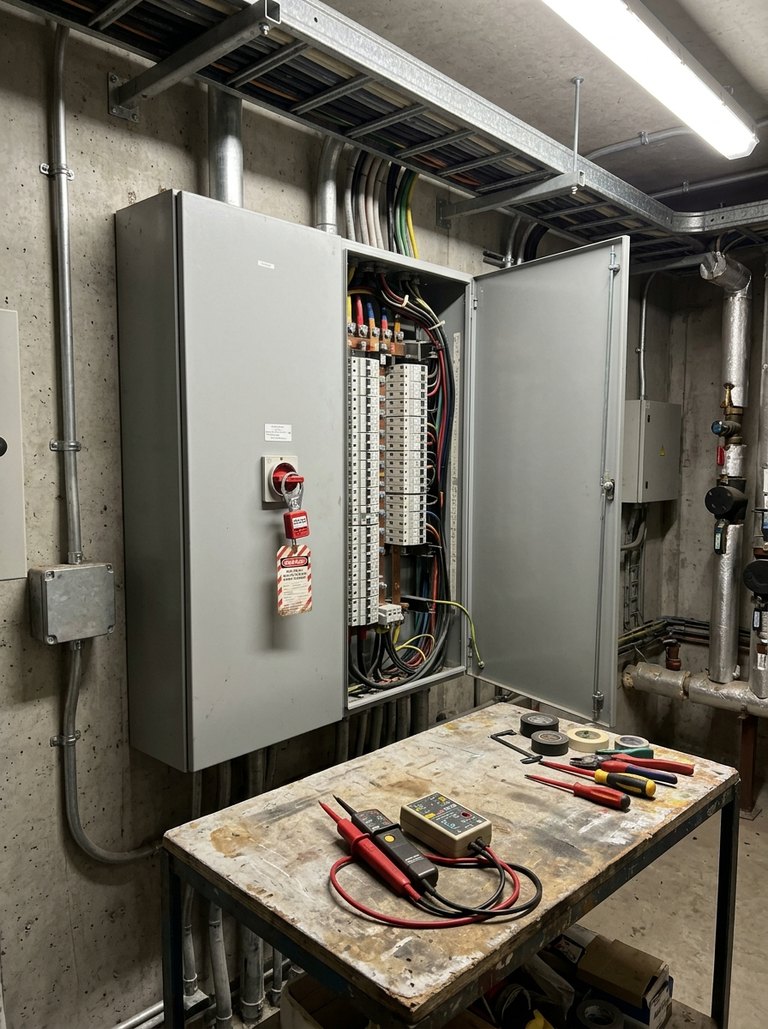
Safe isolation is how dead working is achieved. Identify the circuit, disconnect every source including any backfeed, lock the isolator off with a personal lock and keep the key, post a caution notice, then prove dead with a two-pole voltage indicator that is itself checked on a proving unit before and after the test. HSG85 advises against multimeters and non-contact testers for proving dead. Regulation 13 requires precautions so the equipment cannot become live again during the work.
Next come safer equipment and guarding. On construction sites, HSR25 points to reduced voltage: 110 V centre tapped to earth gives 55 V to earth on single-phase tools, and cordless tools remove the lead altogether. Where 230 V is used, a 30 mA RCD adds protection but is not the only measure, and it should be tested with its trip button. Adjacent live parts are screened, and where live work is justified it is done with insulated tools, fused test leads, a competent person accompanying, and insulating gloves and face protection. Regulation 16 requires the people doing the work to be competent or supervised. The RAMS template records the supply, whether an RCD is in use and whether any work is live, and the Suggested controls list puts isolation first and PPE last.
Suggested controls
Electrical hazards: control measures, most effective first
These are the 6 controls the SiteSurvey RAMS and risk assessment forms offer for this hazard as a tick list, grouped by their level in the hierarchy of controls. They are a starting point from HSE guidance, not an assessment of your job: tick what applies and say how it works on your site. If only personal protective equipment is ticked, the form says so. How suggested controls work and the hierarchy of controls explained.
Take the hazard away altogether, usually by doing the job a different way or from a different place.
- Supply isolated, locked off and proved dead before work starts
Swap the hazard for something less harmful: a quieter tool, a cold-applied method, a smaller pack.
- Battery tools, or 110 V centre tapped to earth on construction sites
Keep people away from the hazard with a physical measure: a guardrail, a barrier, extraction, isolation.
- 230 V equipment on an RCD, with leads and plugs checked before use
Change the way the work is done: a permit, a check, training, supervision, timing.
- Live work only where working dead is unreasonable, with the justification recorded
- Insulated tools, test equipment proved before and after, and a second competent person present for live work
Protect the person as the last line: a harness, hard hat, gloves or respirator. Never the only control.
- Insulating gloves and eye protection for live testing
Offered to: Construction and building work, Electrical and M&E, AV, IT and data cabling installation, Facilities, cleaning and maintenance, Events, exhibitions and staging.
Try it
Build the controls for electrical hazards
Tick the controls you would put in place, see which levels of the hierarchy they reach, and score the risk before and after. Or fill in the example from a completed RAMS to see how one crew did it.
Interactive
Try it: electricity and live working
Works the same way as the RAMS form. Nothing you tick is saved or sent anywhere.
Your controls, by level
- Eliminatenot ticked
- Substitutenot ticked
- Engineeringnot ticked
- Adminnot ticked
- PPEnot ticked
Nothing ticked yet.
3. Score the risk with these controls
What the law says
- Electricity at Work Regulations 1989, regulations 4, 12 and 13
- Systems built, maintained and worked on so as to prevent danger, with suitable means to cut off the supply and isolate equipment, and precautions so equipment made dead cannot become charged during the work.
- Electricity at Work Regulations 1989, regulation 14
- No work on or near a live conductor unless it is unreasonable for it to be dead, reasonable to work on it live, and suitable precautions, including protective equipment, are taken.
- Electricity at Work Regulations 1989, regulation 16
- Nobody does work that needs technical knowledge or experience to prevent danger unless they have it or are suitably supervised.
- Management of Health and Safety at Work Regulations 1999, regulation 3
- The suitable and sufficient risk assessment that identifies the electrical work and the controls, including the decision to work dead or live.
Worked example
Electrical hazards in a completed RAMS
The hazard entry exactly as it was recorded in one of our completed example RAMS: the controls ticked from the list, how they apply on that job, and the score before and after the further action.
Electrical and M&E
Calverley House, Leeds: plant room distribution board and sub-mains replacement
- Hazard
- Electricity and live working: Plant room: the tenant main switch and board, the adjacent live landlord's board, and the riser
- What could happen, and to whom
- Electric shock, arc flash and burns from the 400 A three-phase supply while stripping the old board and terminating the new one, from the landlord's board 1.2 m away which stays live, from a backfeed through the floor 3 tenant UPS, and during the live tests after re-energising. The two electricians, and the apprentice if he strays past the barrier.
- Controls ticked
- Supply isolated, locked off and proved dead before work starts
- Live work only where working dead is unreasonable, with the justification recorded
- 230 V equipment on an RCD, with leads and plugs checked before use
- Insulated tools, test equipment proved before and after, and a second competent person present for live work
- Insulating gloves and eye protection for live testing
- How they apply on this job
- The network operator withdraws the cut-out fuses for the tenant service at 08:00 on the Sunday (their job reference is on the permit) and keeps them until A. Whitfield asks for them back on the Monday. The tenant main switch is then opened, locked off with A. Whitfield's personal lock and tagged, and the floor 3 UPS output breaker and bypass are opened and locked off with a second lock so nothing can backfeed the sub-mains. Dead is proved at the incoming terminals and at every floor board with a GS38 two-pole voltage indicator, checked on a proving unit before and after each test, witnessed by K. Dhillon and signed on the permit to work. The landlord's board stays live: it is screened with a rigid insulating sheet, taped off and labelled LIVE, and no tray or cable is routed within 300 mm of it. Live work is limited to proving dead and the live tests at step 7 (Ze, PFC, Zs, RCD and polarity): it is unreasonable to make those tests dead, so they are done by A. Whitfield with K. Dhillon present and the apprentice outside the barrier, using GS38 fused leads, insulated tools, class 0 insulating gloves and a face shield, with covers and barriers on everything except the terminals under test. Hand tools are cordless; the only 230 V equipment is the temporary LED lighting and the battery chargers, plugged into the landlord's socket in the corridor through a 30 mA RCD adaptor that is tested before use each day.
- Risk with these controls (likelihood x severity)
- 3 x 5 = 15 (High)
- Further action
- Isolation confirmed in writing by the network operator for 08:00 Sunday 15 November. Two locks and tags (main switch and UPS bypass) on and the prove-dead witnessed and signed on the permit before any cover comes off. Live tests only at step 7 with both electricians present, the apprentice outside the barrier and the test leads, gloves and face shield checked beforehand. Owner: A. Whitfield.
- Residual risk
- 1 x 5 = 5 (Medium)
A fictional job, filled in as a worked example. The form and the report are real.
It also appears in led display and speakers in a school hall, outdoor stage and rig for a christmas lights switch-on, pump replacement in a foul water chamber and welding heating pipework in a hospital plant room. All eleven completed RAMS.
Electrical hazards: common questions
When is live working allowed?
Only when all three conditions in regulation 14 are met: it is unreasonable for the equipment to be dead, it is reasonable to work on it live, and suitable precautions are in place. Fault finding on a control system or live testing after a board change are typical examples, while saving time or avoiding a call to the client is not. Record the justification, keep the live part of the job as short as possible, and have a competent second person present. The worked example below limits live work to proving dead and the tests after re-energising.
What does proving dead involve?
Check the voltage indicator on a proving unit, test every conductor at the point of work, then check the indicator on the proving unit again. On three-phase equipment, or anything with more than one supply, every supply conductor has to be proved dead. HSG85 recommends a two-pole voltage indicator or test lamp with fused leads, not a multimeter or a non-contact tester. Only after that does a cover come off.
Do we have to use 110 V tools on a construction site?
HSE guidance in HSR25 points to reduced voltage for portable tools on construction sites, where leads get damaged and conditions are often wet. A 110 V supply centre tapped to earth limits the voltage to earth to 55 V on single-phase tools. Cordless tools are a good alternative. Where 230 V cannot be avoided, use a 30 mA RCD as extra protection, test it with its button, and check leads and plugs before use.
Who can isolate a circuit?
Someone competent for that system, as regulation 16 requires: they know the installation, can identify every source of supply and have the right lock and test equipment. Each person working on the circuit should fit their own lock and keep the key, using a multi-lock hasp where several people are working. The person who isolated should also be the one to remove their lock. If the circuit cannot be positively identified, stop and find out before going further.
Last updated . See every hazard in the library.
Write the RAMS with these controls already listed.
Pick the hazard, tick its controls, score it and brief the crew, on a phone or laptop. The report goes to the client as one PDF.