Hazards and control measures
Hot work hazards and control measures
The hazards of hot work, from welding, cutting and grinding to torch-on roofing: fires that start hours after the job, and welding fume. Who gets hurt and the control measures HSE expects, from cold methods first to a permit, a fire watch and fume extraction.
What are the main hazards of hot work?
Hot work is any process that generates flame, sparks or heat, such as welding, flame cutting, grinding metal, torch-applied roofing and soldering. The main hazards are a fire started by sparks, slag or heat reaching something combustible, often smouldering unseen for some time after the work stops, and the fume from welding, which HSE says can cause lung cancer. HSE expects hot work to be designed out or replaced with a cold method where possible, and otherwise controlled by a permit, cleared or protected combustibles, extinguishers at the work and a fire watch that continues after the job ends.
Last updated . Facts checked by the SiteSurvey team on 24 October 2026 against HSE: Fire safety in construction (HSG168), HSE: Safety risks from welding, HSE: Health risks from welding and HSE: Controlling the risks from welding.
What counts as hot work
HSE's construction fire guidance, HSG168, defines hot work as any process that generates flame, sparks or heat. That covers oxy-fuel heating, cutting and welding, grinding and cutting metal, torch-applied roofing, heat guns and soldering irons. Pipefitters, steel erectors, roofers, plumbers, maintenance engineers and electricians all do it, often in someone else's building and often for only a few minutes.
The danger is rarely the flame itself. It is the spark that drops through a gap in the floor, the slag that lands in packaging, or the heat conducted along a pipe into insulation behind a wall. HSE's welding guidance says heat, sparks and drips of metal and slag can travel a considerable distance and start fires in adjacent rooms. HSG168 warns that even minor hot work near combustible material could have catastrophic consequences, and that some materials smoulder for a long time before they ignite. That is why so many hot work fires start after the crew has gone. For the wider picture of ignition sources and fuel on site, see fire hazards.
Who is harmed, and how
HSE estimates that hundreds of fires happen on construction sites every year, putting both workers and the public at risk. Hot work puts the person on the torch at risk of burns, but a fire in a roof void, a plant room or an occupied building can reach far more people: other trades on the floor above, residents, patients or shoppers who have no idea work is going on.
Welding brings a second hazard that does not depend on a fire at all. HSE says all welding fume can cause lung cancer and is classed as a Group 1 carcinogen. Welders are also at greater risk of pneumonia, which kills about two welders a year, and HSE estimates that breathing metal fume at work leads to 40 to 50 welders being hospitalised each year.
What the law expects
The order of controls is clear in HSG168. First design hot work out and use a cold method instead: mechanical cutting, a bolted or pressed joint, a cold-applied roof system. Where heat is still needed, an electrically powered torch or heat gun is preferred to a naked flame. Where hot work cannot be avoided, it is controlled through a permit-to-work system, with no blanket authorisation for anywhere on site at any time. Loose combustibles are removed from below the work and behind the wall, anything that cannot move is protected with non-combustible board, and at least two suitable extinguishers sit within reach. If the fire alarm has to be isolated, there is a firm plan to reinstate it.
The fire watch is where most jobs fall short. HSG168 asks for a careful watch during the work and through breaks, a continuous watch for at least an hour after it ends, then a further check two hours after it ends, with hot work finished two hours before the end of the day. For fume, HSE expects extraction at source where possible and suitable respiratory protection where extraction is not enough, including all outdoor welding. In SiteSurvey, the RAMS template has a permits page that records the hot works permit reference, and the Suggested controls list puts the cold method ahead of extinguishers and flame resistant clothing.
Suggested controls
Hot works: control measures, most effective first
These are the 7 controls the SiteSurvey RAMS and risk assessment forms offer for this hazard as a tick list, grouped by their level in the hierarchy of controls. They are a starting point from HSE guidance, not an assessment of your job: tick what applies and say how it works on your site. If only personal protective equipment is ticked, the form says so. How suggested controls work and the hierarchy of controls explained.
Swap the hazard for something less harmful: a quieter tool, a cold-applied method, a smaller pack.
- Cold-applied or mechanical method used where it does the job
Keep people away from the hazard with a physical measure: a guardrail, a barrier, extraction, isolation.
- Extinguishers and a fire blanket at the work before the torch is lit
- Gas cylinders upright, secured, leak checked and shut off at the end of the shift
Change the way the work is done: a permit, a check, training, supervision, timing.
- Hot works permit issued for each day and closed at the end
- Combustibles moved or covered within the permit distance
- Fire watch during the work and for the time the permit says afterwards
Protect the person as the last line: a harness, hard hat, gloves or respirator. Never the only control.
- Flame resistant clothing and gloves for the person on the torch
Offered to: Construction and building work, Electrical and M&E, Roofing, scaffolding and work at height, Facilities, cleaning and maintenance.
Try it
Build the controls for hot works
Tick the controls you would put in place, see which levels of the hierarchy they reach, and score the risk before and after. Or fill in the example from a completed RAMS to see how one crew did it.
Interactive
Try it: hot works
Works the same way as the RAMS form. Nothing you tick is saved or sent anywhere.
Your controls, by level
- Eliminateno control at this level for this hazard
- Substitutenot ticked
- Engineeringnot ticked
- Adminnot ticked
- PPEnot ticked
Nothing ticked yet.
3. Score the risk with these controls
What the law says
- Regulatory Reform (Fire Safety) Order 2005, article 9
- The responsible person makes a suitable and sufficient assessment of fire risks to identify the general fire precautions needed, including the risk from hot work brought into the premises.
- HSG168: Fire safety in construction
- HSE guidance on designing out hot work, permit-to-work systems, clearing combustibles, extinguishers and the fire watch after the work ends.
- Management of Health and Safety at Work Regulations 1999, regulation 3
- The suitable and sufficient risk assessment that identifies the hot work, the fire risk and the fume, and the controls.
Worked example
Hot works in a completed RAMS
The hazard entry exactly as it was recorded in one of our completed example RAMS: the controls ticked from the list, how they apply on that job, and the score before and after the further action.
Electrical and M&E
Wheatstone Outpatients Building: plant room heating pipework repair
- Hazard
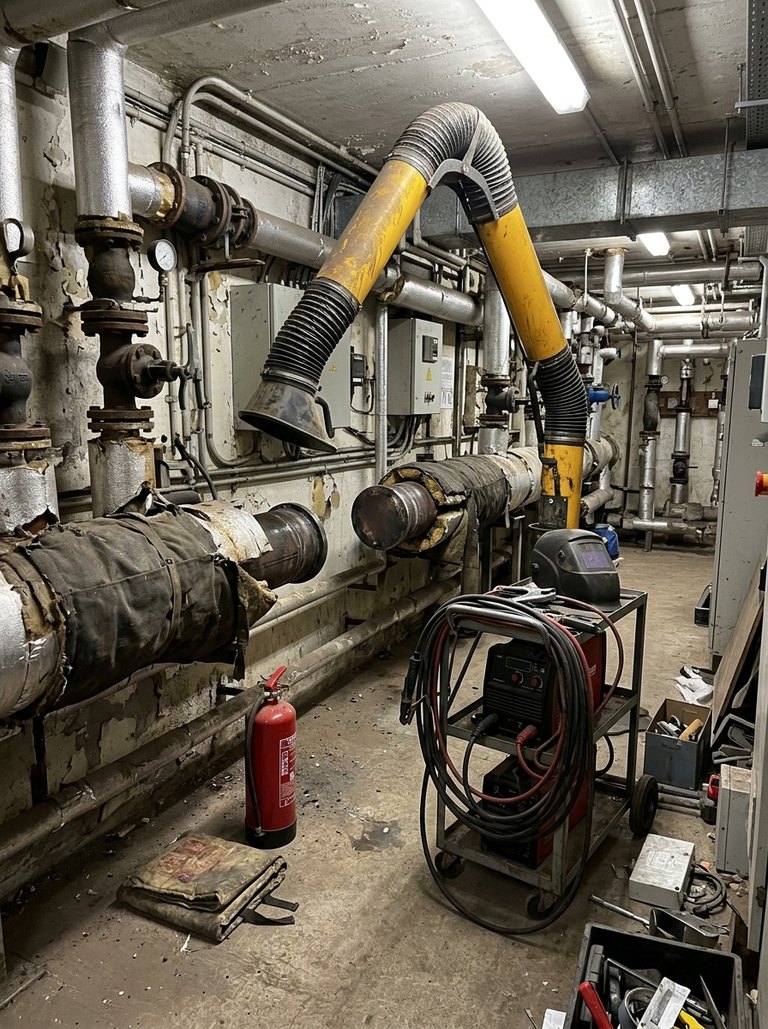
- Hot works: The four butt welds and the grinding on the flow and return, between the pump headers and the riser
- What could happen, and to whom
- Welding arc, spatter and grinding sparks landing on the remaining pipe insulation, the cable trays and containment 1.5 m above the return, the pump motor cables and stored items in the plant room. Fire in a hospital basement under occupied clinics, and burns to the welder. The crew, estates staff and the building occupants.
- Controls ticked
- Hot works permit issued for each day and closed at the end
- Combustibles moved or covered within the permit distance
- Extinguishers and a fire blanket at the work before the torch is lit
- Fire watch during the work and for the time the permit says afterwards
- Flame resistant clothing and gloves for the person on the torch
- How they apply on this job
- A hot works permit is issued by the estates duty officer at 07:30 each day and closed after the fire watch. Before the permit is signed: all stored items are out of the room, the insulation is stripped back 1 m beyond each weld, the cable trays and pump cables are covered with fire blankets, and the floor under each weld is swept. Two 6 litre foam extinguishers, one 2 kg CO2 and a welding blanket are at the weld before the arc is struck. Welding and grinding by P. Marsh and K. Dunne only. L. Obi and K. Dunne keep a fire watch during welding and P. Marsh for 60 minutes after the last weld, logged on the permit. The hospital fire detectors in the plant room are isolated by estates for the permit period and reinstated before the fire watch ends; detectors outside the room stay live. A grooved mechanical coupling was considered and rejected because the system specification is welded steel and the client requires welded joints.
- Risk with these controls (likelihood x severity)
- 3 x 5 = 15 (High)
- Further action
- Permit HW-WOB-2026-114-01 and -02 issued each morning and checked at the step 1 and step 4 hold points. Fire blankets over the cable trays and the fire point photographed before the first weld each day. Owner: P. Marsh with the estates duty officer.
- Residual risk
- 1 x 5 = 5 (Medium)
A fictional job, filled in as a worked example. The form and the report are real.
It also appears in felt roof renewal on a school sports hall. All eleven completed RAMS.
Hot works: common questions
How long should a fire watch last after hot work?
HSG168 asks for a continuous fire watch of the hot work area for at least an hour after the work ends, then at least one more check two hours after it ends. HSE's general welding guidance gives at least 30 minutes, extended to 60 where a fire would be hard to spot, so on a construction site the longer HSG168 watch is the one to plan for. That is why HSG168 says hot work should finish two hours before the end of the working day. In the worked example, the fire watch runs for 60 minutes after the last weld and is logged on the permit.
Does grinding count as hot work?
Yes. HSG168 lists grinding and cutting metal alongside welding, flame cutting, torch-applied roofing, heat guns and soldering irons, because each generates sparks or heat. An angle grinder throws sparks further than most people expect, so clear or cover combustibles in the spark path and check below gratings and floor gaps. A mechanical cutter or a saw that does not spark is a better choice where it does the job.
Can one permit cover all the hot work on a site for the week?
No. HSG168 says permits should not give blanket authorisation to carry out hot work anywhere on site at any time. A permit names the location and nature of the work, the time it is valid for and the precautions before, during and after, and only someone with assigned authority issues and closes it. On a multi-day job, issue a new permit each day and close it once the fire watch is complete.
Do we need fume control for welding outdoors?
Yes. HSE says extraction cannot be relied on to capture welding fume outdoors, so suitable respiratory protection is needed for outdoor welding. Indoors, local exhaust ventilation at the weld is the first choice, with respiratory protection where extraction alone does not give adequate control. HSE says all welding fume can cause lung cancer, so the metal being welded changes the level of control, not whether control is needed.
Last updated . See every hazard in the library.
Write the RAMS with these controls already listed.
Pick the hazard, tick its controls, score it and brief the crew, on a phone or laptop. The report goes to the client as one PDF.