Hazards and control measures
Confined space hazards and control measures
What makes a space confined, examples from sewers and tanks to ducts and plant rooms, the hazards of gas, low oxygen, flooding and heat, why rescuers die, and the control measures the Confined Spaces Regulations 1997 expect. With a worked example from a completed RAMS.
What are the main hazards in a confined space?
A confined space is a substantially enclosed place, such as a chamber, tank, sewer, silo or duct, where the enclosure creates a reasonably foreseeable risk of serious injury from fire or explosion, loss of consciousness from gas, fumes, lack of oxygen or heat, drowning, or being buried in a free-flowing solid. Those killed include the people working inside and the people who go in to rescue them without training or equipment. The Confined Spaces Regulations 1997 expect you to avoid entry where you can, follow a safe system of work where you cannot, and have the rescue arrangements ready before anyone goes in.
Last updated . Facts checked by the SiteSurvey team on 24 October 2026 against The Confined Spaces Regulations 1997, HSE L101: Safe work in confined spaces, Approved Code of Practice and HSE INDG258: Confined spaces, a brief guide to working safely.
What makes a space confined
Two things together make a confined space in law: the place is substantially enclosed, and because of that enclosure there is a reasonably foreseeable specified risk. The specified risks are serious injury from fire or explosion, loss of consciousness from a rise in body temperature, loss of consciousness or asphyxiation from gas, fume, vapour or lack of oxygen, drowning from a rising liquid, and asphyxiation or entrapment in a free-flowing solid. A cramped loft, ceiling void or cellar with none of those risks is not a confined space under the regulations, though it still needs assessing.
Some examples are obvious: storage tanks, silos, sewers, enclosed drains, chambers and manholes. Others are easy to miss: open-topped chambers, vats, ductwork, trenches, sumps, inspection pits, building voids, plant rooms and unventilated or poorly ventilated rooms. A space can also become confined because of the work, for example when welding or solvent use fills it with fume.
Who is harmed, and how
The atmosphere is the main killer. Gas builds up in sewers and manholes, enters tanks from connecting pipes, or is released when sludge is disturbed. Oxygen is used up by rusting steel, grain or soil, or pushed out by carbon dioxide or an inert purge. HSE's code of practice warns that even a small fall from the normal 20.9% oxygen impairs judgement, that below 16% people lose consciousness and die, and that there is usually no warning, even with only a head inside the space. Too much oxygen is as dangerous, because it makes clothing and grease burn fiercely, which is why the air must never be sweetened with oxygen.
Water can rise after heavy rain upstream or from a pipe that was not isolated, and drowning can happen in a small depth. Grain, sugar, flour and sand can bridge in a silo and collapse without warning. Heat, strenuous work and protective suits together can cause heat stroke. HSE says those killed include the people working in the space and those who try to rescue them without proper training and equipment. Would-be rescuers die because they meet the same gas or low oxygen that took the first person down.
What the law expects
The Confined Spaces Regulations 1997 set an order. First avoid entry: do the work from outside, with remote cameras for inspection, tools used through the opening, or a remote flail to clear a silo, or change the space so nobody needs to go in. Where entry cannot be avoided, follow a safe system of work: a supervisor, competent and suitable people, mechanical, electrical and pipe isolation checked as effective, cleaning, an entrance big enough to get out of in an emergency, ventilation, and the air tested by a competent person before entry and monitored where it may change. A permit to work is the formal check that all of that is in place. Breathing apparatus is the last line where the air cannot be made fit to breathe.
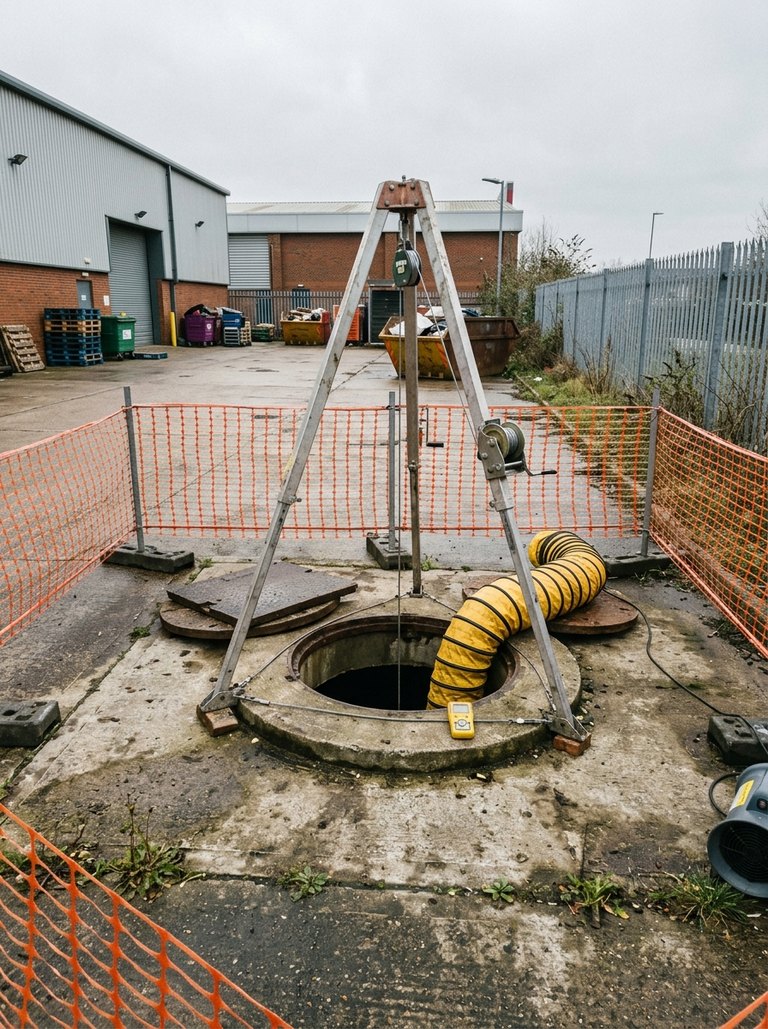
Before anyone enters, the rescue arrangements must be ready: the equipment, the trained people, a harness and lifeline running back outside the space, a person outside to keep watch and raise the alarm, and resuscitation equipment where it may be needed. HSE says you should not rely on the public emergency services. In SiteSurvey, the RAMS template asks whether the work can be done without entering the confined space and records the permit to work reference, and the Suggested controls list follows the same order.
Suggested controls
Confined spaces: control measures, most effective first
These are the 6 controls the SiteSurvey RAMS and risk assessment forms offer for this hazard as a tick list, grouped by their level in the hierarchy of controls. They are a starting point from HSE guidance, not an assessment of your job: tick what applies and say how it works on your site. If only personal protective equipment is ticked, the form says so. How suggested controls work and the hierarchy of controls explained.
Take the hazard away altogether, usually by doing the job a different way or from a different place.
- Work done from outside the space wherever it can be
Keep people away from the hazard with a physical measure: a guardrail, a barrier, extraction, isolation.
- Atmosphere tested before entry and monitored during the work
- Forced ventilation while anyone is inside
Change the way the work is done: a permit, a check, training, supervision, timing.
- Confined space permit and safe system of work before entry
- Trained entrants, a top person at the entry and rescue arrangements ready before entry
Protect the person as the last line: a harness, hard hat, gloves or respirator. Never the only control.
- Escape breathing apparatus and harness with retrieval line
Offered to: Construction and building work, Electrical and M&E, Facilities, cleaning and maintenance.
Try it
Build the controls for confined spaces
Tick the controls you would put in place, see which levels of the hierarchy they reach, and score the risk before and after. Or fill in the example from a completed RAMS to see how one crew did it.
Interactive
Try it: confined spaces
Works the same way as the RAMS form. Nothing you tick is saved or sent anywhere.
Your controls, by level
- Eliminatenot ticked
- Substituteno control at this level for this hazard
- Engineeringnot ticked
- Adminnot ticked
- PPEnot ticked
Nothing ticked yet.
3. Score the risk with these controls
What the law says
- Confined Spaces Regulations 1997, regulation 1
- Defines a confined space as an enclosed place where a reasonably foreseeable specified risk arises, and lists the specified risks.
- Confined Spaces Regulations 1997, regulation 4
- No entry where the work can reasonably be done another way, and where entry is needed, entry, work and exit only under a safe system of work.
- Confined Spaces Regulations 1997, regulation 5
- Suitable and sufficient rescue arrangements, including protecting the rescuers and providing resuscitation equipment where needed, in place before anyone enters.
- Management of Health and Safety at Work Regulations 1999, regulation 3
- The suitable and sufficient risk assessment that decides whether the space is confined and what precautions the work needs.
Worked example
Confined spaces in a completed RAMS
The hazard entry exactly as it was recorded in one of our completed example RAMS: the controls ticked from the list, how they apply on that job, and the score before and after the further action.
Facilities, cleaning and maintenance
Kingsmead Gate Retail Park: foul pump chamber pump replacement
- Hazard
- Confined spaces: Inside pump chamber PS1, 3 m deep, 1.8 m diameter, single top entry
- What could happen, and to whom
- Loss of consciousness or death from hydrogen sulphide or low oxygen in the chamber, drowning if the level rises while someone is inside, and an entrant trapped or injured where a rescue from the top is the only way out. The entrant and the standby, and anyone who goes in after them.
- Controls ticked
- Confined space permit and safe system of work before entry
- Atmosphere tested before entry and monitored during the work
- Forced ventilation while anyone is inside
- Trained entrants, a top person at the entry and rescue arrangements ready before entry
- Escape breathing apparatus and harness with retrieval line
- How they apply on this job
- Entry cannot be avoided: the lower guide rail bracket has sheared, so pump 1 will not lift out on the rails and has to be freed by hand at the bottom of the chamber. Confined space permit CS-RPS-118 is issued by K. Dunmore and signed before the cover comes off. Both pumps are isolated, the inlet penstock is closed and the chamber is pumped down by the tanker before entry, so there is no inflow while anyone is inside. The atmosphere is tested from the top with a four-gas monitor at three depths before entry, and the entrant wears a second monitor throughout. The battery blower runs from the moment the cover is lifted until the cover goes back on. P. Achebe enters on a full body harness clipped to the tripod winch retrieval line, with a 15 minute escape set on his hip. K. Dunmore is the top person and never leaves the entry while anyone is inside. L. Szabo is the standby, dressed and ready to enter only on K. Dunmore's instruction and only on the second line. The rescue drill is walked through before the first entry.
- Risk with these controls (likelihood x severity)
- 4 x 5 = 20 (High)
- Further action
- Gas test clear at all three depths, blower running and the rescue drill walked through are a hold point on step 3. Permit CS-RPS-118 countersigned by K. Dunmore before anyone enters. Entry stopped and everyone out if the monitor alarms, the level rises, or the blower stops. Owner: K. Dunmore.
- Residual risk
- 2 x 5 = 10 (Medium)
A fictional job, filled in as a worked example. The form and the report are real.
Confined spaces: common questions
Is a loft, ceiling void or cellar a confined space?
Not just because it is cramped. HSE's code of practice says these places are only confined spaces under the regulations if they are enclosed and one of the specified risks is present or foreseeable, such as gas, low oxygen or rising water. A cramped void still needs a risk assessment for things like manual handling and how an injured person would be got out. The same space can become confined if the work brings in fume, heat or a gas cylinder.
Can we make the air safe by adding oxygen?
No. HSE says never to sweeten the air in a confined space with oxygen, because enriched air makes clothing, grease and other materials far easier to ignite. Use mechanical ventilation that draws fresh air from a clean point, then test the atmosphere again. Petrol engines should never be used in a confined space because of the carbon monoxide in their exhaust.
Who should do the rescue if something goes wrong?
Your own trained rescuers, ready at the entry before anyone goes in. The regulations require rescue arrangements that protect the rescuers, and HSE says you should not rely on the public emergency services. Untrained colleagues who go in to help are among those killed, so the person outside keeps watch, raises the alarm and starts the rescue without entering. The confined space rescue plan template records who does what and with which equipment.
Do we always need a permit to work?
HSE treats a permit as the formal check that every part of the safe system, such as isolation, air testing and the emergency arrangements, is in place before entry. HSE's code of practice says a permit is usually required where there is a reasonably foreseeable risk of serious injury in entering or working in the space, and that it supports the safe system rather than replacing it. It says who can authorise the entry, includes contractors, and should be monitored to make sure it works. The RAMS template records the permit reference alongside the method.
Last updated . See every hazard in the library.
Write the RAMS with these controls already listed.
Pick the hazard, tick its controls, score it and brief the crew, on a phone or laptop. The report goes to the client as one PDF.