Hazards and control measures
Chainsaw hazards and control measures
The hazards of chainsaw work and tree felling, from kickback and chain contact to falling timber, noise and vibration, who gets hurt and how, and the control measures HSE expects: trained and certificated users, checked saws, planned felling, exclusion zones and chainsaw PPE.
What are the main hazards of using a chainsaw?
The main chainsaw hazards are cuts from the moving chain, kickback throwing the bar up and back towards the operator's face and upper body, falling trees and timber, and long term harm from noise and hand-arm vibration. HSE says direct contact with a chainsaw has caused many deaths and serious injuries in forestry and arboriculture, most of them where operators took shortcuts. The control measures are trained and certificated users, a saw with a working chain brake checked every day, planned felling with escape routes and an exclusion zone, and chainsaw PPE as the last line of defence.
Last updated . Facts checked by the SiteSurvey team on 24 October 2026 against HSE: Working with chainsaws, HSE: Chainsaws at work (INDG317), Provision and Use of Work Equipment Regulations 1998, regulation 9 and HSE: Extended scope of the Personal Protective Equipment at Work Regulations.
What counts as a chainsaw hazard
A chainsaw hazard is anything in the job that can bring a person into contact with the chain, or put them in the path of what the saw has cut. Arborists and forestry workers face it every day, but so do grounds teams clearing storm damage, farmers hedging and clearing fallen branches, and site crews cutting back vegetation before a build. The saw itself is only part of it. Tree felling hazards include rot, a lean or uneven growth that changes the direction of fall, broken crowns and hung up branches, a tree hung up on its neighbour, overhead lines and buried services.
Kickback is the one that catches people out. HSE describes it as the sudden, uncontrolled upward and backward movement of the chain and guide bar towards the operator, which happens when the chain at the nose of the bar touches an object. A chain brake and a low kickback chain reduce the effect but cannot prevent it. Top-handled saws add their own risk: they are only suitable for trained arborists working off the ground, never as a small saw for ground work.
Who is harmed, and how
HSE says direct contact with a chainsaw has caused many deaths and serious injuries in forestry and arboriculture, and that most fatal and major injuries involve operators taking shortcuts, usually to save time. Kickback accounts for a significant proportion of chainsaw injuries, many of them to the face and upper body where protective clothing struggles to help. The groundsman under the crown is at risk from falling sections, and anyone on a road or footpath within twice the height of a tree being felled is inside the danger zone.
The harm is not only sudden. Chainsaws expose operators to high levels of noise and hand-arm vibration, which can lead to hearing loss and vibration white finger. Experience matters too: HSE warns that holders of the basic CS30 and CS31 awards with little further experience can quickly find themselves outside their skill base on large or awkward fells, especially in gardens.
What the law expects
Regulation 9 of the Provision and Use of Work Equipment Regulations 1998 requires employers to make sure everyone who uses or supervises work equipment has adequate training. For tree work, HSE's Approved Code of Practice sets the minimum: before using a chainsaw on or in a tree, a worker should hold a relevant certificate of competence or national competence award, unless they are in training and adequately supervised. Then follow the hierarchy. Avoid the cut where you can, for example with a MEWP or machine instead of a climber with a saw. Choose the shortest guide bar suitable for the work, and check the chain brake, chain catcher and stop switch before use and through the day. Plan the fell, the escape routes and the emergency arrangements, keep everyone else outside an exclusion zone, and avoid working alone. HSE also says to avoid using a chainsaw from a ladder.
Chainsaw PPE comes last because HSE is clear that no protective equipment gives 100% protection against a hand-held chainsaw. Since 6 April 2022 the duty to provide suitable PPE free of charge covers limb (b) workers as well as employees. If the job is in or near a tree, see work at height hazards. In SiteSurvey, the RAMS template records the saw controls for each hazard and warns when only PPE is ticked, and the Suggested controls list follows the same order.
Suggested controls
Chainsaws and cutting equipment: control measures, most effective first
These are the 5 controls the SiteSurvey RAMS and risk assessment forms offer for this hazard as a tick list, grouped by their level in the hierarchy of controls. They are a starting point from HSE guidance, not an assessment of your job: tick what applies and say how it works on your site. If only personal protective equipment is ticked, the form says so. How suggested controls work and the hierarchy of controls explained.
Keep people away from the hazard with a physical measure: a guardrail, a barrier, extraction, isolation.
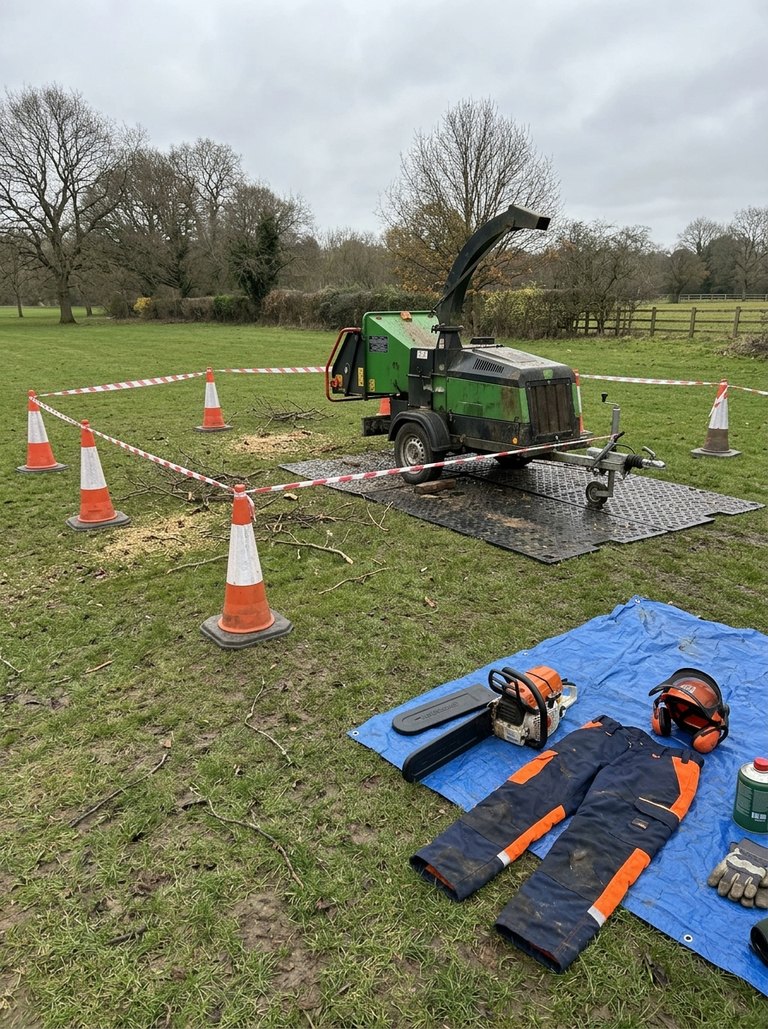
- Exclusion zone around the cutting and felling area
Change the way the work is done: a permit, a check, training, supervision, timing.
- Users trained and certificated for the saw and the task
- Chain brake, guards and stop control checked before each use
- Safe felling, snedding and cross-cutting methods used, no cutting above shoulder height
Protect the person as the last line: a harness, hard hat, gloves or respirator. Never the only control.
- Chainsaw trousers, boots, gloves and a helmet with visor and ear defenders worn
Offered to: Grounds, landscaping and tree work.
Try it
Build the controls for chainsaws and cutting equipment
Tick the controls you would put in place, see which levels of the hierarchy they reach, and score the risk before and after. Or fill in the example from a completed RAMS to see how one crew did it.
Interactive
Try it: chainsaws and cutting equipment
Works the same way as the RAMS form. Nothing you tick is saved or sent anywhere.
Your controls, by level
- Eliminateno control at this level for this hazard
- Substituteno control at this level for this hazard
- Engineeringnot ticked
- Adminnot ticked
- PPEnot ticked
Nothing ticked yet.
3. Score the risk with these controls
What the law says
- Provision and Use of Work Equipment Regulations 1998, regulation 9
- Everyone who uses, supervises or manages the use of work equipment must have adequate training in its use, the risks and the precautions; the supporting Code of Practice expects a certificate of competence for chainsaw work on or in trees.
- Personal Protective Equipment at Work Regulations 1992 (amended 2022), regulation 4
- Suitable PPE must be provided to workers exposed to a risk that has not been adequately controlled by other, equally or more effective means.
- Lifting Operations and Lifting Equipment Regulations 1998
- Apply to work off the ground that involves lifting and lowering people or loads, including rigging sections down and work positioning.
- Management of Health and Safety at Work Regulations 1999, regulation 3
- The suitable and sufficient risk assessment that covers the site, the task and the tree before any cutting starts.
Worked example
Chainsaws and cutting equipment in a completed RAMS
The hazard entry exactly as it was recorded in one of our completed example RAMS: the controls ticked from the list, how they apply on that job, and the score before and after the further action.
Grounds, landscaping and tree work
Kingsmere Primary School: storm-damaged ash dismantle
- Hazard
- Chainsaws and cutting equipment: Top-handled saw in the MEWP basket; two rear-handled saws on the ground
- What could happen, and to whom
- Cuts from the chain to the operator or the groundsmen, kickback when cutting under tension in split dieback timber, and the ground saws being used while sections are still coming down. The crew.
- Controls ticked
- Users trained and certificated for the saw and the task
- Chain brake, guards and stop control checked before each use
- Exclusion zone around the cutting and felling area
- Safe felling, snedding and cross-cutting methods used, no cutting above shoulder height
- Chainsaw trousers, boots, gloves and a helmet with visor and ear defenders worn
- How they apply on this job
- Only H. Prosser uses the top-handled saw and only from the MEWP basket, with the saw on a lanyard to the harness. The ground saws are used by C. Beddoes and A. Nowak, and never while a section is being lowered. Chain brakes, chain catchers, stop switches and chain tension are checked at the start of the day and after every refuel. Split and hung-up limbs are cut from the tension side first with a small bite, and the release cut is made with nobody in line. No cutting above shoulder height from the ground. The 15 m exclusion zone around the tree is for the three crew only.
- Risk with these controls (likelihood x severity)
- 3 x 4 = 12 (Medium)
- Further action
- Pre-use saw checks recorded on the plant sheet in the pickup. The hung-up limb on the north side is cut first in step 3 so the ground saws are not working under it. Owner: H. Prosser.
- Residual risk
- 1 x 4 = 4 (Low)
A fictional job, filled in as a worked example. The form and the report are real.
Chainsaws and cutting equipment: common questions
Does everyone who uses a chainsaw need a certificate?
For work on or in a tree, HSE's Code of Practice says the operator should hold a relevant certificate of competence or national competence award, unless they are in training and adequately supervised. There is a narrow exception in agriculture for occupiers and their employees doing agricultural work who used a chainsaw before 5 December 1998. Everyone else using a chainsaw at work, in any industry, must still be trained and competent under PUWER. HSE suggests refresher training every two to three years for occasional users and every five years for full time users.
What should be checked on a chainsaw before use?
INDG317 lists the on and off switch, chain brake, chain catcher, silencer, guide bar, drive sprocket and chain links, hand guards, anti-vibration mounts and the starter cord. Once the saw is running, the operator checks that the chain stops at idle, the chain brake works, the stop switch works and the bar and chain are being oiled. These checks are repeated at intervals through the day. In the worked example the crew repeats them after every refuel.
How far away should people be when a tree is felled?
HSE's felling guidance works in tree lengths. If roads or public rights of way are within twice the height of the tree, road users and the public must be kept out of the danger zone, using signs, diversions or traffic control. Overhead line owners within twice the tree height must be contacted before work starts and the precautions agreed. Fuel should be kept at least 4 m from the saw when it is started and used.
Can a chainsaw be used on your own?
HSE advises avoiding working alone with a chainsaw. Where it cannot be avoided, there must be a way to raise the alarm, such as regular radio or phone contact, site visits, a whistle, an automatic signalling device or an agreed return time. Anyone using a chainsaw should be trained in emergency first aid, especially controlling major bleeding, and carry a personal first aid kit with a large wound dressing.
Last updated . See every hazard in the library.
Write the RAMS with these controls already listed.
Pick the hazard, tick its controls, score it and brief the crew, on a phone or laptop. The report goes to the client as one PDF.