Walk the same route through the work area, stop where something needs attention or is working well, and leave with named actions instead of a page of ticks.
Hold to record. Keep holding while you film and speak; release to save the clip and its transcribed answer.
Four 9:16 example clips generated in Google Flow. Fictional inspection; no customer site is shown.
App-style example using Google Flow footage. The animated recording interface and gradually appearing words are scripted; no real inspection or live transcription took place.
The full visual example
Watch all four inspection points.
Each short clip shows one point in the guided route. The footage is AI-generated and the observations are scripted examples, not findings from a real inspection.
POINT 01
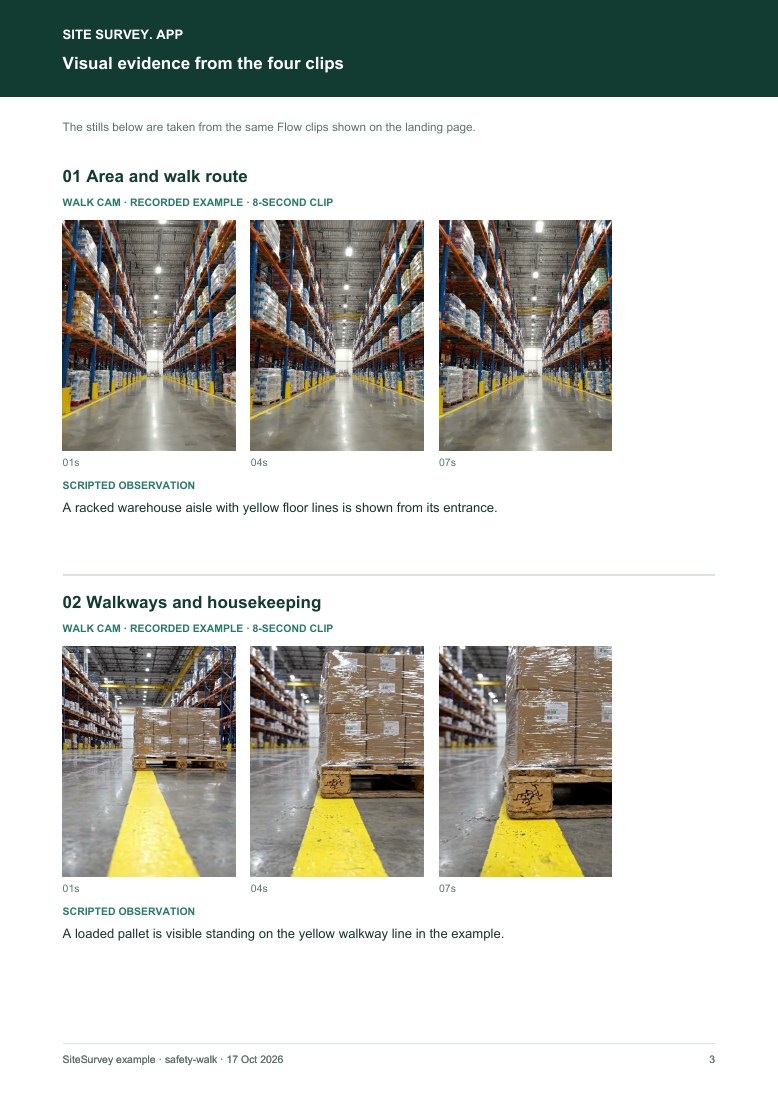
Area and walk route
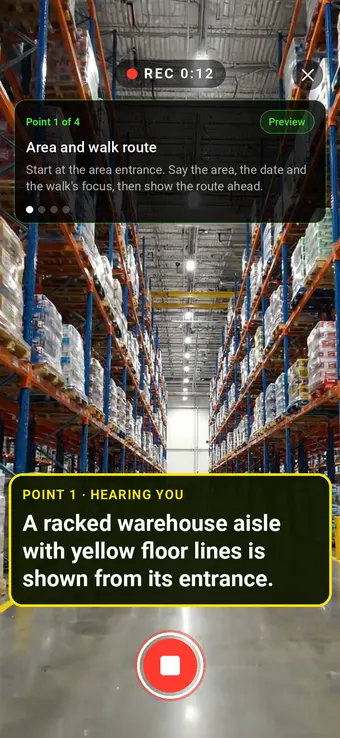
Start at the area entrance. Say the area, the date and the walk's focus, then show the route ahead.
A racked warehouse aisle with yellow floor lines is shown from its entrance.
POINT 02
Walkways and housekeeping
Film the walkway at walking pace and stop on anything that narrows or blocks it, keeping its position in frame.
A loaded pallet is visible standing on the yellow walkway line in the example.
POINT 03
Fire exit and emergency equipment
Show the exit, its sign and nearby equipment from the walkway without opening, moving or testing anything.
A fire exit sign, push-bar door and wall-mounted extinguisher are visible with a clear approach.
POINT 04
Areas not walked
End by recording any area the walk did not enter, such as a restricted zone or active loading area, and why.
A locked gate with an authorised access only sign closes the mezzanine stair, which was not climbed.
What can a safety walk visual inspection record?
Name the area, the date, who is walking and what the walk is focusing on. Follow a set route at walking pace, film anything that needs attention in its location, and talk to the people doing the work about how the job really runs. Record positive observations as well as concerns, and agree an owner and date for each action before you leave. The four AI-generated clips illustrate separate points on one route, not a real site visit. A safety walk is a leadership and monitoring activity. It does not replace risk assessments, statutory inspections and examinations, equipment servicing or a formal audit, and a clip cannot show that a control works or that a hazard is absent elsewhere.
The six-page sample contains four inspection points, twelve footage stills, scripted observations and follow-up actions. The preview shows the first visual-evidence page.
Name the area, the date, who is walking and what the walk is focusing on. Follow a set route at walking pace, film anything that needs attention in its location, and talk to the people doing the work about how the job really runs. Record positive observations as well as concerns, and agree an owner and date for each action before you leave. The four AI-generated clips illustrate separate points on one route, not a real site visit.
01
Area and walk route
Start at the area entrance. Say the area, the date and the walk's focus, then show the route ahead.
Example observation
“A racked warehouse aisle with yellow floor lines is shown from its entrance.”
Scripted example, not a real finding.02
Walkways and housekeeping
Film the walkway at walking pace and stop on anything that narrows or blocks it, keeping its position in frame.
Example observation
“A loaded pallet is visible standing on the yellow walkway line in the example.”
Scripted example, not a real finding.03
Fire exit and emergency equipment
Show the exit, its sign and nearby equipment from the walkway without opening, moving or testing anything.
Example observation
“A fire exit sign, push-bar door and wall-mounted extinguisher are visible with a clear approach.”
Scripted example, not a real finding.04
Areas not walked
End by recording any area the walk did not enter, such as a restricted zone or active loading area, and why.
Example observation
“A locked gate with an authorised access only sign closes the mezzanine stair, which was not climbed.”
Scripted example, not a real finding.
How to use the record
Make the visual evidence useful.
Identify the visit
Record the asset or site, visit stage, date and inspector. Keep each clip attached to its point and note anything inaccessible.
Describe, then escalate
Say what the camera shows and where it is. Record the next action without guessing the cause or declaring a specialist result from video.
Use the relevant guidance
Says leadership is more effective when board members are seen on the 'shop floor' and address breaches immediately, that they can make extra shop floor visits to gather information, and that some organisations involve workers in monitoring. HSE · Leading health and safety at work (INDG417) ↗
Inspection scope
A safety walk is a leadership and monitoring activity. It does not replace risk assessments, statutory inspections and examinations, equipment servicing or a formal audit, and a clip cannot show that a control works or that a hazard is absent elsewhere.
Questions, answered
Safety walk visual inspection FAQs
What is a safety walk?
A safety walk is a planned walk through a work area by a manager or leader to see how work is really done, talk to the people doing it, spot hazards and good practice, and agree actions. HSE's leadership guidance says leaders being seen on the shop floor and addressing problems straight away makes health and safety leadership more effective.
How is a safety walk different from a workplace inspection?
A workplace inspection usually works through a fixed checklist and scores conditions. A safety walk is shorter and more conversational: the leader follows a route, asks questions and records a few specific observations and actions. Many sites do both.
What should a safety walk checklist cover?
The area and route, walkways and housekeeping, how the current task is being done, emergency exits and equipment, anything the team raises, positive observations, and each action with an owner and date. Add the specific risks for your site.
Should you film people during a safety walk?
Film the location and conditions, not individuals. Ask before recording anyone, keep faces out of frame where you can, and write up what people tell you rather than recording conversations.
Can a safety walk replace statutory inspections?
No. Equipment examinations, fire safety checks, racking inspections and similar duties have their own scope, frequency and competent-person requirements.
What is in the sample report?
A fictional six-page report with four points on the route, twelve stills from the clips, scripted observations, agreed actions and the limits of the walk.
Sources and review
Guidance checked 9 October 2026. The four-point route is a SiteSurvey example, not a method prescribed by these sources.
Says leadership is more effective when board members are seen on the 'shop floor' and address breaches immediately, that they can make extra shop floor visits to gather information, and that some organisations involve workers in monitoring.
Sets out how employers must consult workers on health and safety and the ways to engage them, which is why a safety walk includes talking to the people doing the work.
Search research: Keywords Everywhere estimated 2,900 UK monthly searches for “safety walk” when checked 16 October 2026. 'safety walkthrough' and 'safety walk checklist' each measured 170 and 'safety walkaround' 110. Results are mostly walk checklist templates. Scored workplace inspection searches belong to the construction site safety checklist page, and lean process walks to the gemba walk checklist page. This is not a traffic or conversion forecast.
SiteSurvey Walk Cam explains the product capability. The clips are AI-generated examples.