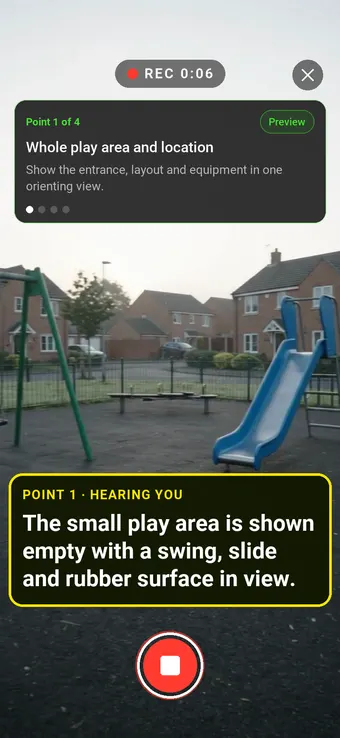
Hold to record. Keep holding while you film and speak; release to save the clip and its transcribed answer.
Four 9:16 example clips generated in Google Flow. Fictional inspection; no customer site is shown.
App-style example using Google Flow footage. The animated recording interface and gradually appearing words are scripted; no real inspection or live transcription took place.
The full visual example
Watch all four inspection points.
Each short clip shows one point in the guided route. The footage is AI-generated and the observations are scripted examples, not findings from a real inspection.
POINT 01
Whole play area and location
Show the entrance, layout and equipment in one orienting view. Record the site ID and visit time separately.
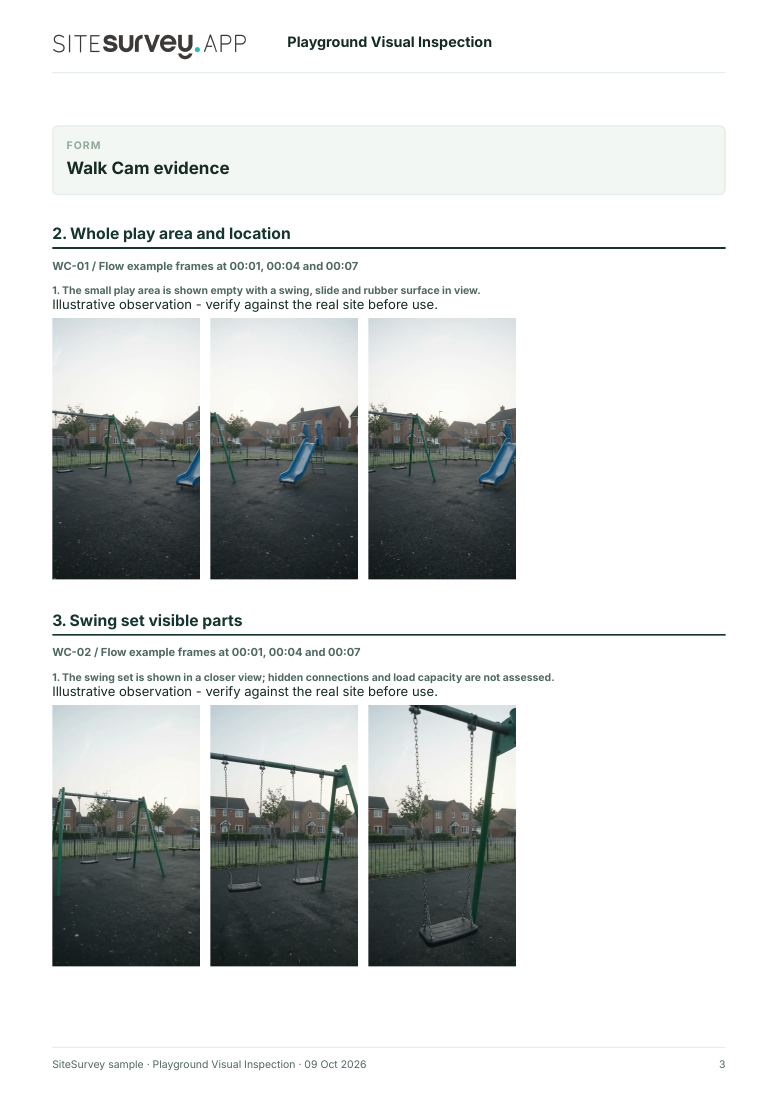
The small play area is shown empty with a swing, slide and rubber surface in view.
POINT 02
Swing set visible parts
Film the seat, accessible chains, suspension area and ground below from safe positions. Record only what is visible.
The swing set is shown in a closer view; hidden connections and load capacity are not assessed.
POINT 03
Slide and immediate area
Show the slide, accessible edge and approach. Note any area obscured by the camera angle.
The slide and its visible approach are shown; no operational test is recorded.
POINT 04
Surfacing and final context
Show accessible ground below and around the equipment, including obvious litter, damage or pooled water if present. Finish with the context view.
Pale worn-looking patches and mat seams are visible on the rubber surface near the slide; impact performance is not tested.
What can a playground visual inspection record?
Identify the site, equipment and visit stage, then take a wide view before each closer clip. Record obvious visible condition and where the camera cannot see. Route any concern for prompt action under the operator’s inspection and maintenance process. Routine phone footage cannot test stability, impact protection or BS EN 1176 compliance. It does not replace operational or annual specialist inspection.
The six-page sample contains four inspection points, twelve footage stills, scripted observations and follow-up actions. The preview shows the first visual-evidence page.
Identify the site, equipment and visit stage, then take a wide view before each closer clip. Record obvious visible condition and where the camera cannot see. Route any concern for prompt action under the operator’s inspection and maintenance process.
01
Whole play area and location
Show the entrance, layout and equipment in one orienting view. Record the site ID and visit time separately.
Example observation
“The small play area is shown empty with a swing, slide and rubber surface in view.”
Scripted example, not a real finding.02
Swing set visible parts
Film the seat, accessible chains, suspension area and ground below from safe positions. Record only what is visible.
Example observation
“The swing set is shown in a closer view; hidden connections and load capacity are not assessed.”
Scripted example, not a real finding.03
Slide and immediate area
Show the slide, accessible edge and approach. Note any area obscured by the camera angle.
Example observation
“The slide and its visible approach are shown; no operational test is recorded.”
Scripted example, not a real finding.04
Surfacing and final context
Show accessible ground below and around the equipment, including obvious litter, damage or pooled water if present. Finish with the context view.
Example observation
“Pale worn-looking patches and mat seams are visible on the rubber surface near the slide; impact performance is not tested.”
Scripted example, not a real finding.
How to use the record
Make the visual evidence useful.
Identify the visit
Record the asset or site, visit stage, date and inspector. Keep each clip attached to its point and note anything inaccessible.
Describe, then escalate
Say what the camera shows and where it is. Record the next action without guessing the cause or declaring a specialist result from video.
Routine phone footage cannot test stability, impact protection or BS EN 1176 compliance. It does not replace operational or annual specialist inspection.
Questions, answered
Playground visual inspection FAQs
Is a phone video an annual playground inspection?
No. RoSPA distinguishes routine, operational and annual inspections. The annual inspection requires an independent specialist; footage only supports an appropriate visual record.
What should a routine playground visual record show?
Start with the whole site and equipment location, then record obvious visible condition of accessible equipment and surfacing, with a clear follow-up route.
Can video confirm equipment is safe to use?
No. It does not test hidden fixings, stability, impact attenuation or dimensional compliance. The operator follows its inspection and maintenance process.
Why include a completed sample report?
It shows how site details, four guided clips, observations, limits and follow-up can be assembled into a readable visit record.
Sources and review
Guidance checked 9 October 2026. The four-point route is a SiteSurvey example, not a method prescribed by these sources.
Describes the inspection types under BS EN 1176-7 and the role of trained playground inspectors.
Search research: Keywords Everywhere estimated 880 UK monthly searches for “playground equipment inspection” when checked 9 October 2026. Search intent includes specialist inspections, annual certification and routine checklists; validate which searches seek a video-recording workflow. This is not a traffic or conversion forecast.
SiteSurvey Walk Cam explains the product capability. The clips are AI-generated examples.