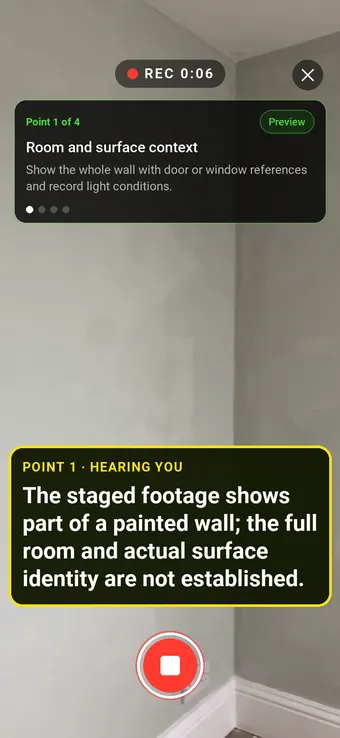
Hold to record. Keep holding while you film and speak; release to save the clip and its transcribed answer.
Four 9:16 example clips generated in Google Flow. Fictional inspection; no customer site is shown.
App-style example using Google Flow footage. The animated recording interface and gradually appearing words are scripted; no real inspection or live transcription took place.
The full visual example
Watch all four inspection points.
Each short clip shows one point in the guided route. The footage is AI-generated and the observations are scripted examples, not findings from a real inspection.
POINT 01
Room and surface context
Show the whole wall with door or window references and record light conditions.
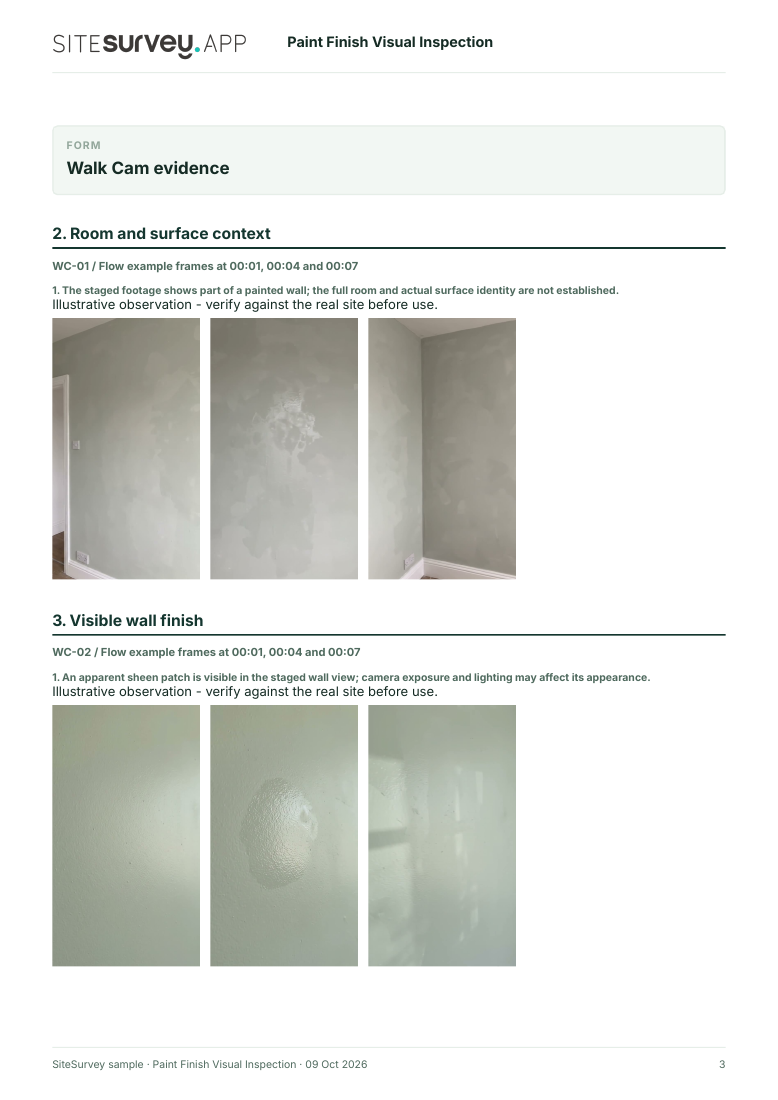
The staged footage shows part of a painted wall; the full room and actual surface identity are not established.
POINT 02
Visible wall finish
Move steadily across the wall at normal viewing distance before close-up of any apparent difference.
An apparent sheen patch is visible in the staged wall view; camera exposure and lighting may affect its appearance.
POINT 03
Trim and cut-in edge
Show accessible skirting, corner and trim edges without touching wet or uncertain paint.
An accessible trim edge is shown; hidden or unfilmed edges remain unknown.
POINT 04
Final view and exceptions
Return to a wider view and note surfaces the camera did not capture.
The final staged view shows more of the wall and skirting; it does not certify completion.
What can a paint finish visual inspection record?
Record room, surface, finish specification and lighting conditions. Film the whole wall before moving to visible runs, missed edges or colour differences. Locate each observation and compare against the agreed finish standard. Phone video is sensitive to lighting, camera exposure and compression. It cannot measure coating thickness, adhesion, substrate moisture or contractual acceptance. Apply the actual specification and inspection conditions.
The six-page sample contains four inspection points, twelve footage stills, scripted observations and follow-up actions. The preview shows the first visual-evidence page.
Record room, surface, finish specification and lighting conditions. Film the whole wall before moving to visible runs, missed edges or colour differences. Locate each observation and compare against the agreed finish standard.
01
Room and surface context
Show the whole wall with door or window references and record light conditions.
Example observation
“The staged footage shows part of a painted wall; the full room and actual surface identity are not established.”
Scripted example, not a real finding.02
Visible wall finish
Move steadily across the wall at normal viewing distance before close-up of any apparent difference.
Example observation
“An apparent sheen patch is visible in the staged wall view; camera exposure and lighting may affect its appearance.”
Scripted example, not a real finding.03
Trim and cut-in edge
Show accessible skirting, corner and trim edges without touching wet or uncertain paint.
Example observation
“An accessible trim edge is shown; hidden or unfilmed edges remain unknown.”
Scripted example, not a real finding.04
Final view and exceptions
Return to a wider view and note surfaces the camera did not capture.
Example observation
“The final staged view shows more of the wall and skirting; it does not certify completion.”
Scripted example, not a real finding.
How to use the record
Make the visual evidence useful.
Identify the visit
Record the asset or site, visit stage, date and inspector. Keep each clip attached to its point and note anything inaccessible.
Describe, then escalate
Say what the camera shows and where it is. Record the next action without guessing the cause or declaring a specialist result from video.
Phone video is sensitive to lighting, camera exposure and compression. It cannot measure coating thickness, adhesion, substrate moisture or contractual acceptance. Apply the actual specification and inspection conditions.
Questions, answered
Paint finish visual inspection FAQs
Can a phone video prove paintwork passes a standard?
No. Lighting and camera processing change appearance. Use the project’s agreed finish standard and viewing conditions.
What should a close-up include?
Show the defect in a wider location view first, then a steady close-up with the surface and edge identifiable.
Can video measure coating thickness or adhesion?
No. Those require suitable testing where the specification calls for it.
How is this different from whole-home snagging?
This route concentrates on visible paint surfaces and edges. Whole-home snagging covers many building elements and systems.
Sources and review
Guidance checked 9 October 2026. The four-point route is a SiteSurvey example, not a method prescribed by these sources.
Identifies finishes and incomplete paintwork as possible snagging observations requiring a systematic, documented review.
Search research: Keywords Everywhere estimated 10 UK monthly searches for “painting quality inspection” when checked 9 October 2026. Measured volume is very low and may favour generic QA advice. The page focuses on documenting visible finish condition, not product certification. This is not a traffic or conversion forecast.
SiteSurvey Walk Cam explains the product capability. The clips are AI-generated examples.