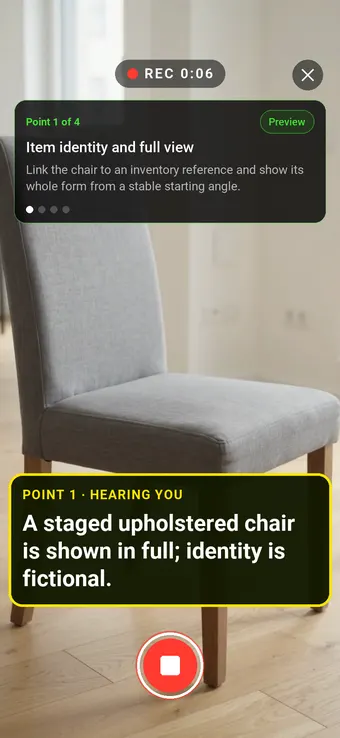
Hold to record. Keep holding while you film and speak; release to save the clip and its transcribed answer.
Four 9:16 example clips generated in Google Flow. Fictional inspection; no customer site is shown.
App-style example using Google Flow footage. The animated recording interface and gradually appearing words are scripted; no real inspection or live transcription took place.
The full visual example
Watch all four inspection points.
Each short clip shows one point in the guided route. The footage is AI-generated and the observations are scripted examples, not findings from a real inspection.
POINT 01
Item identity and full view
Link the chair to an inventory reference and show its whole form from a stable starting angle.
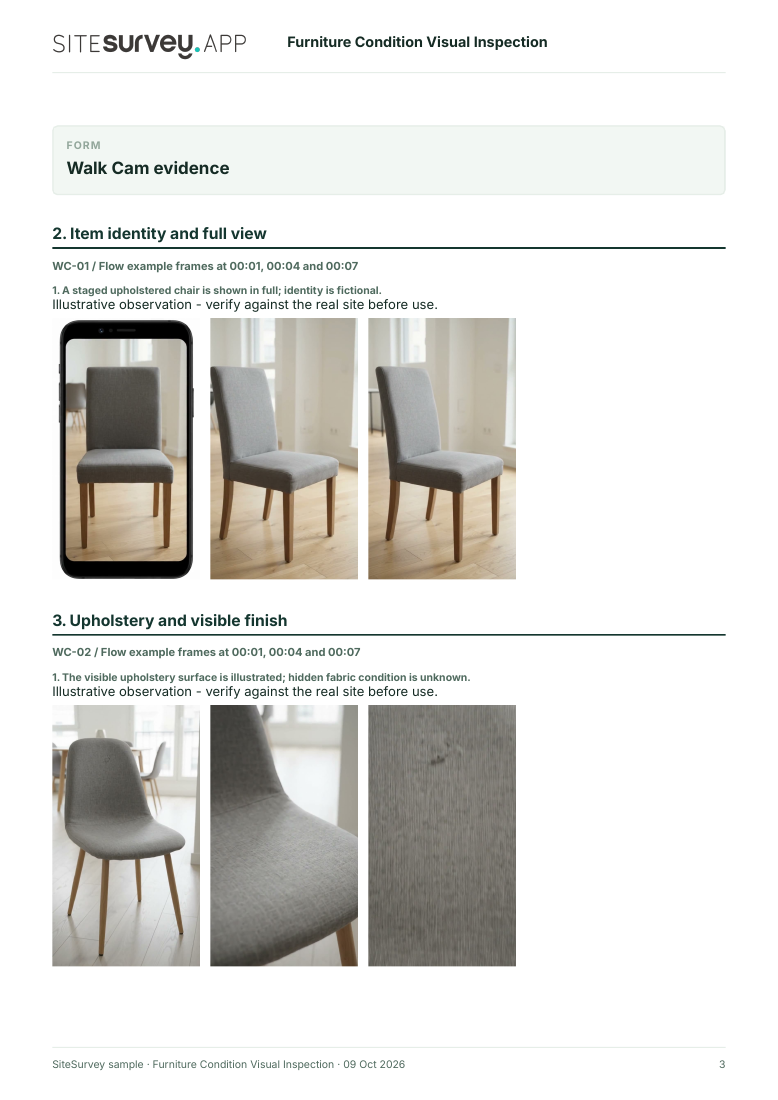
A staged upholstered chair is shown in full; identity is fictional.
POINT 02
Upholstery and visible finish
Move slowly across accessible seat and back surfaces, recording visible marks without inferring hygiene.
The visible upholstery surface is illustrated; hidden fabric condition is unknown.
POINT 03
Frame and exposed edges
Show exposed legs, joints and edges from safe accessible positions without load testing.
Exposed chair edges and legs are shown; strength was not tested.
POINT 04
Final matched view
Return to a wide view and note surfaces not filmed so the same route can be repeated later.
A final illustrative chair view is recorded; continuity with a real item is not claimed.
What can a furniture condition visual inspection record?
Identify each item and handover stage. Film the whole piece before close views of visible marks, edges and fittings. Record what was inaccessible and compare matched views at delivery or return. A phone clip records visible condition only. It cannot establish structural strength, upholstery hygiene, pest absence, fire performance, hidden damage or who caused a mark. Use the applicable inventory and safety process.
The six-page sample contains four inspection points, twelve footage stills, scripted observations and follow-up actions. The preview shows the first visual-evidence page.
Identify each item and handover stage. Film the whole piece before close views of visible marks, edges and fittings. Record what was inaccessible and compare matched views at delivery or return.
01
Item identity and full view
Link the chair to an inventory reference and show its whole form from a stable starting angle.
Example observation
“A staged upholstered chair is shown in full; identity is fictional.”
Scripted example, not a real finding.02
Upholstery and visible finish
Move slowly across accessible seat and back surfaces, recording visible marks without inferring hygiene.
Example observation
“The visible upholstery surface is illustrated; hidden fabric condition is unknown.”
Scripted example, not a real finding.03
Frame and exposed edges
Show exposed legs, joints and edges from safe accessible positions without load testing.
Example observation
“Exposed chair edges and legs are shown; strength was not tested.”
Scripted example, not a real finding.04
Final matched view
Return to a wide view and note surfaces not filmed so the same route can be repeated later.
Example observation
“A final illustrative chair view is recorded; continuity with a real item is not claimed.”
Scripted example, not a real finding.
How to use the record
Make the visual evidence useful.
Identify the visit
Record the asset or site, visit stage, date and inspector. Keep each clip attached to its point and note anything inaccessible.
Describe, then escalate
Say what the camera shows and where it is. Record the next action without guessing the cause or declaring a specialist result from video.
A phone clip records visible condition only. It cannot establish structural strength, upholstery hygiene, pest absence, fire performance, hidden damage or who caused a mark. Use the applicable inventory and safety process.
Questions, answered
Furniture condition visual inspection FAQs
Can a chair video prove it is safe to use?
No. Visible condition footage cannot establish structural strength, fire performance or hidden defects.
Why start with a wide view?
It identifies the item and gives location context before close-ups of a mark.
Can a video decide a deposit deduction?
No. Compare check-in and check-out evidence with the inventory, agreement and applicable rules.
How is this different from a whole-property handover?
This route documents one furniture item from wide view to detail. Property handover covers the wider premises and multiple assets.
Sources and review
Guidance checked 9 October 2026. The four-point route is a SiteSurvey example, not a method prescribed by these sources.
Recommends full views and detail images for three-dimensional objects, with the location of scratches and dents recorded.
Search research: Keywords Everywhere estimated 110 UK monthly searches for “furniture inspection” when checked 9 October 2026. The phrase mixes product QA, pest and condition intent. The page focuses on a visible furniture-condition record, so search relevance remains uncertain. This is not a traffic or conversion forecast.
SiteSurvey Walk Cam explains the product capability. The clips are AI-generated examples.