Hold to record. Keep holding while you film and speak; release to save the clip and its transcribed answer.
Four 9:16 example clips generated in Google Flow. Fictional inspection; no customer site is shown.
App-style example using Google Flow footage. The animated recording interface and gradually appearing words are scripted; no real inspection or live transcription took place.
The full visual example
Watch all four inspection points.
Each short clip shows one point in the guided route. The footage is AI-generated and the observations are scripted examples, not findings from a real inspection.
POINT 01
Whole wall and location
Show the entire accessible wall face and a fixed asset reference from a safe ground-level position before moving closer.
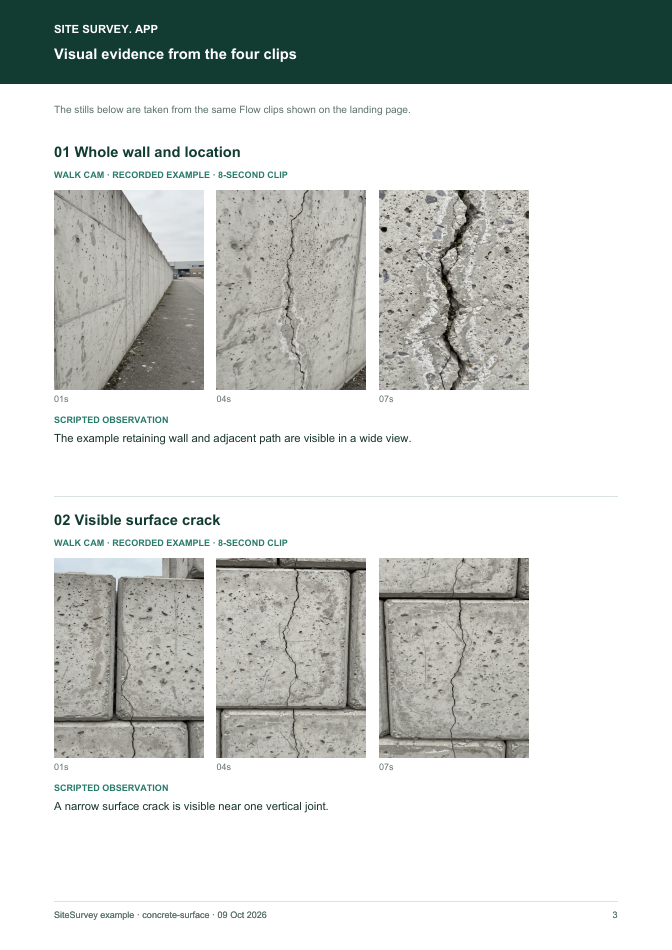
The example retaining wall and adjacent path are visible in a wide view.
POINT 02
Visible surface crack
Follow the visible crack slowly with surrounding concrete and a location reference in frame. Measure separately if a competent person requires dimensions.
A narrow surface crack is visible near one vertical joint.
POINT 03
Rough-looking surface area
Move from a location view to the rough surface without touching or disturbing loose material.
A rough-looking patch is visible near the wall base; its extent and cause need an in-person check.
POINT 04
Lower edge and drainage context
Show the outlet and nearby staining from safe access. Describe what is visible without diagnosing its cause.
The lower wall edge, outlet and adjacent staining are shown.
What can a concrete surface visual inspection record?
Identify the asset and accessible face. Establish the wall's location, then record visible crack, spall and lower-edge details with a fixed reference in each clip. Phone footage records accessible surface appearance only. It cannot measure structural capacity, hidden reinforcement, crack depth, delamination or a cause of deterioration; refer concerns for competent assessment.
The six-page sample contains four inspection points, twelve footage stills, scripted observations and follow-up actions. The preview shows the first visual-evidence page.
Identify the asset and accessible face. Establish the wall's location, then record visible crack, spall and lower-edge details with a fixed reference in each clip.
01
Whole wall and location
Show the entire accessible wall face and a fixed asset reference from a safe ground-level position before moving closer.
Example observation
“The example retaining wall and adjacent path are visible in a wide view.”
Scripted example, not a real finding.02
Visible surface crack
Follow the visible crack slowly with surrounding concrete and a location reference in frame. Measure separately if a competent person requires dimensions.
Example observation
“A narrow surface crack is visible near one vertical joint.”
Scripted example, not a real finding.03
Rough-looking surface area
Move from a location view to the rough surface without touching or disturbing loose material.
Example observation
“A rough-looking patch is visible near the wall base; its extent and cause need an in-person check.”
Scripted example, not a real finding.04
Lower edge and drainage context
Show the outlet and nearby staining from safe access. Describe what is visible without diagnosing its cause.
Example observation
“The lower wall edge, outlet and adjacent staining are shown.”
Scripted example, not a real finding.
How to use the record
Make the visual evidence useful.
Identify the visit
Record the asset or site, visit stage, date and inspector. Keep each clip attached to its point and note anything inaccessible.
Describe, then escalate
Say what the camera shows and where it is. Record the next action without guessing the cause or declaring a specialist result from video.
Phone footage records accessible surface appearance only. It cannot measure structural capacity, hidden reinforcement, crack depth, delamination or a cause of deterioration; refer concerns for competent assessment.
Questions, answered
Concrete surface visual inspection FAQs
Can a phone video diagnose structural damage?
No. It locates and records visible conditions for follow-up; structural conclusions need competent assessment and, where required, testing.
Is this the same as a concrete pour checklist?
No. This records the visible condition of an existing surface. The pour form records construction-stage placement evidence.
Should a crack width be estimated from the clip?
No. Record the location and have any required dimensions measured with appropriate equipment.
What does the sample report contain?
A fictional wall visit with four clip still sets, observations, next actions and explicit limits.
Sources and review
Guidance checked 9 October 2026. The four-point route is a SiteSurvey example, not a method prescribed by these sources.
Describes visual examination as an initial stage that may be supplemented by further investigation.
Search research: Keywords Everywhere estimated 720 UK monthly searches for “concrete inspection” when checked 9 October 2026. The broad query includes specialist condition surveys and testing; a Walk Cam recording is supporting evidence, not that service. This is not a traffic or conversion forecast.
SiteSurvey Walk Cam explains the product capability. The clips are AI-generated examples.