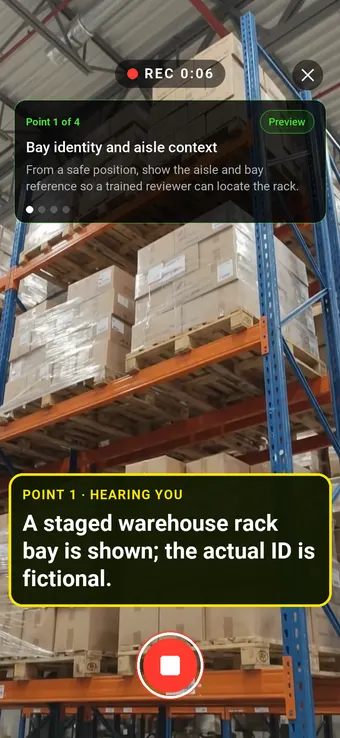
Hold to record. Keep holding while you film and speak; release to save the clip and its transcribed answer.
Four 9:16 example clips generated in Google Flow. Fictional inspection; no customer site is shown.
App-style example using Google Flow footage. The animated recording interface and gradually appearing words are scripted; no real inspection or live transcription took place.
The full visual example
Watch all four inspection points.
Each short clip shows one point in the guided route. The footage is AI-generated and the observations are scripted examples, not findings from a real inspection.
POINT 01
Bay identity and aisle context
From a safe position, show the aisle and bay reference so a trained reviewer can locate the rack.
A staged warehouse rack bay is shown; the actual ID is fictional.
POINT 02
Lower upright and guard
Show accessible lower upright and floor-level protection without measuring or touching it.
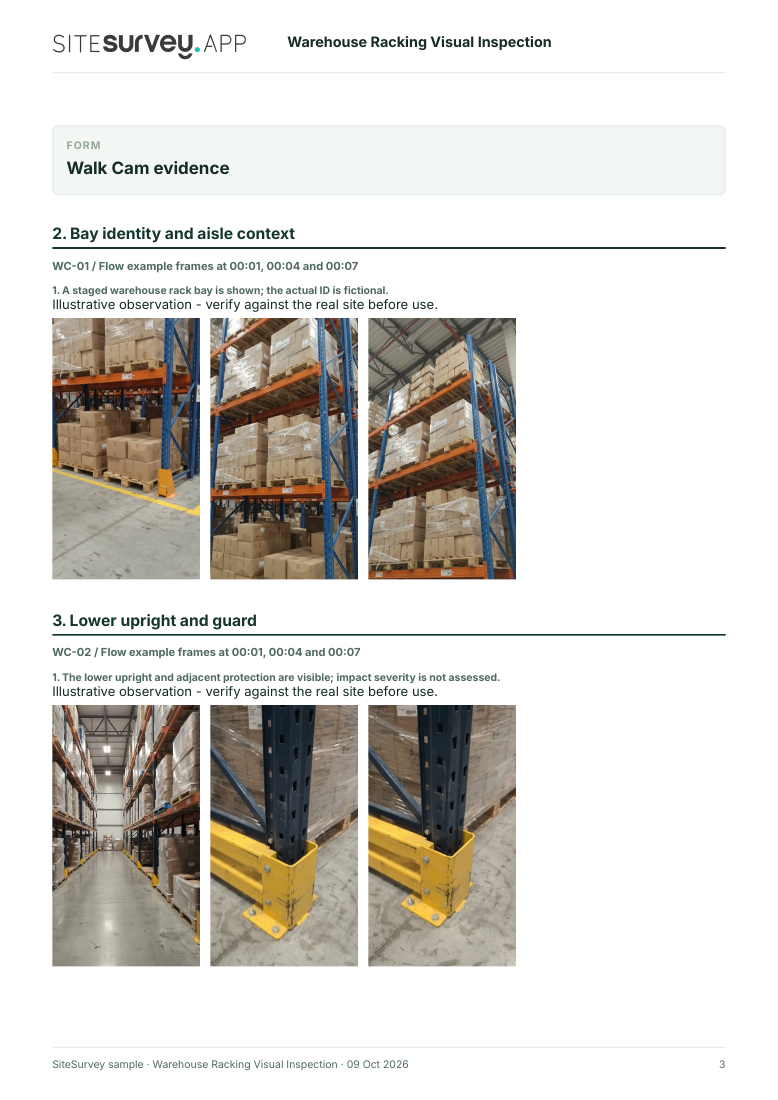
The lower upright and adjacent protection are visible; impact severity is not assessed.
POINT 03
Beam and connection area
From floor level, show accessible beam faces and connection location without approaching a suspect rack.
A beam junction is illustrated; locking and capacity are not established.
POINT 04
Wide location and escalation
Return to a wide bay view and note blind spots, loads or access restrictions.
A final staged bay view provides context but no safety classification.
What can a warehouse racking visual inspection record?
Record the aisle, bay and rack reference before filming from a safe authorised position. Move from wide context to visible upright or beam concerns. Do not enter restricted areas, climb or disturb loads. Send findings through the site racking safety process. A phone clip is a location and condition record. It cannot measure damage tolerances, confirm loading, structural capacity or classify risk. Trained internal checks and competent expert inspection remain separate under the site regime.
The six-page sample contains four inspection points, twelve footage stills, scripted observations and follow-up actions. The preview shows the first visual-evidence page.
Record the aisle, bay and rack reference before filming from a safe authorised position. Move from wide context to visible upright or beam concerns. Do not enter restricted areas, climb or disturb loads. Send findings through the site racking safety process.
01
Bay identity and aisle context
From a safe position, show the aisle and bay reference so a trained reviewer can locate the rack.
Example observation
“A staged warehouse rack bay is shown; the actual ID is fictional.”
Scripted example, not a real finding.02
Lower upright and guard
Show accessible lower upright and floor-level protection without measuring or touching it.
Example observation
“The lower upright and adjacent protection are visible; impact severity is not assessed.”
Scripted example, not a real finding.03
Beam and connection area
From floor level, show accessible beam faces and connection location without approaching a suspect rack.
Example observation
“A beam junction is illustrated; locking and capacity are not established.”
Scripted example, not a real finding.04
Wide location and escalation
Return to a wide bay view and note blind spots, loads or access restrictions.
Example observation
“A final staged bay view provides context but no safety classification.”
Scripted example, not a real finding.
How to use the record
Make the visual evidence useful.
Identify the visit
Record the asset or site, visit stage, date and inspector. Keep each clip attached to its point and note anything inaccessible.
Describe, then escalate
Say what the camera shows and where it is. Record the next action without guessing the cause or declaring a specialist result from video.
A phone clip is a location and condition record. It cannot measure damage tolerances, confirm loading, structural capacity or classify risk. Trained internal checks and competent expert inspection remain separate under the site regime.
Questions, answered
Warehouse racking visual inspection FAQs
Can video replace a racking inspection?
No. It helps locate visible concerns; trained in-house and competent expert inspections remain separate.
Should staff climb to film upper beams?
No. Film only from safe authorised positions and follow the site access process.
Can a clip assign a damage colour category?
No. The category needs the site’s trained racking assessment and any required measurements.
What if an impact is suspected?
Report it promptly and follow site controls while a competent person assesses it.
Sources and review
Guidance checked 9 October 2026. The four-point route is a SiteSurvey example, not a method prescribed by these sources.
Explains regular trained in-house visual checks and separate expert racking inspections.
Search research: Keywords Everywhere estimated 2400 UK monthly searches for “racking inspection” when checked 9 October 2026. High measured volume may predominantly seek expert or statutory inspection services. Validate Walk Cam software intent before indexing. This is not a traffic or conversion forecast.
SiteSurvey Walk Cam explains the product capability. The clips are AI-generated examples.