Give maintenance staff a precise view of the hose route and visible concern. Record from a safe position with the equipment isolated under site procedure.
Hold to record. Keep holding while you film and speak; release to save the clip and its transcribed answer.
Four 9:16 example clips generated in Google Flow. Fictional inspection; no customer site is shown.
App-style example using Google Flow footage. The animated recording interface and gradually appearing words are scripted; no real inspection or live transcription took place.
The full visual example
Watch all four inspection points.
Each short clip shows one point in the guided route. The footage is AI-generated and the observations are scripted examples, not findings from a real inspection.
POINT 01
Machine and hose position
Show the isolated machine and identify the accessible hose run from a safe position before moving closer.
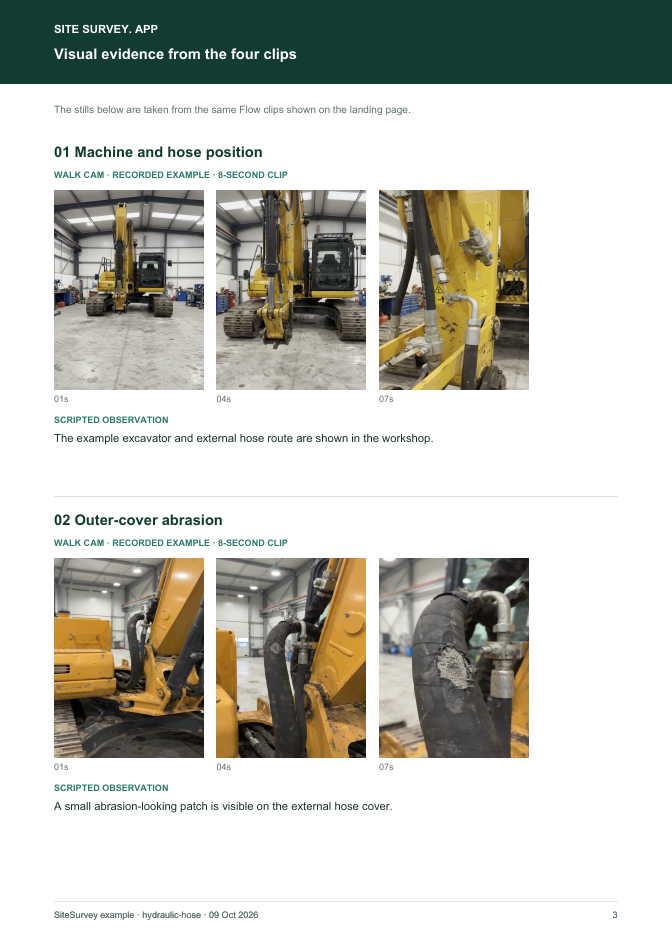
The example excavator and external hose route are shown in the workshop.
POINT 02
Outer-cover wear review
Follow the accessible hose without contact and keep its clamp or adjacent feature in view to locate apparent cover wear.
The external hose cover and surrounding route are visible; possible wear needs in-person examination.
POINT 03
External fitting surface
Film the external connection and surrounding hose from a safe angle. Do not loosen or manipulate a fitting for the clip.
A small area of surface discoloration is visible on an accessible fitting.
POINT 04
Full visible hose run
End with a wider view of the entire accessible route, clamps and any area that could not be seen.
The visible route is recorded again; hidden sections were not examined.
What can a hydraulic hose visual inspection record?
Identify the machine and hose position. Follow the site's isolation and access procedure before recording. Film a wide view, then the accessible hose cover, external fittings and final route. A phone video is not a pressure test, leak test, safe-to-use decision or substitute for a competent examination. Never touch a suspected leak, reach into moving machinery or remove guarding to get footage.
The six-page sample contains four inspection points, twelve footage stills, scripted observations and follow-up actions. The preview shows the first visual-evidence page.
Identify the machine and hose position. Follow the site's isolation and access procedure before recording. Film a wide view, then the accessible hose cover, external fittings and final route.
01
Machine and hose position
Show the isolated machine and identify the accessible hose run from a safe position before moving closer.
Example observation
“The example excavator and external hose route are shown in the workshop.”
Scripted example, not a real finding.02
Outer-cover wear review
Follow the accessible hose without contact and keep its clamp or adjacent feature in view to locate apparent cover wear.
Example observation
“The external hose cover and surrounding route are visible; possible wear needs in-person examination.”
Scripted example, not a real finding.03
External fitting surface
Film the external connection and surrounding hose from a safe angle. Do not loosen or manipulate a fitting for the clip.
Example observation
“A small area of surface discoloration is visible on an accessible fitting.”
Scripted example, not a real finding.04
Full visible hose run
End with a wider view of the entire accessible route, clamps and any area that could not be seen.
Example observation
“The visible route is recorded again; hidden sections were not examined.”
Scripted example, not a real finding.
How to use the record
Make the visual evidence useful.
Identify the visit
Record the asset or site, visit stage, date and inspector. Keep each clip attached to its point and note anything inaccessible.
Describe, then escalate
Say what the camera shows and where it is. Record the next action without guessing the cause or declaring a specialist result from video.
A phone video is not a pressure test, leak test, safe-to-use decision or substitute for a competent examination. Never touch a suspected leak, reach into moving machinery or remove guarding to get footage.
Questions, answered
Hydraulic hose visual inspection FAQs
Does this video certify a hydraulic hose?
No. It records visible condition only. A competent person must determine any examination, repair or replacement required.
Should the machine be running while filming?
No. Follow the site's isolation and safe-access procedure. Do not approach moving machinery or suspected pressurised leaks for video.
Can a clip reveal internal hose damage?
No. Hidden layers and pressure integrity are outside the scope of phone footage.
What is in the sample report?
A fictional isolated-plant record with four clip still sets, observations, follow-up and explicit limits.
Sources and review
Guidance checked 9 October 2026. The four-point route is a SiteSurvey example, not a method prescribed by these sources.
Industry guidance differentiating visible signs from a complete assessment of hydraulic hose condition.
Search research: Keywords Everywhere estimated 210 UK monthly searches for “hydraulic hose inspection” when checked 9 October 2026. Search results are largely maintenance guidance and service providers; demand for Walk Cam software has not been measured. This is not a traffic or conversion forecast.
SiteSurvey Walk Cam explains the product capability. The clips are AI-generated examples.